

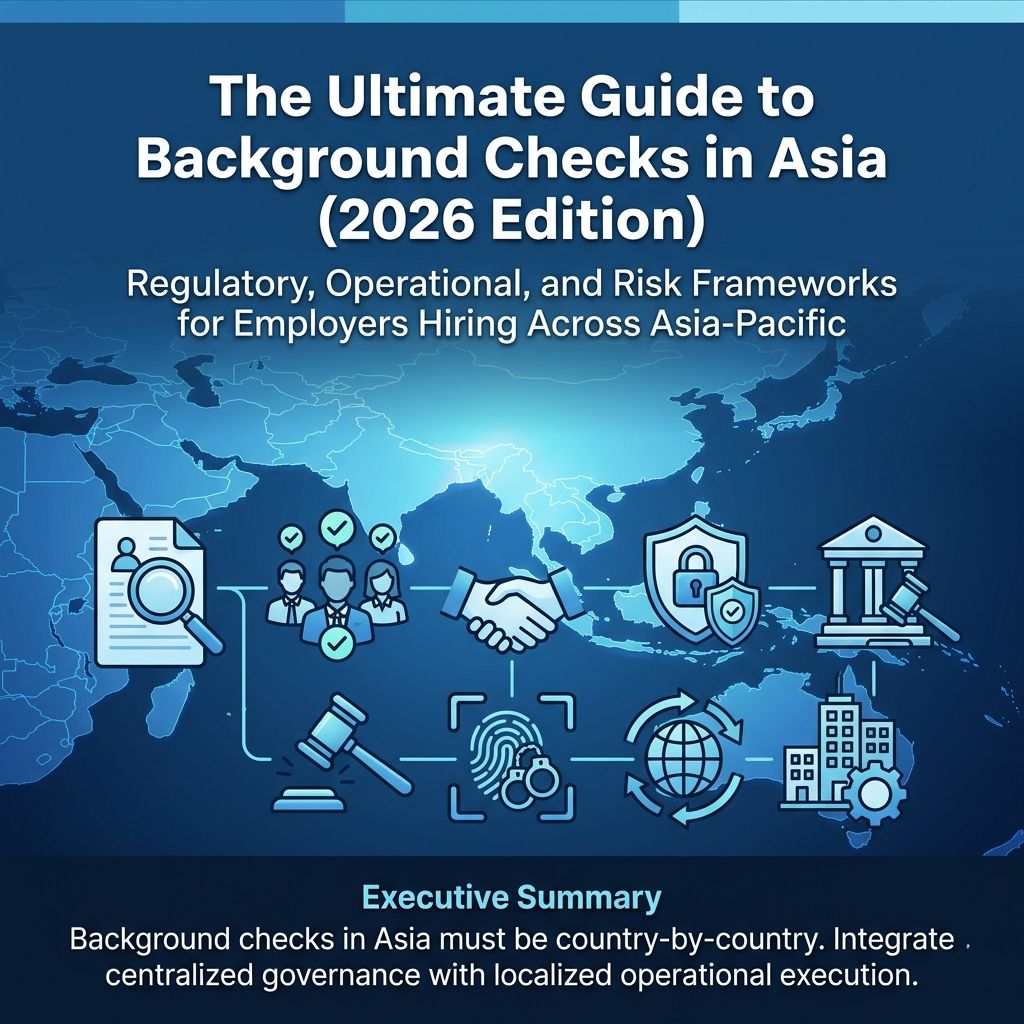
The Ultimate Guide to Background Checks in Asia (2026 Edition)
Regulatory, Operational, and Risk Frameworks for Employers Hiring Across Asia-Pacific
Hiring across Asia-Pacific presents extraordinary opportunity — and extraordinary structural complexity. Unlike the United States or the European Union, Asia does not operate under a harmonized background screening framework. The region comprises dozens of independent legal systems, data protection regimes, verification infrastructures, and institutional practices. There is no such thing as a “standard Asia background check.” Each jurisdiction requires deliberate compliance design, operational adaptation, and structured governance oversight. For a practical regional framework, see eeCheck’s Asia Background Check Compliance Guide and Compliant Background Screening Policy in Asia. This guide provides a comprehensive advisory framework covering:- Structural diversity of Asia’s regulatory landscape
- Core background check components
- Legal permissibility and consent requirements
- What can and cannot be verified
- Country-level strategic comparison
- Primary-source vs database screening models
- Data protection architecture and cross-border risk
- In-house vs outsourced screening models
- Scaling across 5–15 jurisdictions
- AI boundaries in employment screening
- Governance maturity benchmarks
🔎 Executive Summary
Background checks in Asia must be conducted on a country-by-country basis due to varying legal restrictions, data protection laws, criminal record accessibility, and institutional verification practices.
A compliant Asia-Pacific screening program integrates centralized governance, localized operational execution, primary-source verification standards, structured discrepancy handling, and human-reviewed quality control.
Organizations that apply uniform global screening templates without adapting to jurisdiction-specific regulatory requirements risk compliance breaches, inaccurate reporting, and reputational exposure. Employers can strengthen programme design through Role-Based Background Screening in Asia and Risk-Based Background Screening in Asia.
📥 Download the Updated 2026 Guide
Download Asia Background Check Guide 2026 (PDF)
2026 Asia Background Screening: Key Facts at a Glance
The following facts summarise the operating environment described in this guide and are designed as quick-reference points for HR, compliance and talent acquisition teams.13country and market guides interlinked from this regional pillar
5core screening categories compared in this guide
4governance maturity levels from Basic to Enterprise
1regional principle: there is no standard Asia background check
| 2026 Quick Fact | What Employers Should Know |
|---|---|
| Regional legal model | Asia-Pacific does not operate under one harmonized background screening framework; screening must be adapted by jurisdiction. |
| Most sensitive checks | Criminal record and credit-history screening are among the most compliance-sensitive categories and are restricted in many markets. |
| Verification quality | Primary-source verification generally provides stronger accuracy and defensibility than relying on database results alone. |
| Cross-border risk | Data hosting, processing location and access to candidate information should be considered when screening spans multiple jurisdictions. |
| Enterprise governance | Mature regional programmes combine centralized policy and reporting with local compliance mapping and jurisdiction-specific execution. |
1. Asia’s Structural Diversity: Why a Unified Model Does Not Exist
| Dimension | Variation Across Asia | Practical Impact on Screening |
|---|---|---|
| Legal Systems | Common law, civil law, hybrid | Different evidentiary norms |
| Criminal Record Access | Open access, certificate-based, restricted | Inconsistent availability |
| Data Protection | Mature vs emerging frameworks | Transfer risk varies |
| Institutional Structure | Centralized vs decentralized | Turnaround differences |
| Language & Documentation | Multiple languages | Misidentification risk |
| Cultural Employment Norms | Direct vs indirect reference cultures | Interpretation complexity |
2. Asia Jurisdiction Comparison Snapshot
| Country | Data Protection | Regulatory Enforcement | Verification Structure | Operational Complexity |
|---|---|---|---|---|
| Singapore | High | High | Centralized | Moderate |
| Hong Kong | High | Moderate | Institutional | Moderate |
| China | Evolving | High | Government influenced | High |
| India | Developing | Moderate | Decentralized | Moderate–High |
| Japan | High | High | Highly formalized | Moderate |
| South Korea | High | High | Structured | Moderate |
| Taiwan | High | Moderate–High | Institutional / consent-led | Moderate |
| Vietnam | Evolving | Moderate | Manual / institutional | Moderate–High |
| Philippines | Moderate | Moderate | Institutional | Moderate |
| Indonesia | Moderate | Moderate | Manual / decentralized | Moderate–High |
| Malaysia | Moderate–High | Moderate | Institutional | Moderate |
| Thailand | Moderate | Moderate | Manual / institutional | Moderate–High |
| Macau | Moderate–High | Moderate | Institutional / certificate-based | Moderate |
3. Core Components of Background Checks in Asia
| Check Category | Typical Scope | Availability | Compliance Sensitivity |
|---|---|---|---|
| Identity Verification | Government ID validation | Generally available | Moderate |
| Employment Verification | Tenure and job title confirmation | Widely available | Low–Moderate |
| Education Verification | Degree confirmation | Widely available | Low |
| Professional License | Regulatory authority validation | Sector dependent | Moderate |
| Criminal Record | Government certificate | Highly variable | High |
4. What Can and Cannot Be Verified in Asia
| Category | Accessibility | Compliance Sensitivity |
|---|---|---|
| Identity | Generally available | Moderate |
| Employment | Generally available | Low–Moderate |
| Education | Widely available | Low |
| Criminal Records | Restricted in many markets | High |
| Credit History | Often restricted | High |
5. Legal Foundations
- Explicit candidate consent
- Role-relevant screening scope
- Compliance with local privacy regulations
6. Primary-Source Verification vs Database Screening
| Dimension | Database Model | Primary Source Model |
|---|---|---|
| Accuracy | Variable | Higher |
| Update Frequency | May lag | Real-time confirmation |
| Legal Defensibility | Lower | Stronger |
7. Cross-Border Data Transfer Risk
| Risk Question | Why It Matters |
|---|---|
| Where is screening data hosted? | Localization laws may apply |
| Where is verification conducted? | Cross-border processing exposure |
| Who accesses candidate data? | Data minimization compliance |
8. Data Governance & Security Architecture
- Encryption of sensitive information
- Role-based access control
- Secure data storage
- Vendor risk management
9. In-House vs Outsourced Screening
| Factor | In-House | Outsourced |
|---|---|---|
| Compliance expertise | Internal burden | Specialist support |
| Scalability | Limited | Structured coordination |
| Operational knowledge | Variable | Jurisdiction depth |
10. Scaling Screening Across Asia
- Centralized policy
- Local compliance mapping
- Standardized reporting
- Structured escalation procedures
11. The Role of AI
- Workflow automation
- Document extraction
- Anomaly detection
12. Common Employer Mistakes
- Using US-centric screening templates
- Assuming criminal checks are universal
- Over-reliance on databases
- Ignoring cross-border data rules
13. Governance Maturity Model
| Maturity Level | Characteristics |
|---|---|
| Basic | Single-country checks |
| Intermediate | Partial standardization |
| Advanced | Centralized governance |
| Enterprise | Regional framework with audit readiness |
Country-by-Country Background Check Guides
This pillar guide provides the regional framework. For country-level legal, operational and verification considerations, use the dedicated eeCheck guides below.| Country / Market | Dedicated 2026 Guide |
|---|---|
| Hong Kong | Hong Kong Background Check Guide |
| Singapore | Singapore Background Checks Guide |
| Mainland China | China Background Check Process |
| Taiwan | Taiwan Background Checks Guide |
| Japan | Japan Background Check Guide |
| South Korea | South Korea Background Checks Guide |
| India | India Background Check Process |
| Philippines | Philippines Background Checks Guide |
| Vietnam | Vietnam Background Checks Guide |
| Thailand | Thailand Background Checks Guide |
| Malaysia | Malaysia Background Check Guide |
| Indonesia | Indonesia Background Checks Guide |
| Macau | Macau Background Check Guide |
Frequently Asked Questions
Are background checks legal across Asia?
Yes when conducted with proper consent and compliance.
Can one screening model work across Asia?
No. Each jurisdiction requires adaptation.
Is primary-source verification preferable?
Yes. It improves accuracy and defensibility.
How long do background checks take in Asia?
Turnaround time varies by country and check type. Database-driven checks may be faster, while employment, education, criminal-record and government-source checks depend on institutional response times and local procedures.
Are criminal record checks available in every Asian country?
No. Criminal-record access varies significantly across Asia. Some jurisdictions use candidate-obtained government certificates, while others restrict access or require a specific legal basis and role relevance.
What are the most common employment background checks in Asia?
Common components include identity, employment and education verification, professional licence checks and, where lawful and relevant, criminal records, sanctions, regulatory, credit, adverse media and other role-specific checks.
Why should employers use country-specific background check procedures?
Privacy laws, consent requirements, data access, criminal-record procedures, languages and institutional practices differ by jurisdiction. Country-specific procedures reduce compliance and verification risk.
Final Strategic Takeaway
Asia-Pacific is not a unified screening market.
Organizations that treat background screening as a compliance-led risk management function supported by centralized governance and localized execution are best positioned to protect hiring integrity.
In Asia, precision matters.

