

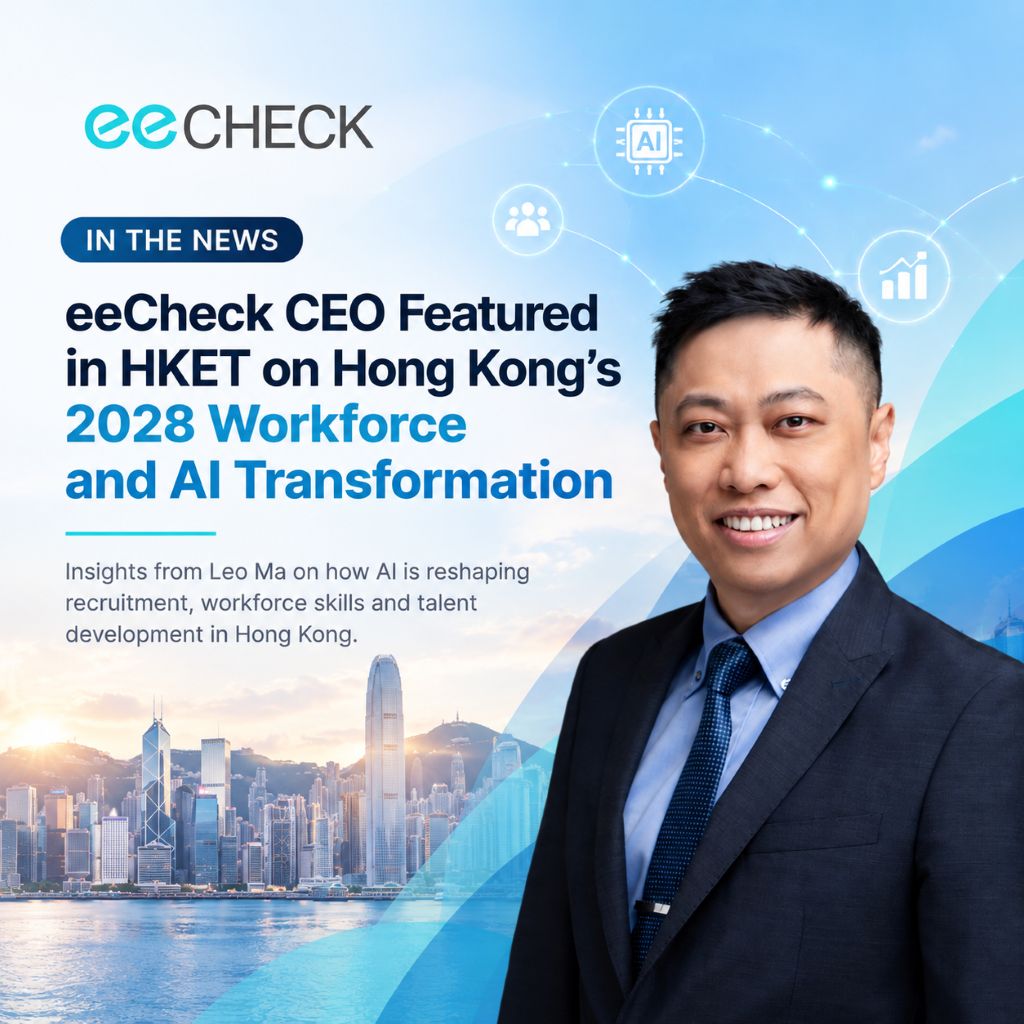
eeCheck CEO Featured in HKET on Hong Kong’s 2028 Workforce and AI Transformation
eeCheck CEO Leo Ma was interviewed by Hong Kong Economic Times (HKET) following the Hong Kong Government’s latest manpower projections, discussing how artificial intelligence is reshaping recruitment, workforce skills and talent development in Hong Kong.
The Government’s latest manpower projections indicate that Hong Kong’s overall manpower shortage is expected to narrow to approximately 130,000 by 2028, while the changing nature of work — particularly the growing adoption of AI — is expected to affect demand across different occupations.
Executive Summary
AI is changing not only how work is performed, but also the capabilities employers may increasingly value. As routine administrative work becomes more automated, organisations may place greater emphasis on people who can combine AI tools with professional expertise, critical thinking, judgement and accountability.
Employers should also consider the long-term talent pipeline. Reducing junior hiring may improve short-term efficiency, but organisations still need to develop the experienced professionals and managers of the future.
eeCheck’s Perspective: AI Is Changing What Employers Look For
Speaking with HKET, Leo highlighted how AI is beginning to change the capabilities employers value.
As AI increasingly supports routine administrative and clerical work, organisations may require fewer people for certain junior and repetitive functions. At the same time, employees who can effectively apply AI within their professional roles are becoming increasingly valuable.
Managers will also play an increasingly important role. As AI makes information and analysis more accessible, organisations still require experienced people who can interpret that information, exercise judgement and take responsibility for decisions.
Don’t Overlook the Future Talent Pipeline
Leo also highlighted a longer-term workforce consideration.
If organisations substantially reduce junior hiring as more entry-level work becomes automated, they also need to consider succession planning. Today’s junior employees are tomorrow’s experienced professionals and managers.
Organisations therefore need to balance the productivity benefits of AI with the continued development of people who can acquire experience, institutional knowledge and leadership capabilities over time.
What This Means for Employers
The changing workforce environment reinforces the need for employers to think beyond headcount.
Recruitment increasingly involves understanding whether candidates have the experience, qualifications, professional capabilities and adaptability required for changing roles.
For eeCheck, this is closely connected with our work supporting employers across Asia with employment background screening and verification.
As jobs evolve and cross-border hiring becomes increasingly common, reliable verification of employment history, qualifications and other role-relevant information remains an important part of informed hiring decisions.
Read the HKET Coverage
The full article was published by Hong Kong Economic Times (HKET) on 22 September 2026:
「人力短缺|政府推算2028年人力短缺收窄至13萬 AI令人力需求增長放緩 料2028年3萬文員過剩」
Read the Original HKET Coverage →
About eeCheck
eeCheck is an Asia-focused employment background screening company supporting employers with cross-border background checks and workforce verification across Asian and international markets.
Our services include employment and education verification, professional qualification checks and other role-appropriate screening services, supported by local market knowledge, multilingual capabilities and technology.
Media: Hong Kong Economic Times (HKET)
Published: 23 September 2026
Commentator: Leo Ma, CEO, eeCheck
Topic: AI, manpower planning, recruitment and Hong Kong’s workforce outlook
Final Takeaway
AI is changing the workforce, but effective hiring still depends on understanding the people behind the technology. Employers need to consider not only immediate productivity gains, but also professional capability, judgement, succession planning and the development of future talent.
As workforce requirements evolve, reliable background screening and verification can continue to support informed, role-appropriate hiring decisions across Hong Kong and the wider Asia-Pacific region.

