

Background Screening RFP Template for APAC
Published: 13 October 2026 | Last updated: 13 October 2026
Selecting the right background screening provider across Asia-Pacific requires more than comparing prices and turnaround times. Employers need to consider country coverage, compliance requirements, screening methodology, candidate experience, information security, reporting standards and service capabilities across multiple jurisdictions. This practical APAC background screening RFP guide outlines the key questions, evaluation criteria and requirements employers should consider when preparing a Request for Proposal (RFP) and assessing potential background screening providers.Executive Summary
Selecting a background-screening provider across Asia-Pacific is not simply a matter of comparing check names and unit prices. The same check can involve different permitted sources, consent requirements, identity documents, verification routes, languages and turnaround times from one jurisdiction to another. A strong APAC RFP should therefore test country coverage, lawful and defensible screening methods, service delivery, candidate support, technology, information security, reporting and total commercial cost. It should also require vendors to distinguish direct capabilities from subcontracted coverage and disclose country-specific limitations. Before issuing an RFP, employers may find it useful to establish a compliant background screening policy for Asia, define role-based screening requirements, and review the broader Asia background check compliance framework.Why an APAC Background-Screening RFP Needs Regional Detail
“Global coverage” is not a sufficiently precise buying criterion. A provider may technically offer a service in a country while relying on a third party, an indirect database, candidate-supplied documents or a process that works only for certain record types. Even when two providers use the same check label, the underlying scope can differ. Privacy requirements also vary by jurisdiction. Employers should have their own legal or privacy advisers confirm the lawful basis, notices, consent or authorisation, relevance and decision-making rules for each check. A screening vendor can explain its process, but should not replace the employer’s legal analysis. For a broader regional starting point, see eeCheck’s Asia Background Check Guide.Before Issuing the RFP: Define the Buying Scope
Complete the internal decisions below first. If they remain unclear, vendor proposals will be difficult to compare.| Decision | Questions to answer |
|---|---|
| Hiring footprint | In which countries and territories will candidates be screened? |
| Annual volume | What is the expected annual and monthly volume by country? Are there seasonal peaks? |
| Worker types | Will the programme cover employees, contractors, interns, contingent workers or regulated appointments? |
| Screening policy | Which checks apply to each role or risk tier? Consider a background screening policy template for Asia-Pacific. |
| Timing | Are checks conducted before offer, after conditional offer, before start date or periodically? |
| Operating model | Will requests be initiated by HR, recruiters, candidates, an ATS or an API? |
| Decision ownership | Who reviews results and makes hiring decisions? |
| Candidate experience | Which languages and support channels are required? |
| Data model | Where may data be accessed, processed, transferred and stored? |
| Commercial model | Is pricing required per check, per package, per candidate or by committed volume? |
Copyable APAC Background Screening RFP Template
The sections below can be copied into a procurement document and adapted to your organisation.Request for Proposal: APAC Background Screening Services
1. RFP overview
Issuing organisation: [Organisation name] RFP reference: [Reference number] Issue date: [Date] Deadline for clarification questions: [Date and time zone] Proposal deadline: [Date and time zone] Expected selection date: [Date] Target implementation date: [Date] Initial contract term: [Term] Optional extensions: [Details] Procurement contact: [Name or role and contact details]1.1 Purpose
[Organisation name] invites qualified providers to submit a proposal for employment background-screening services across selected Asia-Pacific jurisdictions. The selected provider is expected to deliver accurate, timely, secure and candidate-appropriate screening services while supporting our internal policies and applicable legal and regulatory requirements.1.2 Objectives
Our objectives are to:- establish a consistent screening programme across APAC while accommodating local requirements;
- improve visibility over case status, turnaround time and exceptions;
- provide a clear and respectful candidate experience;
- protect personal data throughout the screening lifecycle;
- integrate screening with our recruitment processes and systems where required;
- obtain transparent and comparable pricing; and
- maintain appropriate governance, quality assurance and escalation arrangements.
1.3 Instructions to respondents
Respondents must:- answer every requirement using the response format specified;
- distinguish currently available, available through a disclosed subcontractor, requiring development, and not available;
- identify all assumptions, dependencies, exclusions and country-specific limitations;
- avoid describing roadmap capabilities as currently operational;
- provide supporting evidence where requested; and
- keep pricing valid for at least [90/120/180] days.
| Code | Meaning |
|---|---|
| S | Fully supported as standard |
| C | Supported with configuration |
| T | Delivered through a subcontractor or local partner |
| D | Requires development |
| N | Not supported |
2. Organisation and programme profile
2.1 Hiring footprint and estimated volume
| Country/territory | Estimated annual candidates | Estimated peak monthly volume | Primary hiring cities | Required languages | Worker types |
|---|---|---|---|---|---|
| Singapore | |||||
| Hong Kong | |||||
| Mainland China | |||||
| India | |||||
| Japan | |||||
| Australia | |||||
| Other |
2.2 Role-based screening packages
Respondents should price and describe the following proposed packages. The final scope remains subject to applicable law, role relevance and [Organisation name]’s approved screening policy.| Package/risk tier | Illustrative population | Required checks | Optional checks |
|---|---|---|---|
| Standard | General professional and operational roles | [Identity, employment, education] | |
| Financial responsibility | Finance, treasury, procurement or payment roles | [Standard package plus relevant credit, bankruptcy or regulatory checks] | |
| Regulated | Licensed or regulated personnel | [Standard package plus sanctions, regulatory and qualification checks] | |
| Senior/executive | Directors, C-suite and senior appointments | [Enhanced employment, directorship, adverse media and other role-relevant checks] | |
| Technology/high trust | Security and privileged-access roles | [Standard package plus role-relevant criminal or integrity checks] |
3. Vendor profile and experience
Provide:- legal name, registered address, ownership structure and year established;
- APAC office locations and the services performed in each location;
- number of employees supporting background-screening operations in APAC;
- countries in which the respondent has its own operational capability;
- experience supporting regional or multinational screening programmes of comparable scale;
- experience in our industry and any relevant regulated sectors;
- three client references, subject to client permission;
- audited or otherwise supportable evidence of financial stability where requested;
- relevant licences, accreditations and certifications; and
- details of any material regulatory enforcement, security incident or litigation relevant to the proposed service during the past [three/five] years, together with remediation taken.
4. Country and service coverage
Complete one row for every proposed check in every required jurisdiction. Do not respond with a single list of countries.| Country | Check type | Available? | Delivery entity | Primary source/method | Direct or subcontracted | Candidate documents required | Typical TAT | Key limitation |
|---|---|---|---|---|---|---|---|---|
| Identity | ||||||||
| Employment | ||||||||
| Education |
- identity verification;
- employment verification;
- education verification;
- professional qualification and licence verification;
- criminal-record or police-certificate checks;
- civil litigation searches;
- bankruptcy and insolvency searches;
- credit checks;
- sanctions and watchlist screening;
- politically exposed person screening;
- regulatory and enforcement searches;
- directorship and company-interest searches;
- adverse-media screening;
- social-media screening;
- employment references;
- right-to-work or work-authorisation checks; and
- recurring or post-hire monitoring.
5. Verification methodology and report quality
Describe:- the standard verification workflow for each check type;
- how candidate identity is matched to the source record;
- the identifiers used and how partial or conflicting matches are handled;
- the number and cadence of verification attempts;
- when alternative sources or candidate documents may be used;
- how the report distinguishes verified facts, source statements, database matches, vendor analysis and inconclusive results;
- how discrepancies are classified;
- whether and how candidates can supply clarification or supporting evidence;
- the quality-control steps completed before a report is released;
- how translations and transliterations are managed;
- how common names, former names and local naming conventions are handled; and
- how source evidence and audit trails are retained.
- Respondents must not treat “no result found” as equivalent to “no record exists” unless the underlying source and methodology support that conclusion.
6. Legal, privacy and candidate rights
The respondent must describe its role and responsibilities under the data-protection framework applicable to each service and jurisdiction. The response must include:- the legal entities processing or accessing candidate data;
- the purposes and categories of personal data processed;
- the proposed allocation of controller, joint-controller, processor or analogous responsibilities;
- the required candidate notices, consent or authorisation process;
- procedures for checks involving sensitive or specially regulated information;
- data-minimisation controls;
- data-access, correction, withdrawal, complaint and deletion workflows;
- restrictions on secondary use, sale, analytics and model training;
- retention periods by data category and jurisdiction;
- deletion methods and deletion certification;
- cross-border transfer locations and transfer mechanisms;
- government or law-enforcement request handling;
- privacy impact assessment support;
- breach-notification obligations and proposed contractual timescales; and
- a process for monitoring and communicating changes in relevant laws, sources or service availability.
7. Information security
Provide the following information and supporting evidence:| Control area | Required response |
|---|---|
| Governance | Information-security framework, accountable roles and policy review cycle |
| Certifications | Current certification scope, issuing body, certificate dates and relevant exclusions |
| Access control | Role-based access, least privilege, MFA, privileged-access management and access reviews |
| Encryption | Encryption in transit and at rest, key-management approach |
| Endpoint security | Device management, malware protection, patching and removable-media controls |
| Secure development | SDLC, code review, dependency management and application testing |
| Vulnerability management | Scanning, remediation targets and penetration-testing frequency |
| Logging | Security and user activity logs, monitoring and retention |
| Segregation | Client data separation and production/non-production controls |
| Resilience | Backups, disaster recovery, business continuity, RTO and RPO |
| Incident response | Response plan, testing frequency and notification workflow |
| Personnel | Screening, confidentiality commitments and security training |
| Subprocessors | Due diligence, contractual controls and ongoing monitoring |
| Assurance | Latest audit reports, penetration-test summary and remediation evidence |
- the purpose of the system;
- the data inputs and outputs;
- the role of human review;
- testing for accuracy, bias and false matches;
- explainability and audit logging;
- whether client or candidate data is retained by the AI provider; and
- how [Organisation name] can disable the feature.
8. Subcontractors and supply chain
List every material subcontractor, affiliate, data provider and local screening partner expected to access data or perform a material part of the service.| Entity | Country | Service/check | Data accessed | Processing location | Due diligence completed | Replacement/notification process |
|---|---|---|---|---|---|---|
- the criteria used to approve and monitor third parties;
- contractual privacy, security, confidentiality and deletion requirements;
- audit and assurance arrangements;
- controls over further subcontracting;
- the advance-notification or approval process for changes; and
- responsibility for third-party performance, errors and incidents.
9. Candidate experience and accessibility
Describe the candidate journey from invitation to completion, including:- supported portal and support languages;
- mobile and desktop experience;
- accessibility conformance;
- estimated form-completion time;
- document-upload requirements;
- identity-verification and anti-fraud measures;
- save-and-resume capability;
- candidate status updates and reminders;
- support channels, locations and operating hours;
- expected response times;
- process for candidates without standard documents or digital access;
- dispute, correction and escalation process; and
- candidate satisfaction measurement.
10. Service levels and turnaround time
Provide country-and-check-specific turnaround times rather than one global average. For this RFP: Turnaround time (TAT) means the elapsed business time from receipt of all required, valid information and authorisation to delivery of the relevant completed result. Pending means a check remains open because the authoritative source, candidate or other necessary party has not yet provided required information. Unable to verify means the defined process has been completed but the available evidence is insufficient to verify the claim. Complete the table below:| Country/check | Median TAT | 80th percentile | 95th percentile | Proposed SLA | Clock pauses | Escalation point |
|---|---|---|---|---|---|---|
| Measure | Proposed target |
|---|---|
| Order acknowledgement | |
| Candidate support first response | |
| Client support first response | |
| Urgent escalation acknowledgement | |
| Status update frequency for pending checks | |
| Platform availability | |
| Confirmed error correction | |
| Critical security incident notification |
11. Technology, integration and administration
Describe:- recruiter and administrator portal capabilities;
- role-based permissions and single sign-on options;
- ATS and HRIS integrations currently supported;
- REST API, webhook and batch-file capabilities;
- integration documentation, authentication and versioning;
- sandbox and user-acceptance-testing environments;
- standard and custom implementation timescales;
- case status and result codes;
- configurable screening packages and approval workflows;
- bulk ordering and multi-entity administration;
- data export and contract-exit capabilities;
- audit logs;
- planned maintenance and release management; and
- support for data residency or regional hosting requirements.
- Identify all integration, configuration, professional-service and recurring support fees separately.
12. Reporting and programme governance
The proposed service should support operational and management reporting, including:- order volume by country, business unit and package;
- completion and pending status;
- TAT by country and check type;
- SLA attainment;
- discrepancy and unable-to-verify rates;
- candidate support activity;
- complaints, corrections and confirmed errors;
- source and institutional delays;
- invoices and spend; and
- security, privacy and service incidents.
13. Implementation and transition
Submit an implementation plan covering:- discovery and requirements validation;
- screening-policy and package configuration;
- privacy and security review;
- contracting and subprocessor approval;
- integration design and testing;
- data migration, if any;
- administrator and recruiter training;
- candidate communication;
- pilot scope and acceptance criteria;
- cutover and hypercare;
- incumbent-vendor transition;
- open-case handling;
- rollback and contingency planning; and
- contract-exit assistance.
14. Pricing schedule
Prices must be submitted in [currency/currencies] and show taxes separately.14.1 Transaction pricing
| Country | Check/package | Unit price | Included attempts/sources | Third-party fee included? | Cancellation fee | Pass-through fee | Volume tier |
|---|---|---|---|---|---|---|---|
14.2 Non-transaction charges
| Charge | One-time or recurring | Amount | Trigger/assumption |
|---|---|---|---|
| Implementation | |||
| Integration/API | |||
| Account management | |||
| Minimum commitment | |||
| Training | |||
| Custom reporting | |||
| Data migration/export | |||
| Other |
- currency-conversion method and frequency;
- indexation or annual price-review mechanism;
- minimum charges and unused-volume treatment;
- duplicate-order, recheck and cancellation rules;
- source, institution, court, authority, translation, notarisation and courier fees;
- expedited-service charges;
- invoice format and billing frequency; and
- assumptions that could change the quoted price.
15. Contractual requirements
Identify any exception to the proposed contractual requirements, including:- confidentiality;
- data-processing terms;
- security schedule;
- audit and assurance rights;
- subprocessor controls;
- incident and breach notification;
- compliance with applicable laws;
- warranties and service commitments;
- indemnities, liability and insurance;
- business continuity;
- record retention and deletion;
- intellectual property;
- change control;
- termination assistance;
- data return and secure deletion; and
- governing law and dispute resolution.
16. Demonstration scenarios
Shortlisted respondents may be asked to demonstrate the following using fictional data:- a recruiter initiates a multi-country screening package;
- a candidate completes the process on a mobile device;
- an education institution does not respond within the expected time;
- a possible sanctions or adverse-media match requires human review;
- a candidate disputes an item and supplies new evidence;
- a client administrator reviews TAT and SLA performance;
- an urgent privacy or security incident is escalated; and
- case data is exported at contract end.
17. Proposal declaration
The respondent confirms that:- the information in its proposal is accurate and not misleading;
- stated capabilities are available as of the proposal date unless clearly identified otherwise;
- all material subcontracting and assumptions have been disclosed;
- pricing is complete based on the stated assumptions; and
- the signatory is authorised to submit the proposal.
| Declaration field | Response |
|---|---|
| Authorised signatory | |
| Title | |
| Date |
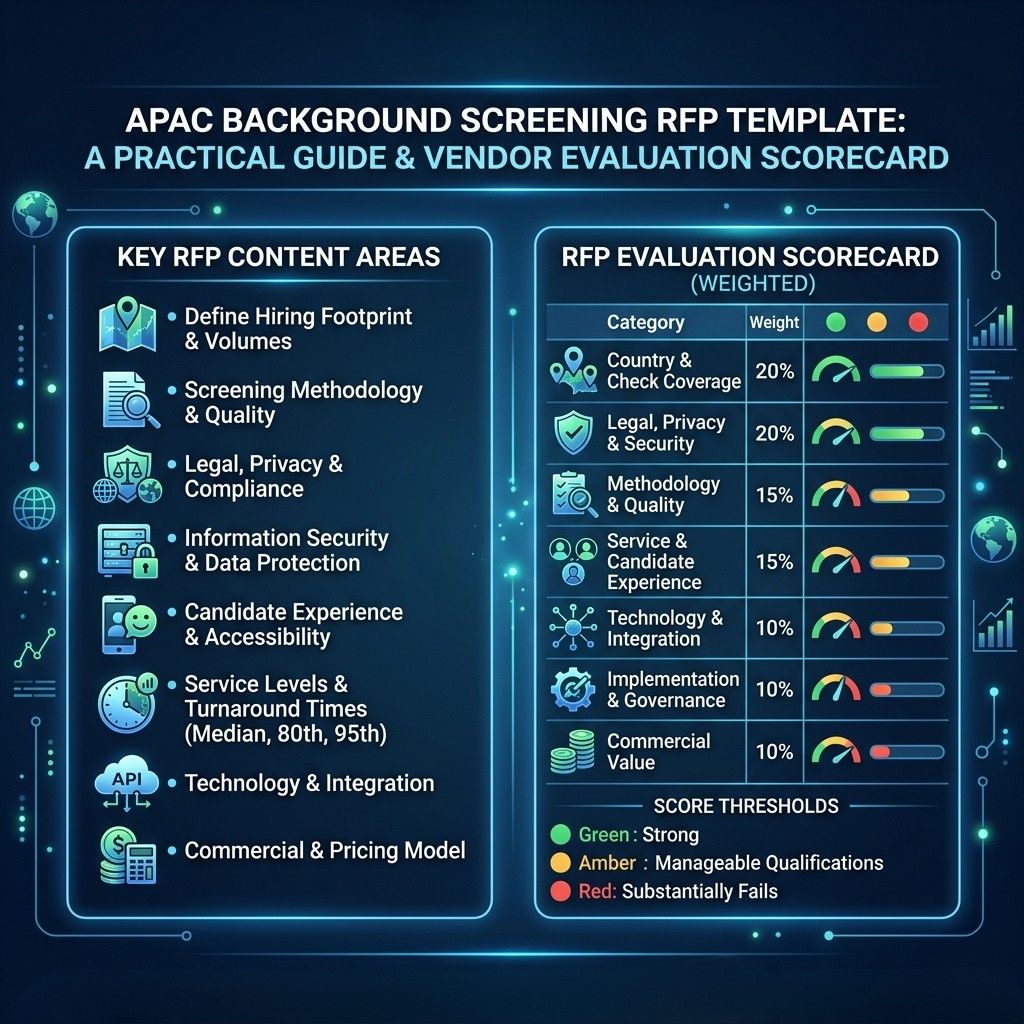
Recommended RFP Evaluation Scorecard
| Evaluation category | Suggested weight | What to test |
|---|---|---|
| Country and check coverage | 20% | Jurisdictions, source quality, limitations, direct vs partner delivery |
| Legal, privacy and security | 20% | Country processes, data flows, certifications, controls, subcontractors |
| Methodology and quality | 15% | Verification routes, matching, QA, evidence and corrections |
| Service and candidate experience | 15% | TAT, languages, escalation, candidate journey, accessibility |
| Technology and integration | 10% | Portal, SSO, ATS/API, reporting, auditability, implementation |
| Implementation and governance | 10% | Project plan, team, transition, reviews, continuous improvement |
| Commercial value | 10% | Total evaluated cost, transparency, scalability, contract terms |
| Total | 100% |
Suggested Scoring Scale
5 — Exceeds the requirement with strong evidence and low delivery risk 4 — Fully meets the requirement with credible evidence 3 — Meets most of the requirement; manageable qualifications remain 2 — Partially meets the requirement; material gaps or dependencies exist 1 — Substantially fails to meet the requirement 0 — No response, unsupported claim or not available Weighted score = (vendor score ÷ 5) × category weight Keep mandatory pass/fail requirements separate. A vendor that fails a non-negotiable privacy, security or country-coverage requirement should not be able to compensate merely by scoring well on price.Seven Common Mistakes in a Background-Screening RFP
- Asking only whether a check is available. Ask how it is performed, what source is used, who delivers it and what the result means.
- Treating APAC as one legal environment. Require jurisdiction-specific answers.
- Using “average TAT” without a definition. Define clock start, pauses, business days and pending cases; request percentiles.
- Comparing incomplete unit prices. Include source fees, institution charges, integrations, support, cancellations and minimum commitments.
- Ignoring subcontracted delivery. Focus on transparency, due diligence, data access, accountability, quality control and change management.
- Scoring certifications without checking scope. Verify covered entities, locations, services, issuing body and validity.
- Skipping live scenarios. Use fictional cases involving delays, disputes, possible matches and escalations.
Questions to Ask During Finalist Presentations
- Show us one country where your normal global workflow has to change. Why?
- Which requested checks would you advise us not to conduct for certain roles or countries?
- What percentage of our proposed volume would be delivered by third parties?
- How do you distinguish direct verification from document review?
- How can a recruiter tell why a case is pending and who must act next?
- What happens if a source, law or data-transfer rule changes during the contract?
- How do you measure candidate effort and support quality?
- Which proposed prices exclude likely third-party fees?
- How will we retrieve our data and close open cases if the contract ends?
Frequently Asked Questions
What is a background screening RFP?
A background screening request for proposal is a structured document used to obtain and compare vendors’ proposed screening scope, country coverage, methodology, compliance controls, service levels, technology, implementation approach, contract terms and pricing.What should an APAC background-screening RFP include?
It should include hiring countries, expected volumes, role-based packages, a country-by-check coverage matrix, verification sources, privacy and security requirements, subcontractor disclosure, candidate support, turnaround-time definitions, integrations, reporting, implementation, pricing and an evaluation scorecard.How long should a background-screening RFP process take?
The timetable depends on scope and internal governance. A multi-country procurement usually needs time for requirements gathering, vendor questions, proposal review, privacy and security assessment, demonstrations, reference checks, contracting, configuration, integration testing and transition.Should an employer choose one provider for all APAC countries?
Not automatically. A single provider can simplify governance, integrations and reporting, but methods and strength may vary by country. Evaluate actual country-by-check capability and the partner model. A primary regional provider with documented exception arrangements may be appropriate for some programmes.Is candidate consent always required for background screening in APAC?
No single answer applies across all checks and jurisdictions. Consent or authorisation is often part of the process, but the applicable legal basis, notice and other requirements depend on the country, data type, source, employment context and proposed use. Employers should obtain jurisdiction-specific advice.What is the difference between turnaround time and an SLA?
Turnaround time measures how long a check or case takes. An SLA is a contractual service commitment with defined measurement rules, exclusions, reporting and remedies. A vendor’s typical TAT is not necessarily a guaranteed SLA.How should employers compare background-check pricing?
Compare total evaluated cost using the same country, check, package and volume assumptions. Include pass-through charges, source fees, minimum commitments, implementation, integrations, support, cancellations and price adjustments—not only headline unit prices.Should the RFP require ISO/IEC 27001 certification?
Certification can provide useful independent assurance, but it should not replace security due diligence. Confirm the certification’s scope, legal entities, locations and validity, and assess the controls and risks relevant to the proposed service.How eeCheck Can Support an APAC RFP
eeCheck provides employment background-screening services across Asia-Pacific, including multi-country programme support, country-specific verification workflows, candidate and client support, reporting and integration options. Organisations preparing an RFP may use this template to structure their requirements and invite eeCheck to respond using the same country-by-check, service-level, security and pricing matrices used for other bidders. You may also review eeCheck’s background screening provider considerations in Asia and Asia background screening executive briefing. Planning an APAC background-screening procurement? Contact eeCheck to discuss your hiring footprint, screening policy, expected volumes and implementation requirements.Final Takeaway
The strongest APAC screening proposal is not necessarily the one promising the most checks in the most countries. A useful proposal explains, with evidence, what can lawfully and reliably be checked, through which source, by whom, within what timeframe, with what limitations and at what total cost. That transparency helps HR, procurement, privacy, security and compliance teams make a defensible decision and gives the selected provider a clearer basis for successful implementation. Organisations can also compare prospective providers using eeCheck’s background screening vendor questions for Asia and in-house vs outsourced screening guide.About This Guide
Prepared by: eeCheck Research & Editorial Team
Subject-matter reviewed by: Ivan Lam, Manager, Business Development & Client Success
Reviewed date: September 2026
Methodology: This template reflects common enterprise procurement workstreams for multi-country background screening: scope, country coverage, methodology, privacy, security, supply chain, candidate experience, service levels, technology, governance, implementation, pricing and contracting.
Limitations: This article is general procurement information, not legal advice. Screening requirements and source availability change and must be assessed for the relevant role, purpose and jurisdiction.

