

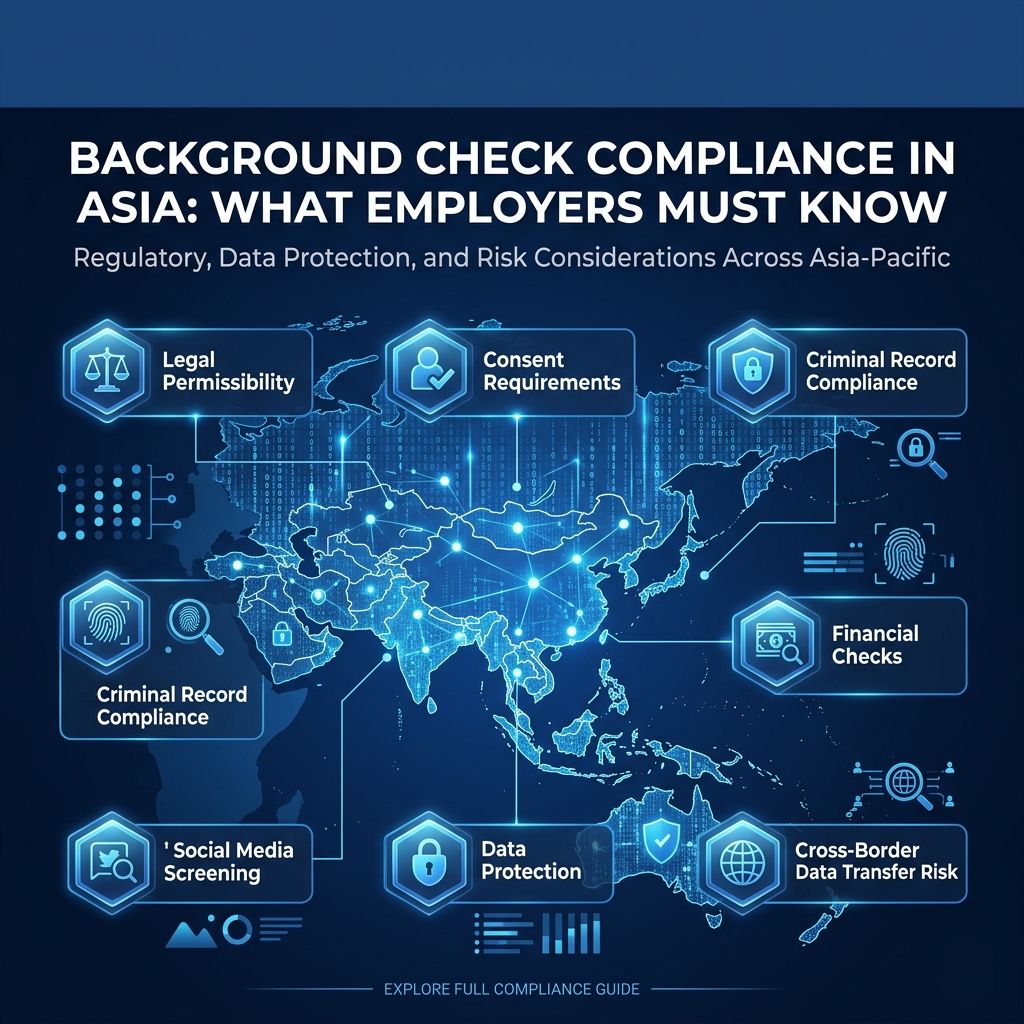
Background Check Compliance in Asia: What Employers Must Know
Regulatory, Data Protection, and Risk Considerations Across Asia-Pacific
Background screening in Asia is legally permissible — but not legally uniform. Unlike jurisdictions with centralized screening laws, Asia-Pacific comprises diverse legal systems, data protection frameworks, and institutional practices. Employers must design screening programs that align with each country’s regulatory environment. Failure to do so can expose organizations to:- Data protection violations
- Regulatory penalties
- Employment disputes
- Reputational damage
- Audit challenges in regulated industries
🔎 Executive Summary
Background check compliance in Asia requires jurisdiction-specific consent frameworks, proportional screening scope, data protection safeguards, and structured governance oversight. Because criminal record access, credit checks, social media screening, and cross-border data transfers are regulated differently across countries, employers must design screening programs on a country-by-country basis. Applying a uniform global model without local adaptation may create regulatory exposure. For a broader regional overview, see our Asia Background Check Guide.
Background check compliance in Asia requires jurisdiction-specific consent frameworks, proportional screening scope, data protection safeguards, and structured governance oversight. Because criminal record access, credit checks, social media screening, and cross-border data transfers are regulated differently across countries, employers must design screening programs on a country-by-country basis. Applying a uniform global model without local adaptation may create regulatory exposure. For a broader regional overview, see our Asia Background Check Guide.
📄 Executive Version Available
⬇ DOWNLOAD THE PDF EDITION1. Legal Permissibility: Screening Must Be Lawful and Proportionate
The first compliance principle is legality. In most Asian jurisdictions, background checks are lawful when:- Proper consent is obtained
- The scope is proportionate to the role
- Data is processed for legitimate business purposes
- Sensitive information is handled appropriately
2. Consent Requirements Across Asia
| Consent Component | Why It Matters |
|---|---|
| Specific check types disclosed | Prevents overreach |
| Purpose limitation | Ensures lawful processing |
| Data retention clarity | Aligns with privacy laws |
| Cross-border transfer disclosure | Required in many jurisdictions |
| Candidate acknowledgment | Strengthens defensibility |
3. Criminal Record Compliance
Criminal record screening is one of the most regulated areas in Asia.- Government-issued certificates may be required
- Third-party database access may be restricted
- Some jurisdictions limit criminal checks to regulated industries
- Certain records may be sealed or expunged
4. Credit, Bankruptcy, and Financial Checks
- Credit checks may only be permissible for financial roles
- Bankruptcy records may be public but not broadly searchable
- Consent requirements may be stricter for financial data
5. Civil Litigation & Court Record Access
- Decentralized court systems
- Non-digitized archives
- Local language record requirements
- Inconsistent public access
6. Social Media and Adverse Media Screening
Social Media Checks- Limited to publicly available content
- Avoid discrimination-sensitive data
- Must remain role-relevant
- Use public sources
- Require contextual review
- Avoid automated conclusions
7. Data Protection & Privacy Compliance
| Compliance Area | Employer Responsibility |
|---|---|
| Lawful Processing | Establish legal basis |
| Data Minimization | Collect only relevant information |
| Access Control | Limit internal access |
| Data Retention | Define retention schedules |
| Breach Notification | Comply with reporting obligations |
| Cross-Border Transfers | Assess localization rules |
8. Cross-Border Data Transfer Risk
- Transfer impact assessments
- Contractual safeguards
- Localization requirements
- Regulatory disclosure obligations
9. Sector-Specific Compliance Considerations
| Industry | Typical Additional Requirements |
|---|---|
| Financial Services | Regulatory history checks |
| Fintech | Enhanced sanctions checks |
| Education | Child protection checks |
| Healthcare | License verification |
| Government-linked entities | Enhanced compliance documentation |
10. Governance & Documentation
- Documented screening policies
- Defined escalation protocols
- Structured discrepancy classification
- Audit trail retention
- Vendor due diligence procedures
- Periodic policy review
11. Common Compliance Mistakes in Asia
- Applying US-centric screening templates
- Failing to adapt consent forms by jurisdiction
- Over-screening without role relevance
- Using unofficial criminal databases
- Ignoring cross-border data localization rules
Frequently Asked Questions
Are background checks legal in Asia?
Yes, when conducted in compliance with local laws and supported by appropriate consent.
Is criminal record screening allowed everywhere in Asia?
No. Access and permissibility vary significantly by jurisdiction and sector.
Can one consent form be used across all Asian countries?
Generally not. Consent language may require jurisdiction-specific adaptation.
Is social media screening compliant?
It may be permissible when limited to public content and applied proportionately.
Who is responsible for compliance — employer or vendor?
Ultimately the employer retains responsibility for lawful processing of candidate data.
Final Strategic Takeaway
Background check compliance in Asia is not about checking boxes.
It is about designing jurisdiction-aware, proportionate, and defensible screening frameworks.
Organizations that:
- Align screening scope with role risk
- Structure consent properly
- Embed data protection safeguards
- Monitor cross-border transfer exposure
- Maintain governance documentation

