

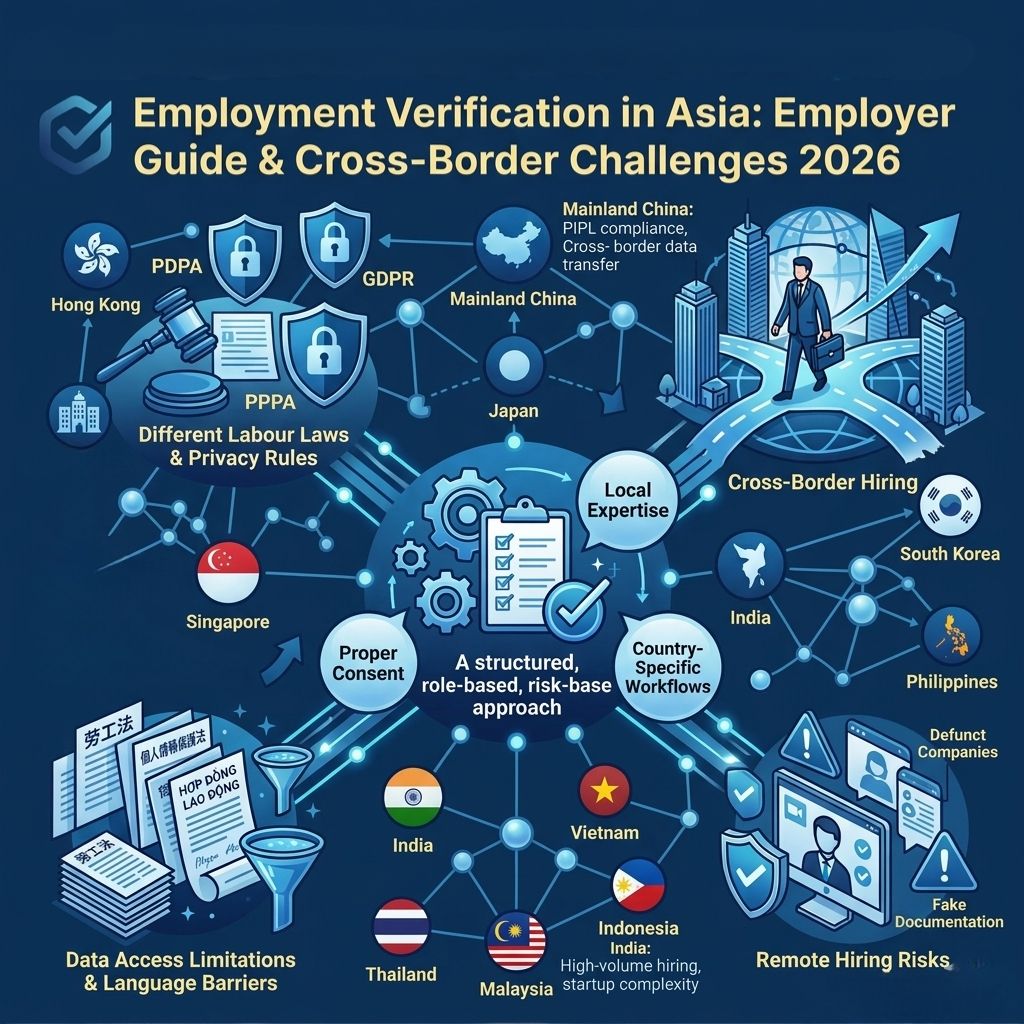
Employment Verification in Asia: Employer Guide & Cross-Border Challenges 2026
Employment Verification in Asia Has Become More Complex Than Ever
Executive Summary
Employment verification has become one of the most important parts of background screening in Asia-Pacific. As employers hire across Hong Kong, Singapore, Mainland China, Japan, South Korea, India, Vietnam, the Philippines, Indonesia, Malaysia, Thailand, Taiwan, and other markets, verification is becoming more complex.
Each country has different labour laws, privacy rules, languages, employer disclosure practices, and verification standards. This means employment verification in Asia cannot rely on one simple global process.
Employers should use a structured, role-based, and risk-based approach supported by proper consent, local expertise, and country-specific workflows. For broader regional planning, see eeCHECKs guide to a compliant background screening policy in Asia, the background screening policy template for Asia-Pacific, and Asia background check compliance guide.
Download Executive BriefingIntroduction: Why Employment Verification in Asia Is More Complex
As companies expand hiring across Asia-Pacific, employment verification has become a critical part of hiring risk management.
Global employers are increasingly recruiting candidates across multiple Asian markets. At the same time, regulators, financial institutions, and multinational organizations are expecting stronger due diligence, better compliance controls, and more accurate hiring decisions.
Employment verification in Asia is rarely straightforward. Employers often need to manage different legal systems, privacy frameworks, cultural norms, data access limitations, language requirements, and employer response practices.
This is especially important for:
- Cross-border hiring
- Financial institutions and regulated industries
- Senior executive hiring
- Remote hiring across Asia
- Multi-country workforce expansion
- Fast-growing startups scaling internationally
- Government and public-sector related projects
eeCHECK supports organizations across Asia-Pacific with employment verification solutions designed for regional complexity, compliance, speed, and accuracy.
For broader background screening guidance, see eeCHECKs Asia Background Check Guide and Asia Background Screening Report.
1. What Is Employment Verification?
Employment verification is the process of confirming a candidates previous work history. The purpose is to check whether the candidate has accurately represented their experience, role, employer, and employment period.
| Verification Area | What It Confirms |
|---|---|
| Employer Name | Confirms whether the candidate worked for the stated organization. |
| Position / Title | Confirms the role or job title held by the candidate. |
| Employment Dates | Confirms start date, end date, and employment duration. |
| Employment Status | Confirms whether the candidate was full-time, part-time, contract, or another employment type where available. |
| Reporting Line or Department | May confirm department, reporting structure, or supervisor details where legally permitted. |
| Rehire Eligibility | May be available depending on local law and employer policy. |
| Reason for Leaving | May be limited or unavailable due to privacy rules or employer disclosure policies. |
| Performance-Related References | May be conducted where legally permitted and relevant to the role. |
| Salary Verification | Country-dependent and often restricted by privacy expectations or employer policy. |
| Regulatory Employment History | Relevant for regulated sectors, financial institutions, licensed roles, or senior positions. |
Depending on the country, industry, and employer policy, verification may be conducted through HR departments, payroll teams, third-party portals, government databases, regulatory databases, professional references, direct supervisor references, or secure digital credential systems.
In Asia, there is no single standardized approach. This creates major operational and compliance challenges for global employers.
2. Why Employment Verification Matters More in Asia
Employment verification is becoming more important in Asia because cross-border hiring is increasing, employment fraud risks are rising, regulatory expectations are stronger, and the region remains operationally fragmented.
| Key Driver | What Employers Should Know |
|---|---|
| Cross-Border Hiring Is Increasing | Employers are hiring across multiple Asian jurisdictions at the same time. For example, a Singapore fintech may hire engineers from India and Vietnam, while a Hong Kong bank may recruit compliance staff from Mainland China. |
| Employment Fraud Risks Are Rising | Employers may encounter inflated job titles, fake employers, altered employment certificates, misrepresented dates, concealed terminations, fabricated managerial responsibilities, hidden directorships, or parallel employment arrangements. |
| Regulatory Expectations Are Higher | Financial institutions and regulated industries are facing stronger expectations around fit and proper assessments, senior management accountability, outsourcing governance, vendor due diligence, ongoing employee screening, and conduct checks. |
| Asia Is Operationally Fragmented | Asia involves multiple languages, different alphabets and transliterations, non-standardized HR practices, limited public databases, privacy restrictions, manual workflows, and different country-level labour practices. |
Senior-level hiring and remote hiring can increase verification risk. For more on regulated-sector screening, see eeCHECKs financial background screening in Asia and Asia background screening executive briefing.
3. Common Employment Verification Challenges Across Asia
Employment verification quality in Asia often depends on employer responsiveness, privacy rules, local language capability, documentation quality, and the ability to handle exceptions.
| Challenge | Why It Creates Difficulty |
|---|---|
| Low Employer Response Rates | Some employers do not respond, require signed consent forms, use manual processes, only respond in local languages, or refuse to provide detailed employment information. |
| Privacy and Data Protection Restrictions | Privacy laws such as Singapore PDPA, Hong Kong PDPO, China PIPL, Japan APPI, South Korea PIPA, and India DPDP Act may restrict data transfers, salary disclosure, reference sharing, personal data exports, and access to HR records. |
| Language and Transliteration Issues | Candidate names may appear differently across English, Chinese, Japanese, Korean, passport, and HR records. This can create false mismatches if not reviewed carefully. |
| Defunct or Acquired Companies | Company closures, mergers, acquisitions, name changes, restructuring, informal businesses, and startup closures can make historical employment records difficult to verify. |
| Fake or Misleading Employment Documentation | Employers may encounter edited employment certificates, fake HR letters, altered payslips, fabricated email domains, false reporting structures, or misrepresented consulting arrangements. |
This is why professional verification methodologies and local expertise matter. For broader screening risk guidance, see eeCHECKs guide on why background checks fail in Asia and risk-based background screening in Asia.
4. Employment Verification Methods Used Across Asia
Employers may use different verification methods depending on the country, role, employer type, available documentation, and legal requirements.
| Method | How It Works | Key Consideration |
|---|---|---|
| Direct Employer Verification | Contacting previous employers through email, HR portals, telephone verification, written forms, secure platforms, or local-language outreach. | This is the most common method, but employer response rates and disclosure levels vary. |
| HRIS and Verification Platforms | Using centralized HR systems, automated verification vendors, secure employer portals, or digital employment credentials. | Useful for larger employers, but adoption levels vary greatly across Asia. |
| Government and Regulatory Sources | Using regulatory licensing databases, public sector employment databases, government accreditation systems, or professional licensing bodies. | Availability depends heavily on country and industry. |
| Outsourced Verification and Digital Credentials | Using specialist providers or secure decentralized credential frameworks to manage verification requests, standardize responses, protect data, and improve scalability. | Can improve security, privacy, cross-border portability, verification speed, fraud resistance, auditability, and candidate control over data. |
Technology can improve speed and scalability, but it should not replace professional judgment. For more on responsible automation, see eeCHECKs guide to AI background check automation risks and the future of background checks in Asia.
5. Country-Level Employment Verification Differences in Asia
Employment verification practices vary significantly by country. Employers should avoid assuming that one global process will work across all Asian markets.
| Country / Market | Typical Practices | Key Challenges | Typical Turnaround |
|---|---|---|---|
| Hong Kong | Employers often verify employment dates, position titles, and basic employment status. Many avoid sharing salary, detailed performance comments, or disciplinary records. | Limited disclosure culture, privacy sensitivity, variable responsiveness, Chinese/English records, and frequent use of references. | 3-10 business days |
| Singapore | Generally has stronger corporate governance, better HR responsiveness, structured documentation, and more standardized practices. | High compliance expectations, regulated industry requirements, fit and proper assessments, and multi-jurisdiction employment histories. | 3-10 business days |
| Mainland China | Verification can be highly variable. Some organizations require local-language communication, formal consent documentation, or decentralized HR procedures. | PIPL compliance, cross-border data transfer restrictions, language barriers, SOE procedures, and regional administrative complexity. | 1-5 business days |
| Japan | Employers often maintain formal HR processes but may be conservative in sharing information. | Cultural sensitivity, privacy concerns, formal communication expectations, language barriers, and limited disclosure practices. | 4-10 business days |
| South Korea | Relatively structured corporate systems, but privacy sensitivity remains high. | Strict personal information protection rules, language handling, corporate response variability, and authorization requirements. | 3-7 business days |
| India | One of the most active employment verification markets in Asia, but complexity varies by employer size, industry, region, and record quality. | Large-volume hiring, informal employment, startup complexity, record inconsistency, and variable HR standards. | 2-7 business days |
| Vietnam | Employment verification infrastructure is still evolving, often relying on manual HR processes, local-language communication, and direct outreach. | Limited digitization, response inconsistency, language barriers, and smaller employer structures. | 3-8 business days |
| Philippines | Generally cooperative HR practices. | BPO workforce mobility, offshore staffing structures, multiple concurrent employment records, and response consistency differences. | 2-6 business days |
| Indonesia | Employment verification is often manual and may require local-language communication with HR teams, payroll teams, or company representatives. | Employer response variability, regional differences, informal employment structures, language handling, and inconsistent documentation practices. | 3-8 business days |
| Malaysia | Employers commonly confirm employment dates, job title, and basic HR records, although response practices vary by company size and sector. | Variable employer responsiveness, privacy expectations, multilingual records, and differences between multinational and local employer practices. | 2-6 business days |
| Thailand | Employment verification is usually manual and often requires local-language outreach to HR teams or employer representatives. | Local-language communication, variable HR processes, consent requirements, manual verification workflows, and employer response delays. | 3-8 business days |
| Taiwan | Employers often confirm employment dates, job title, and basic employment status, usually through HR or administrative channels. | Chinese-language records, privacy sensitivity, employer disclosure limits, and potential name-format differences between Chinese and English records. | 2-6 business days |
For country-specific guidance, see eeCHECKs Hong Kong background check guide, Singapore background checks guide, China background check process guide, and Vietnam background checks guide.
6. Cross-Border Employment Verification Challenges
Cross-border employment verification introduces additional legal, operational, and communication challenges. A verification process that works in one country may not work in another.
| Challenge | Why It Matters |
|---|---|
| Different Legal Standards | Some countries allow broader disclosure, while others restrict reference sharing, require explicit consent, or limit cross-border data transfers. |
| Time Zone and Communication Issues | Regional hiring programs may involve different time zones, languages, holidays, business practices, and escalation procedures. |
| Inconsistent Employer Practices | Even within the same country, some employers disclose details, some only confirm dates, some require written forms, and some only respond verbally. |
| Difficulty Verifying Smaller Employers | SMEs, family-owned businesses, informal entities, startups, and short-lived companies may require supporting documents, alternative methodologies, local-language investigation, or enhanced due diligence. |
7. Best Practices for Employment Verification in Asia
Effective employment verification in Asia requires structure, proper consent, local knowledge, and country-specific execution.
| Best Practice | Why It Matters |
|---|---|
| Use Country-Specific Verification Frameworks | A single global verification process may not work across Asia. Employers should adapt workflows based on country rules, industry requirements, privacy laws, and local employer practices. |
| Obtain Proper Candidate Consent | Consent forms should clearly disclose the verification scope, cover cross-border processing where applicable, meet local privacy requirements, and be properly retained. |
| Apply Risk-Based Verification Models | Not all roles require the same verification depth. Employers may apply role-based screening tiers, enhanced executive screening, financial industry screening, regulated role screening, and sensitive access controls. |
| Work With Local Verification Specialists | Local expertise improves language handling, employer outreach, escalation, country-level compliance, and verification reliability. |
| Integrate Verification Into Hiring Workflows | Integration with ATS systems, HR onboarding, global mobility, vendor onboarding, and ongoing screening improves speed, scalability, auditability, compliance consistency, and candidate experience. |
For program design, see eeCHECKs role-based background screening in Asia and risk-based background screening in Asia.
8. Employment Verification for Financial Institutions in Asia
Financial institutions face particularly high expectations. Banks, payment firms, fintechs, insurers, and regulated organizations may require enhanced employment verification, regulatory reference checks, fit and proper assessments, conduct-related due diligence, cross-border integrity reviews, and senior management screening.
Common challenges include multi-country employment histories, sensitive conduct concerns, regulatory obligations, historical disciplinary investigations, and different disclosure rules across jurisdictions.
This is especially important as regulators continue strengthening governance expectations across Asia. For more guidance, see eeCHECKs financial background screening in Asia.
9. Why Local Expertise Matters in Asia
Employment verification in Asia cannot be treated as a simple administrative process. Success depends on country-level expertise, local-language capability, cultural understanding, regulatory awareness, operational escalation ability, and enterprise-grade governance.
Without strong regional infrastructure, employers may face inaccurate results, delays, compliance risks, missed discrepancies, poor candidate experience, and weak audit defensibility.
10. Why Organizations Across Asia Work With eeCHECK
eeCHECK supports organizations across Asia-Pacific with employment verification and background screening solutions designed for regional complexity.
Our teams support multinational organizations, financial institutions, government-related organizations, payment companies, fintechs, technology firms, and fast-growing enterprises across Asia.
| eeCHECK Capability | Employer Value |
|---|---|
| Multi-Country Employment Verification | Supports organizations hiring across multiple Asian jurisdictions. |
| Local Operational Teams | Improves local outreach, escalation, and verification reliability. |
| Multi-Language Verification Support | Helps manage Chinese, Japanese, Korean, Vietnamese, Thai, Bahasa, and other local-language records. |
| Financial Industry and Regulated Sector Expertise | Supports banks, payment firms, fintechs, insurers, and other regulated organizations. |
| Enterprise-Grade Compliance and Governance Controls | Improves audit readiness and supports defensible screening processes. |
| AI-Assisted Operational Workflows | Improves workflow efficiency while maintaining human review and compliance oversight. |
| ATS and Enterprise Integration Capabilities | Supports scalable hiring workflows and operational efficiency. |
| Cross-Border Verification Coordination | Helps manage multi-country employment histories and regional hiring complexity. |
| High-Volume Hiring Support | Supports organizations scaling hiring across Asia-Pacific. |
| Risk-Based Screening Frameworks | Aligns screening depth with role risk, geography, industry, and compliance requirements. |
eeCHECK continues investing in advanced verification technology, AI-assisted background screening workflows, secure trust infrastructure, decentralized credential ecosystems, regional compliance capabilities, and enterprise automation.
For vendor selection, see eeCHECKs background screening vendor questions for Asia, in-house vs outsourced screening in Asia, top background check firm in Asia, and common mistakes global background check firms make in Asia.
11. Asia Employment Verification Comparison Tables
Employment Verification by Country: Employer Disclosure and Practical Difficulty
| Country / Market | Typical Employer Disclosure | Common Challenges | Practical Difficulty | Typical Turnaround |
|---|---|---|---|---|
| Hong Kong | Employment dates, job title, basic status. | Limited disclosure, privacy sensitivity, Chinese/English records. | Medium | 3-10 business days |
| Singapore | Employment dates, job title, HR confirmation, regulated-sector references where applicable. | High compliance expectations, financial-sector requirements. | Low to Medium | 3-10 business days |
| Mainland China | Employment dates, job title, sometimes limited HR confirmation. | PIPL considerations, language barriers, state-owned enterprise processes, cross-border data transfer restrictions. | High | 1-5 business days |
| Japan | Basic employment confirmation, often through formal HR channels. | Conservative disclosure culture, formal communication expectations, language barriers. | Medium to High | 4-10 business days |
| South Korea | Employment dates and position confirmation where permitted. | Strict personal information protection rules, authorization requirements. | Medium to High | 3-7 business days |
| India | Employment dates, title, HR records, sometimes detailed confirmation. | High-volume hiring, inconsistent records, startup and SME complexity. | Medium | 2-7 business days |
| Vietnam | Basic employment confirmation, usually manual. | Limited digitization, local-language communication, inconsistent response rates. | Medium to High | 3-8 business days |
| Philippines | Employment dates, job title, HR confirmation. | BPO workforce mobility, offshore staffing structures, multiple employment records. | Medium | 2-6 business days |
| Indonesia | Basic employment confirmation, often manual. | Language barriers, employer response variability, regional differences. | Medium to High | 3-8 business days |
| Malaysia | Employment dates, title, HR confirmation. | Variable employer responsiveness, privacy requirements, multilingual records. | Medium | 2-6 business days |
| Thailand | Basic employment confirmation, usually manual. | Local-language communication, variable HR processes, consent requirements. | Medium to High | 3-8 business days |
| Taiwan | Employment dates, title, HR confirmation. | Chinese-language records, privacy sensitivity, employer disclosure limits. | Medium | 2-6 business days |
Employment Verification Risk Factors by Country
| Country / Market | Privacy / Data Protection Sensitivity | Language Complexity | Employer Response Variability | Cross-Border Verification Risk |
|---|---|---|---|---|
| Hong Kong | Medium | Medium | Medium | Medium |
| Singapore | Medium | Low | Low to Medium | Medium |
| Mainland China | High | High | High | High |
| Japan | High | High | Medium | Medium to High |
| South Korea | High | High | Medium | Medium to High |
| India | Medium | Medium | Medium | Medium |
| Vietnam | Medium | High | High | Medium to High |
| Philippines | Medium | Low to Medium | Medium | Medium |
| Indonesia | Medium | High | High | Medium to High |
| Malaysia | Medium | Medium | Medium | Medium |
| Thailand | Medium | High | High | Medium to High |
| Taiwan | Medium to High | Medium | Medium | Medium |
What Employers Should Expect Across Asia
| Verification Issue | Why It Matters | Recommended Employer Approach |
|---|---|---|
| Employer Refuses to Disclose Details | Some employers only confirm minimal information due to privacy or internal policy. | Use documented escalation workflows and obtain proper candidate consent. |
| Candidate Worked for a Defunct Company | Historical employment records may be unavailable. | Request supporting documents and apply alternative verification methods. |
| Different Name Formats Appear in Records | Asian names may appear differently across English, Chinese, Japanese, Korean, or local records. | Use local-language matching and identity reconciliation. |
| Employment Dates Do Not Match Exactly | Minor discrepancies may arise from resignation date, last working day, payroll date, or contract date. | Review discrepancies contextually before treating them as adverse. |
| Salary or Reason for Leaving Is Unavailable | Many employers do not disclose salary, performance, or departure reasons. | Define the verification scope clearly before screening begins. |
| Cross-Border Transfer Restrictions Apply | Some countries impose restrictions on personal data transfer or processing. | Use compliant consent language, secure processing, and country-specific controls. |
12. Key Questions About Employment Verification in Asia
| Question | Answer |
|---|---|
| What is employment verification in Asia? | It is the process of confirming a candidates previous employment history across Asian markets, including employer name, job title, employment dates, and other information where legally permitted. |
| Why is employment verification difficult in Asia? | Asia is fragmented across different legal systems, privacy regulations, languages, HR practices, and employer disclosure standards. |
| Which Asian countries are harder for employment verification? | Mainland China, Japan, South Korea, Vietnam, Indonesia, and Thailand can be more complex due to privacy requirements, language barriers, local employer practices, and manual verification procedures. |
| How long does employment verification take in Asia? | Employment verification in Asia typically takes 1-10+ business days depending on the country, employer responsiveness, documentation quality, and verification scope. |
Final Takeaway
Employment verification in Asia is becoming increasingly important as organizations expand hiring across borders and regulators raise governance expectations.
However, Asia remains one of the worlds most operationally complex regions for background screening. Successful employment verification requires local expertise, country-level compliance knowledge, multi-language capability, enterprise-grade governance, scalable technology, and risk-based screening frameworks.
Organizations that invest in robust employment verification processes are better positioned to reduce hiring risk, improve compliance, and support scalable cross-border growth across Asia.
Frequently Asked Questions
What is employment verification in Asia?
Employment verification in Asia is the process of confirming a candidates previous employment history across Asian markets, including employer name, job title, employment dates, and other information where legally permitted. Because Asia has different privacy laws, languages, employer practices, and regulatory expectations, employment verification often requires local expertise and country-specific workflows.
Why is employment verification difficult in Asia?
Employment verification is difficult in Asia because the region is fragmented across different legal systems, privacy regulations, languages, HR practices, and employer disclosure standards. Some employers only confirm basic information, while others require signed consent forms, local-language communication, or formal verification procedures.
How long does employment verification take in Asia?
Employment verification in Asia typically takes 1 to 10 or more business days depending on the country, employer responsiveness, language requirements, consent procedures, industry, and availability of historical records.
Which Asian countries are most complex for employment verification?
Mainland China, Japan, South Korea, Vietnam, Indonesia, and Thailand can be more complex for employment verification due to privacy requirements, language barriers, local employer practices, manual verification procedures, and variable employer response rates.
Do employers need candidate consent for employment verification in Asia?
Yes. In most Asian jurisdictions, employers should obtain clear candidate consent before conducting employment verification. Consent should describe the verification scope, cross-border processing where applicable, and data handling practices in line with local privacy requirements.
What information can usually be verified during employment verification?
Employment verification commonly confirms employer name, employment dates, job title, department, and employment status. Salary, performance, reason for leaving, disciplinary history, and rehire eligibility may be restricted or unavailable depending on country law, employer policy, and candidate consent.
Why should companies use a local background check firm for employment verification in Asia?
Companies should use a local or Asia-specialist background check firm because employment verification in Asia requires country-level compliance knowledge, local-language communication, employer escalation experience, cultural understanding, and secure cross-border verification workflows.
How can employers reduce delays in Asia employment verification?
Employers can reduce delays by collecting accurate employment details upfront, obtaining proper consent, preparing supporting documents, using local-language verification workflows, applying escalation procedures, and working with a background check provider experienced across Asian markets.

