

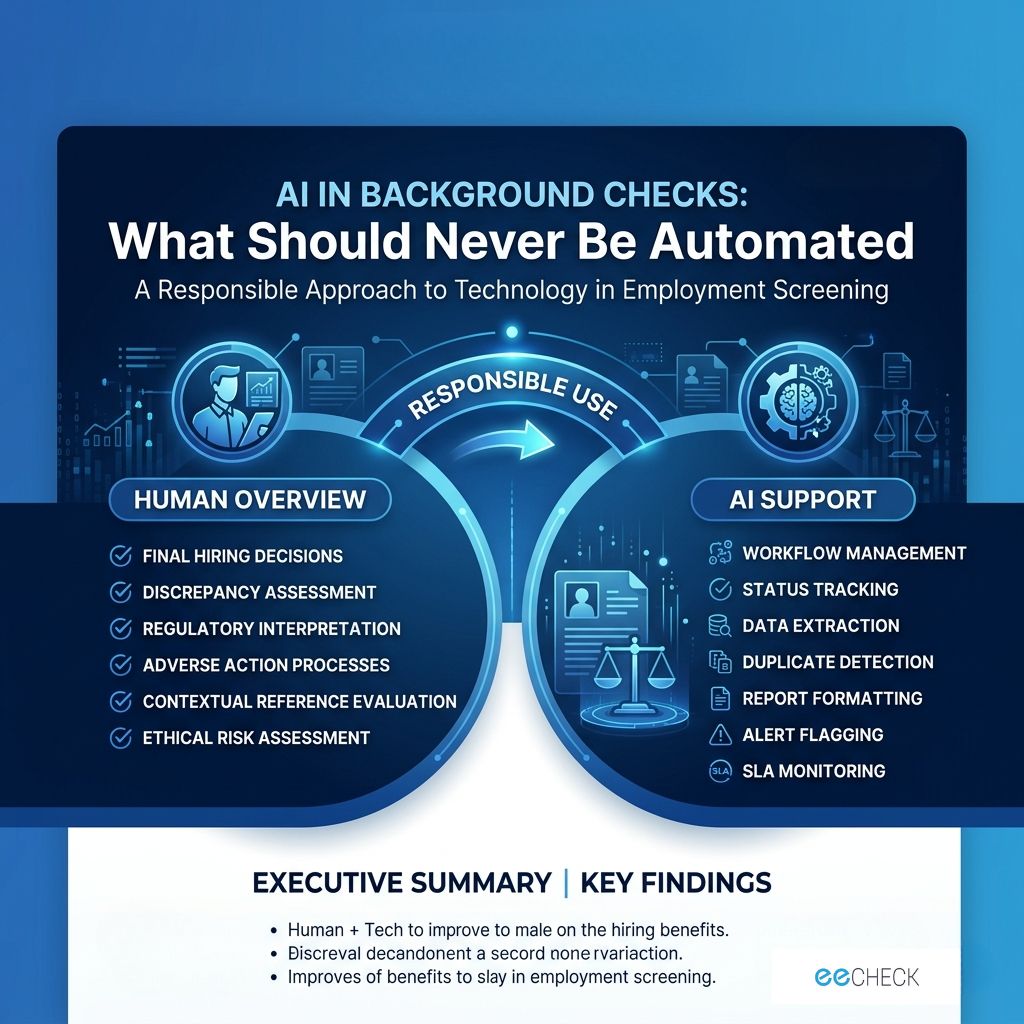
AI in Background Checks: What Should Never Be Automated
A Responsible Approach to Technology in Employment Screening
Artificial intelligence is transforming background screening. From workflow automation to document processing and anomaly detection, AI can improve speed and operational efficiency. But not everything in background screening should be automated. Employment screening directly affects hiring decisions, regulatory compliance, and candidate rights. In Asia-Pacific — where legal frameworks differ significantly by country — responsible use of AI requires clear boundaries. The question is not whether AI should be used. The question is: what should never be automated?Executive Summary
AI can enhance efficiency in background screening, but final decision-making, discrepancy assessment, regulatory interpretation, and adverse impact evaluation should never be fully automated. Human oversight is essential to ensure legal compliance, contextual judgment, and defensible hiring outcomes. In Asia-Pacific’s diverse regulatory environment, a Human + Technology model provides the safest approach. For organizations designing screening programs across the region, AI governance should be aligned with a compliant background screening policy in Asia, supported by a background screening policy template for Asia-Pacific, and adapted to Asia background check compliance requirements. Download Executive Summary PDFWhere AI Adds Value in Background Screening
Before defining limits, it is important to acknowledge where AI can be responsibly used. AI can support background screening by improving administrative consistency, workflow speed, and report organization. These functions can reduce manual workload while keeping human reviewers in control.| AI-Supported Function | Responsible Use | Why It Helps |
|---|---|---|
| Workflow management | Routing cases, assigning tasks, and tracking progress | Improves consistency and operational visibility |
| Status tracking | Monitoring case progress and pending items | Helps recruiters and compliance teams manage timelines |
| Data extraction | Reading structured information from documents | Reduces repetitive manual entry |
| Duplicate detection | Identifying repeated records or repeated submissions | Improves data quality |
| Report formatting | Organizing report sections into a standardized layout | Supports readability and audit consistency |
| Alert flagging | Highlighting possible anomalies for human review | Helps reviewers prioritize attention |
| SLA monitoring | Tracking turnaround time and escalation points | Supports operational accountability |
What Should Never Be Fully Automated
1. Final Hiring Decisions
AI-generated screening reports should not directly determine hiring outcomes.
Background checks often contain nuance:
- Name variations
- Partial employment matches
- Cultural differences in reference language
- Document inconsistencies
Human review ensures context is properly interpreted.
Hiring decisions must remain human-led.
2. Discrepancy Assessment
Not all discrepancies indicate misconduct.
Examples:
- Minor employment date differences
- Translation inconsistencies
- Institutional naming variations
- Record format mismatches
AI may flag discrepancies, but human professionals must evaluate:
- Materiality
- Context
- Intent
- Legal relevance
Automated misclassification can lead to unfair outcomes.
3. Regulatory Interpretation
Asia-Pacific screening regulations vary widely.
Legal considerations include:
- Permissibility of criminal checks
- Consent requirements
- Data localization rules
- Cross-border data transfer limitations
- Retention restrictions
AI cannot reliably interpret evolving jurisdiction-specific regulations without human compliance oversight.
Regulatory misinterpretation creates exposure.
4. Adverse Action Processes
In certain jurisdictions, candidates must be notified before adverse hiring decisions are finalized.
Automating adverse notifications without human verification risks:
- Premature rejection
- Inaccurate reporting
- Legal disputes
- Reputational damage
Adverse processes require documented, structured review.
5. Contextual Reference Evaluation
Reference checks often involve qualitative input.
Examples:
- Tone of response
- Cultural communication style
- Indirect feedback
- Hesitation patterns
AI may struggle to interpret nuance across languages and cultures.
Human judgment remains essential.
6. Ethical Risk Assessment
Screening intersects with:
- Fair hiring principles
- Non-discrimination standards
- Proportionality of findings
- Rehabilitation considerations
Automated systems may lack ethical judgment in complex cases.
Human oversight ensures balanced decision-making.
The Risk of Over-Automation
Fully automated screening models may lead to:- False positives
- False negatives
- Regulatory violations
- Inconsistent outcomes
- Reputational damage
- Reduced defensibility in disputes
The Human + Technology Model
Responsible screening programs adopt a hybrid framework. Technology should improve efficiency, while human reviewers protect fairness, compliance, and defensibility.| Technology Handles | Humans Handle |
|---|---|
| Workflow routing | Discrepancy assessment |
| Data extraction | Regulatory interpretation |
| Status tracking | Escalation decisions |
| Document organization | Final review and sign-off |
| SLA monitoring | Contextual evaluation |
Why This Matters More in Asia-Pacific
Asia’s regulatory diversity increases complexity. Each country presents different data protection laws, criminal record access limitations, employment verification practices, language norms, and documentation standards. AI systems trained on one jurisdiction may not translate accurately to another. Human oversight becomes critical when screening spans multiple countries, business units, or regulated roles. This is particularly relevant for multinational employers scaling screening programs across Asia. Related resources include how MNCs scale background screening in Asia, in-house vs outsourced screening in Asia, and questions to ask before hiring a background screening vendor.Frequently Asked Questions
Is AI safe to use in background screening?
Yes, when used responsibly. AI can support workflow efficiency, data extraction, status tracking, and report organization. However, human oversight is essential for compliance, discrepancy evaluation, and final hiring decisions.
Can AI replace human reviewers?
No. AI can assist reviewers but should not replace professional judgment, especially in regulatory interpretation, discrepancy assessment, adverse action processes, and contextual reference evaluation.
What is the biggest risk of fully automated screening?
The biggest risks include misclassification, regulatory non-compliance, unfair candidate outcomes, and legally indefensible hiring decisions.
Should regulated industries use AI in screening?
Yes, but only within a structured Human + Technology framework that prioritizes compliance, auditability, human review, and documented escalation controls.
Why is human oversight especially important in Asia-Pacific?
Asia-Pacific has diverse legal systems, privacy rules, documentation practices, and record access limitations. Human oversight helps ensure screening results are interpreted in the correct jurisdictional and cultural context.
Final Takeaway
AI is a powerful tool in background screening, but screening is not simply data processing. It is a compliance-sensitive, reputation-impacting, risk management function. Technology should enhance accuracy and efficiency — not replace human judgment. In Asia-Pacific’s diverse regulatory landscape, responsible automation requires boundaries, governance, and human oversight. For organizations building a defensible screening program, start with clear policy design, jurisdictional compliance mapping, and a responsible Human + Technology operating model. Learn more from eeCheck’s guides on Asia background check compliance, compliant screening policy design, and choosing a leading background check firm in Asia.Related eeCheck Resources
- How to Design a Compliant Background Screening Policy for Asia
- Background Screening Policy Template for Asia-Pacific
- Role-Based Background Screening in Asia
- Risk-Based Background Screening in Asia
- Asia Background Check Compliance
- Asia Background Check Guide
- Financial Background Screening in Asia
- Questions to Ask Before Hiring a Background Screening Vendor
- In-House vs Outsourced Screening in Asia
- Turnaround Time in Asia: Why “Fast” Is Not Always Accurate

