

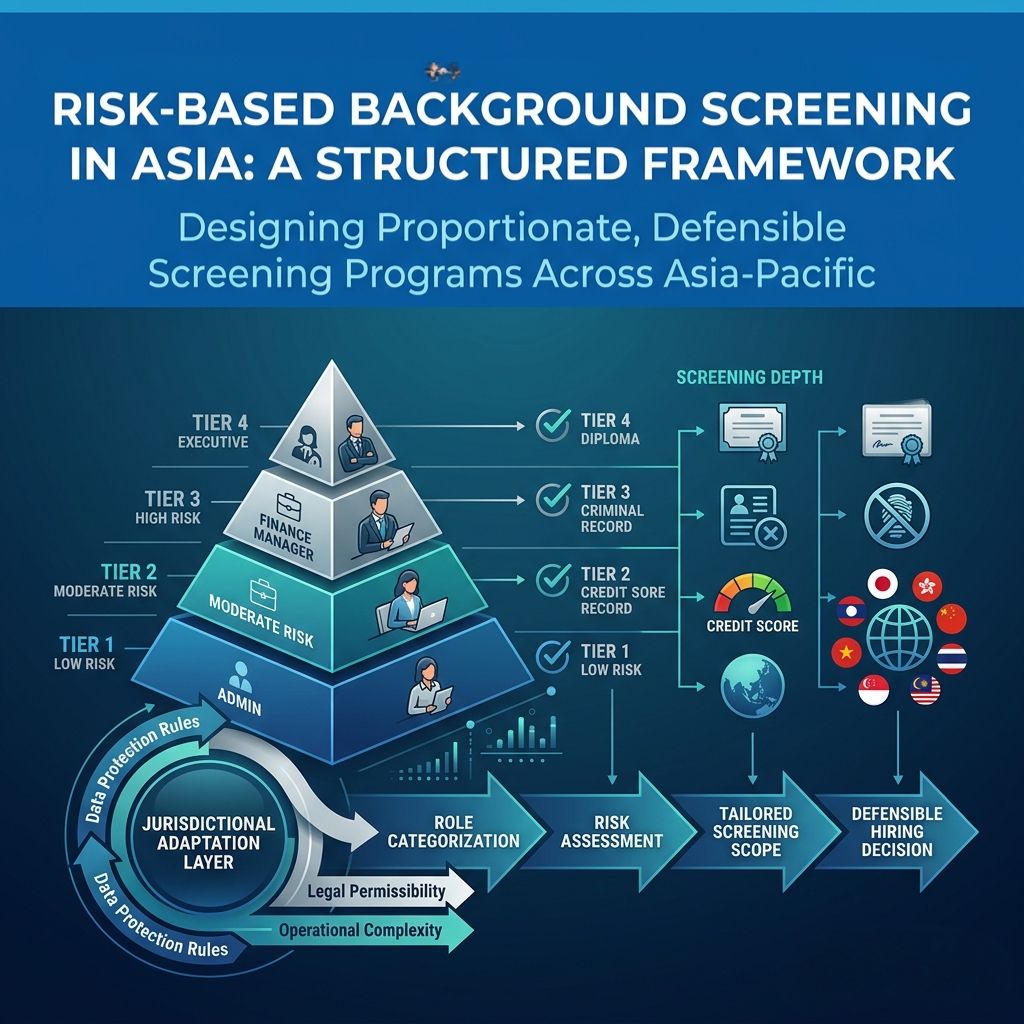
Risk-Based Background Screening in Asia: A Structured Framework
Designing Proportionate, Defensible Screening Programs Across Asia-Pacific
Background screening in Asia-Pacific should not follow a uniform template. Legal permissibility, data protection rules, operational complexity, and role sensitivity vary significantly across jurisdictions.
A “one-size-fits-all” screening package may either over-screen (creating compliance risk) or under-screen (creating hiring risk).
The most defensible approach is risk-based background screening.
Risk-based background screening in Asia aligns the scope and intensity of checks with role sensitivity, industry regulation, and jurisdictional legal constraints.
Organizations operating across multiple jurisdictions must also consider Asia background check compliance requirements to ensure screening programs remain legally defensible.
For a broader regional overview, see the Asia Background Check Guide.
By categorizing roles into risk tiers and adapting checks accordingly, organizations reduce regulatory exposure, avoid over-screening, and improve defensibility.
1. Why Risk-Based Screening Matters in Asia
- Legal permissibility varies by jurisdiction
- Certain checks are highly sensitive (criminal, credit, social media)
- Operational complexity increases across multiple countries
Without a structured framework, organizations risk:
- Over-collection of personal data
- Inconsistent screening standards
- Regulatory scrutiny
- Inadequate screening of high-risk roles
2. Core Risk Dimensions in Asia Screening
| Risk Dimension | Description | Executive Consideration |
|---|---|---|
| Role Risk | Level of authority, financial control, regulatory exposure | Seniority & decision power |
| Industry Risk | Regulatory intensity of sector | Financial services vs non-regulated roles |
| Jurisdiction Risk | Data protection maturity, verification limitations | Cross-border exposure |
| Data Sensitivity | Type of personal data involved | Criminal, financial, identity data |
| Volume Risk | Hiring scale across region | Operational consistency |
3. Role-Based Risk Tier Framework
| Tier | Role Examples | Risk Exposure Level | Screening Depth |
|---|---|---|---|
| Tier 1 – Low Risk | Junior administrative roles | Limited decision authority | Foundational verification only |
| Tier 2 – Moderate Risk | Mid-level professionals | Operational responsibility | Enhanced credential checks |
| Tier 3 – High Risk | Finance, compliance roles | Financial & regulatory exposure | Expanded legal checks |
| Tier 4 – Executive | C-suite and directors | Strategic & reputational exposure | Comprehensive screening |
4. Screening Scope by Risk Tier
| Check Type | Tier 1 | Tier 2 | Tier 3 | Tier 4 |
|---|---|---|---|---|
| Identity Verification | ✓ | ✓ | ✓ | ✓ |
| CV Validation | ✓ | ✓ | ✓ | ✓ |
| Employment Verification | ✓ | ✓ | ✓ | ✓ |
| Education Verification | ✓ | ✓ | ✓ | ✓ |
| Professional License | – | ✓ (if applicable) |
✓ | ✓ |
| Criminal Record | – | Role dependent |
✓ | ✓ |
| Financial Regulatory History | – | – | ✓ | ✓ |
| Bankruptcy Record | – | – | ✓ | ✓ |
| Credit Check | – | Role dependent |
✓ | ✓ |
| Civil Litigation | – | – | Role dependent |
✓ |
| Conflict of Interest | – | – | ✓ | ✓ |
| Sanctions & Watchlist | – | ✓ | ✓ | ✓ |
| Adverse Media | – | – | ✓ | ✓ |
| Performance Reference | – | ✓ | ✓ | ✓ |
| Social Media (Public Only) | – | Role dependent |
Role dependent |
Role dependent |
5. Jurisdictional Adaptation Layer
| Consideration | Why It Matters |
|---|---|
| Criminal check permissibility | Not uniform across Asia |
| Credit check legality | Often restricted |
| Data localization | Affects storage & transfer |
| Consent requirements | Must reflect local law |
| Retention limits | Vary by country |
6. Governance Controls for Risk-Based Screening
| Governance Element | Purpose |
|---|---|
| Documented screening policy | Defines role tiers & scope |
| Defined escalation thresholds | Manages discrepancies |
| Structured discrepancy classification | Ensures consistency |
| Audit trail retention | Supports regulatory review |
| Vendor oversight documentation | Maintains accountability |
| Periodic policy review | Adjusts for regulatory change |
7. Avoiding Over-Screening and Under-Screening
Over-screening risks:- Privacy violations
- Discrimination claims
- Data protection breaches
- Fraud risk
- Regulatory non-compliance
- Reputational exposure
8. Scaling Risk-Based Screening Across Asia
| Centralized | Localized |
|---|---|
| Tier definitions | Compliance adaptation |
| Reporting format | Institutional verification |
| Escalation thresholds | Consent language |
| Governance oversight | Data localization compliance |
9. Integrating AI Within Risk-Based Frameworks
- Workflow automation
- Tier classification
- Discrepancy flagging
- SLA monitoring
However final hiring decisions and regulatory interpretation must remain human-led.
10. Governance Maturity in Risk-Based Programs
| Level | Characteristics |
|---|---|
| Basic | Uniform screening applied to all roles |
| Developing | Partial role differentiation |
| Advanced | Structured tier matrix with documentation |
| Enterprise | Integrated tier system + jurisdiction mapping |
Frequently Asked Questions
Final Strategic Takeaway
Risk-based background screening ensures the right checks are applied to the right roles in the right jurisdictions.
Organizations implementing structured frameworks can:
- Improve compliance defensibility
- Reduce privacy exposure
- Enhance operational consistency
- Strengthen audit readiness

