

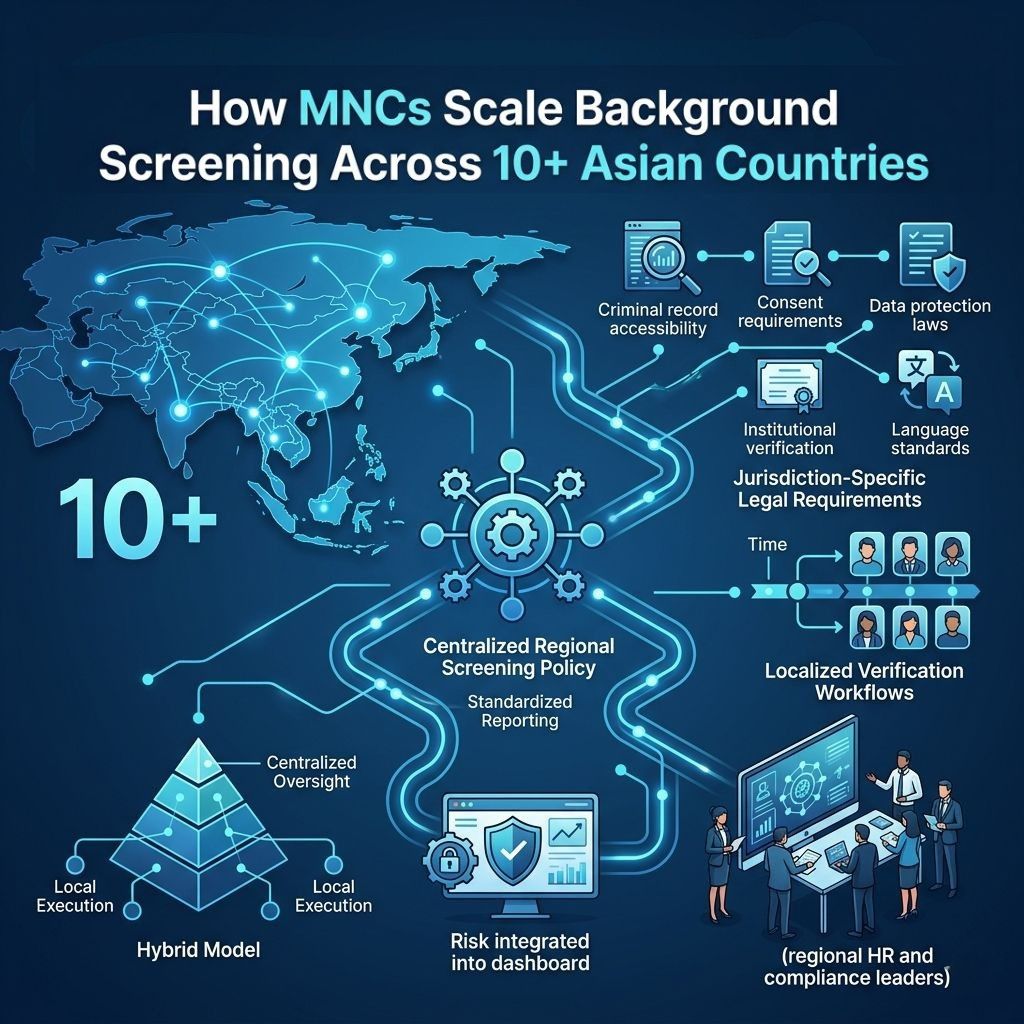
How MNCs Scale Background Screening Across 10+ Asian Countries
A Practical Framework for Regional Hiring Programs
Expanding into Asia-Pacific offers enormous growth opportunities for multinational corporations (MNCs). But scaling hiring across 10 or more Asian countries introduces complexity — especially in background screening.
Asia is not a single regulatory region. Each jurisdiction operates under its own legal system, privacy framework, data access rules, and verification norms.
For MNCs, scaling background screening across Asia requires more than simply replicating a home-country model. It requires structured, jurisdiction-aware design.
🔎 Executive Summary
MNCs successfully scale background screening across 10+ Asian countries by implementing centralized governance with localized execution.
They standardize policy, reporting, and oversight while adapting verification workflows to each country’s legal and operational requirements.
This hybrid model reduces compliance risk, improves defensibility, and ensures consistency across jurisdictions.
For a broader regional overview, read EECheck’s Asia Background Screening Executive Briefing.
Download Full ReportThe Core Challenge: Asia Is Not Uniform
Unlike the US or EU, Asia-Pacific does not operate under a single harmonized screening framework.
| Area of Difference | Why It Matters for MNCs |
|---|---|
| Criminal record accessibility | Availability and process differ significantly by country. |
| Consent requirements | Candidate authorization may need to follow local privacy rules. |
| Data protection laws | Screening data must be collected, stored, and processed lawfully. |
| Cross-border data transfers | Regional HR teams must consider transfer restrictions and safeguards. |
| Institutional verification procedures | Education and employment checks may require localized workflows. |
| Language and documentation standards | Documents and responses may require local language handling. |
Scaling screening requires navigating these differences without losing consistency. For more detail, see EECheck’s Asia Background Check Compliance Guide.
Step 1: Establish a Centralized Regional Screening Policy
Leading MNCs begin with policy design.
A regional screening policy should define:
- Role-based screening tiers
- Mandatory vs optional checks
- Escalation and discrepancy protocols
- Compliance oversight responsibilities
- Data retention standards
Policy should be centralized at regional or global level — but adaptable by country. This prevents fragmentation.
Useful resources include Compliant Background Screening Policy Asia and Background Screening Policy Template Asia Pacific.
Step 2: Map Jurisdiction-Specific Legal Requirements
Each country must be assessed individually.
Key considerations include:
- What checks are legally permissible?
- What consent structure is required?
- Are criminal checks restricted?
- Is data localization required?
- Are cross-border transfers limited?
MNCs that skip this step risk regulatory exposure. A legal compliance map becomes the foundation of scalable screening.
For regional and country-level guidance, explore Asia Background Check Guide, Hong Kong Background Check Guide, and China Background Check Process.
Step 3: Implement Localized Verification Workflows
Once compliance mapping is complete, execution must reflect local realities.
Effective scaling requires:
- In-language verification processes
- Understanding of local documentation norms
- Familiarity with employer and institutional practices
- Adaptation to varying turnaround expectations
Centralized coordination does not eliminate the need for localized operational knowledge. This is especially important when designing Role-Based Background Screening Asia.
Step 4: Standardize Reporting Across Jurisdictions
One of the biggest pain points for MNCs is inconsistent reporting formats.
Scalable programs implement:
- Uniform report templates
- Standardized discrepancy categorization
- Consistent risk rating terminology
- Consolidated dashboards
This enables regional HR and compliance leaders to interpret results efficiently. EECheck’s Asia Background Screening Report explains how reporting supports regional governance.
Step 5: Establish Governance & Quality Control Frameworks
Scaling across 10+ countries multiplies error risk.
MNCs should ensure:
- Documented quality control checkpoints
- Defined escalation procedures
- Audit trail retention
- Role-based access controls
- Data encryption standards
- Vendor oversight protocols
Screening at scale requires governance maturity. When evaluating providers, consider EECheck’s Background Screening Vendor Questions Asia.
Step 6: Centralized Oversight, Local Execution
The most effective model used by MNCs is a hybrid structure:
| Centralized Functions | Localized Functions |
|---|---|
| Policy design | Primary-source verification |
| Compliance oversight | In-language communication |
| Reporting standards | Institutional engagement |
| Vendor governance | Local document validation |
| Risk escalation framework | Country-specific process adaptation |
This structure balances consistency with jurisdictional nuance. For operating model design, read In-House vs Outsourced Screening Asia.
Step 7: Treat Screening as a Risk Function
High-performing MNCs integrate screening into enterprise risk frameworks.
This includes:
- Alignment with compliance teams
- Integration with information security controls
- Regular internal audits
- Regulatory update monitoring
- Periodic policy reviews
Screening becomes part of governance infrastructure — not an HR afterthought. See EECheck’s Risk-Based Background Screening Asia for further guidance.
Common Mistakes MNCs Make When Scaling in Asia
| Common Mistake | Potential Impact |
|---|---|
| Applying a US-centric model across all countries | Creates compliance and process gaps. |
| Assuming criminal checks are uniformly accessible | Can lead to unrealistic policy expectations. |
| Ignoring cross-border data transfer limitations | May create privacy and regulatory exposure. |
| Relying heavily on databases instead of primary-source verification | Can reduce accuracy and defensibility. |
| Failing to standardize discrepancy classification | Makes regional decision-making inconsistent. |
| Underestimating language and cultural differences | Slows verification and increases misunderstanding. |
To avoid these issues, read Global Background Check Firms Asia Mistakes and Why Background Checks Fail in Asia.
Technology’s Role in Regional Scaling
Technology supports scalability through:
- Workflow automation
- Centralized tracking dashboards
- Standardized documentation
- Controlled user access
- Escalation alerts
However, automation alone cannot replace jurisdiction-specific expertise. Human review remains essential.
For sensitive roles, technology should also support deeper checks such as Financial Background Screening Asia.
Frequently Asked Questions
How do MNCs maintain consistency across multiple Asian countries?
They centralize policy and reporting while adapting execution to each country’s legal and operational framework.
Is it possible to use one uniform screening process across Asia?
No. Legal permissibility and verification access differ by jurisdiction. A hybrid standardized-localized model is necessary.
What is the biggest compliance risk when scaling screening in Asia?
Cross-border data transfer violations and conducting impermissible checks in certain jurisdictions are among the most significant risks.
Should screening be managed centrally or locally?
Best practice combines centralized governance with localized operational execution.
How should MNCs choose a screening partner in Asia?
MNCs should assess country coverage, compliance knowledge, verification methodology, reporting standards, data security, and escalation support. EECheck’s guide to the Top Background Check Firm Asia can help frame this evaluation.
Final Takeaway
Scaling background screening across 10+ Asian countries is not a matter of increasing volume — it is a matter of increasing structural sophistication. Successful MNCs design centralized screening policies, map country-specific legal requirements, implement localized verification workflows, standardize reporting, maintain governance oversight, and integrate screening into enterprise risk frameworks.
In Asia-Pacific’s diverse regulatory landscape, scalable screening programs require both structure and nuance.

