

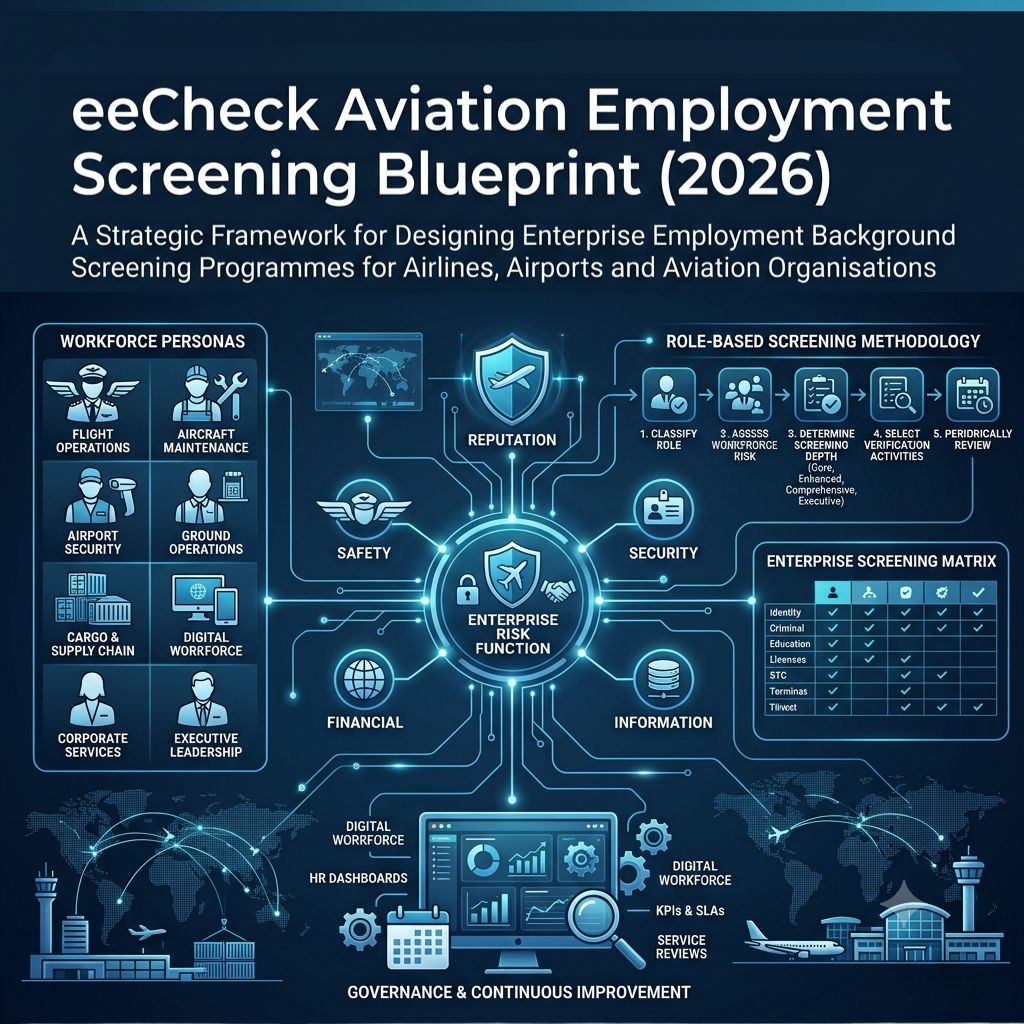
eeCheck Aviation Employment Screening Blueprint (2026)
A Strategic Framework for Designing Enterprise Employment Background Screening Programmes for Airlines, Airports and Aviation OrganisationsExecutive Summary
The aviation industry is one of the world’s most safety-critical and highly regulated sectors. Every employee—whether a captain, aircraft maintenance engineer, cargo specialist, cybersecurity professional or procurement manager—contributes to the safety, security and resilience of aviation operations. While employment background screening is commonly viewed as a recruitment activity, leading aviation organisations increasingly recognise it as an enterprise risk management function. A well-designed screening programme helps organisations strengthen workforce integrity, support regulatory compliance, reduce operational risk and maintain public trust. However, one of the most common mistakes organisations make is applying identical screening requirements across all employee groups. A pilot, finance manager, airport operations controller and IT administrator face fundamentally different operational risks and therefore require different screening approaches. The eeCheck Aviation Employment Screening Blueprint provides a structured methodology for designing an enterprise employment screening programme specifically for the aviation industry. Rather than focusing on individual verification services, the Blueprint introduces a practical framework that aligns employment screening with workforce risk, operational responsibilities and organisational governance.For broader programme design, see eeCheck’s compliant background screening policy guide, background screening policy template for Asia-Pacific, role-based background screening guide and risk-based background screening guide.
Why This Blueprint Was Developed
Most articles discussing employment background screening answer a single question: “What background checks should we perform?” The more important question is often overlooked: “How should an aviation organisation design an enterprise employment screening programme?” The objective of this Blueprint is therefore not simply to describe background screening services, but to provide aviation organisations with a practical methodology for designing a screening programme that supports operational resilience, workforce integrity and enterprise governance.The Shift from Recruitment Activity to Enterprise Risk Function
Employment screening has traditionally been owned by Human Resources and Talent Acquisition teams. Today, however, the risks associated with hiring extend far beyond recruitment.| Business Function | Why Employment Screening Matters |
|---|---|
| Human Resources | Hiring consistency and candidate experience |
| Talent Acquisition | Efficient recruitment and onboarding |
| Flight Operations | Safety-critical workforce integrity |
| Engineering & Maintenance | Technical competency and aircraft airworthiness |
| Airport Security | Restricted area access and operational security |
| Information Security | Protection of operational and passenger data |
| Procurement | Supplier integrity and fraud prevention |
| Compliance & Risk | Regulatory governance and policy oversight |
| Executive Management | Enterprise risk management and organisational reputation |
Aviation Hiring Challenges in 2026
| Industry Trend | Employment Screening Consideration |
|---|---|
| Global recruitment | Employees increasingly possess international employment and education histories. |
| Workforce mobility | Aviation professionals frequently move between airlines, airports and jurisdictions. |
| Digital transformation | Greater access to operational systems and sensitive information. |
| Increased regulatory expectations | Organisations require stronger governance and documentation. |
| Operational resilience | Recruitment decisions directly influence business continuity and safety. |
| Cybersecurity | Technical roles increasingly require enhanced workforce integrity measures. |
| Supply chain complexity | Aviation organisations work with multiple contractors and third-party providers. |
Part I: The eeCheck Workforce Risk Framework
The foundation of the Blueprint is a simple principle: Different risks require different screening strategies. Many organisations classify screening according to department or job title. The eeCheck Workforce Risk Framework instead evaluates the nature of the organisational risk associated with a role. Six core risk dimensions are considered.| Risk Dimension | Key Question | Examples |
|---|---|---|
| Safety | Could this role directly affect passenger safety or aircraft operations? | Pilots, Flight Dispatchers, Aircraft Maintenance Engineers |
| Security | Does the employee have access to restricted airport areas, aircraft or critical infrastructure? | Airport Security, Ground Operations |
| Regulatory | Is the role subject to professional licences or aviation regulations? | Pilots, Licensed Engineers |
| Information | Does the employee access sensitive passenger, operational or corporate information? | IT, Cybersecurity, Data Management |
| Financial | Does the employee manage contracts, procurement or financial approvals? | Procurement, Finance |
| Reputation | Would misconduct significantly affect organisational trust or regulatory confidence? | Executive Management, Public-facing Leadership |
Applying the Workforce Risk Framework
Rather than assigning identical screening packages across the workforce, organisations should first determine the overall organisational risk presented by each position.Aviation Workforce Risk Matrix
| Workforce Group | Primary Risk | Overall Risk Level |
|---|---|---|
| Flight Operations | Passenger safety and flight operations | Safety Critical |
| Aircraft Maintenance | Aircraft airworthiness and engineering integrity | Safety Critical |
| Airport Security | Restricted area access | Safety Critical |
| Ground Operations | Airside operations and operational safety | Business Critical |
| Cargo & Dangerous Goods | Supply chain integrity and cargo security | Business Critical |
| Information Technology | Operational systems and cybersecurity | Business Critical |
| Executive Leadership | Governance, regulatory oversight and organisational reputation | Enterprise Critical |
Blueprint Principle
Blueprint Principle #1: Design employment screening around organisational risk—not organisational structure.
Part II — The eeCheck Role-Based Screening Methodology
After identifying workforce risk, the next step is to determine the appropriate level of employment screening. The eeCheck Role-Based Screening Methodology focuses on the organisational risk introduced by each role and selects proportionate screening activities accordingly. This helps aviation organisations build programmes that are risk-based, consistent, defensible and scalable across multiple countries and business units.The eeCheck Role-Based Screening Methodology
The methodology consists of five sequential steps.| Step | Objective | Key Question |
|---|---|---|
| 1. Classify the Role | Understand the nature of the position. | What operational responsibilities does the employee have? |
| 2. Assess Workforce Risk | Evaluate organisational exposure. | Which Workforce Risk Framework dimensions apply? |
| 3. Determine Screening Depth | Match screening to organisational risk. | Should the role receive Core, Enhanced or Comprehensive screening? |
| 4. Select Verification Activities | Build the screening programme. | Which verification activities are appropriate for this level of risk? |
| 5. Periodically Review | Keep the programme aligned with business and regulatory changes. | Does the screening package remain appropriate? |
Four Principles of Effective Employment Screening
| Principle | Description |
|---|---|
| Risk-Based | Screening depth reflects operational, regulatory, financial and reputational exposure. |
| Proportionate | Higher-risk roles receive broader screening while avoiding unnecessary checks for lower-risk positions. |
| Consistent | Similar roles receive comparable screening regardless of department or country. |
| Governed | Screening policies are documented, reviewed and monitored through enterprise governance. |
Aviation Screening Decision Framework
Before selecting a screening package, organisations should evaluate the role through a structured decision process.| Assessment Question | Why It Matters | Example Roles |
|---|---|---|
| Does the role directly influence passenger or flight safety? | Safety-critical positions generally require more comprehensive screening. | Pilots, Flight Dispatchers |
| Does the employee require access to aircraft or restricted airport areas? | Security-sensitive positions may require additional screening. | Ground Operations, Airport Security |
| Does the role require professional licences or technical certifications? | Professional qualifications may require independent verification. | Licensed Aircraft Maintenance Engineers |
| Does the employee manage suppliers, procurement or financial approvals? | Financial authority may increase fraud or governance risks. | Procurement, Finance |
| Does the employee access sensitive operational or passenger information? | Information-sensitive roles may require enhanced screening. | IT, Cybersecurity |
| Does the role involve strategic decision-making or organisational governance? | Executive positions may warrant executive-level screening. | CEO, COO, Board Members |
Enterprise Screening Levels
The Blueprint groups screening programmes into four progressively broader levels: Core, Enhanced, Comprehensive and Executive.Enterprise Screening Matrix
The matrix below illustrates how employment screening can be aligned with workforce risk rather than applied uniformly across all employees.| Screening Activity | Core | Enhanced | Comprehensive | Executive |
|---|---|---|---|---|
| Identity / Passport Verification | ✓ | ✓ | ✓ | ✓ |
| Right-to-Work Verification | ✓ | ✓ | ✓ | ✓ |
| Employment Verification | ✓ | ✓ | ✓ | ✓ |
| Employment Performance Review | — | ✓ | ✓ | ✓ |
| Education Verification | Optional | ✓ | ✓ | ✓ |
| Professional Qualification Verification | — | Role-Based | ✓ | Role-Based |
| Professional Licence Verification | — | Role-Based | ✓ | Role-Based |
| Criminal Record Screening* | Optional | ✓ | ✓ | ✓ |
| Civil Litigation Search | — | — | Role-Based | ✓ |
| Adverse Media Screening | — | Optional | Role-Based | ✓ |
| Sanctions / Watchlist Screening | — | Optional | Role-Based | ✓ |
| Professional Reference Checks | Optional | ✓ | ✓ | ✓ |
| Directorship Search | — | — | — | ✓ |
Matching Screening to Organisational Risk
The objective of the Enterprise Screening Matrix is not to prescribe identical screening for every organisation. Instead, it provides a structured approach for matching verification activities to organisational exposure.Implementation Tip
Implementation Tip: Before creating a new screening package, determine whether the role can be aligned with an existing enterprise screening level.
Part III — The eeCheck Aviation Workforce Persona Framework
Traditional employment screening programmes are often organised by department or business function. The eeCheck Aviation Workforce Persona Framework instead groups employees according to shared operational responsibilities, workforce risk and governance requirements. This enables aviation organisations to standardise screening programmes across business units, subsidiaries and countries while maintaining flexibility for local regulatory and operational requirements.Why Workforce Personas?
Departments change. Organisation charts change. Job titles change. Risk rarely does. Grouping similar roles into workforce personas creates a more scalable enterprise screening model.The eeCheck Aviation Workforce Persona Framework
| Workforce Persona | Typical Roles | Principal Organisational Risks |
|---|---|---|
| Flight Operations | Captains, First Officers, Flight Dispatchers | Flight safety, regulatory compliance |
| Cabin Operations | Cabin Crew, Cabin Service Managers | Passenger safety, emergency response, reputation |
| Technical Workforce | Licensed Aircraft Maintenance Engineers, Avionics Engineers, Aircraft Technicians | Aircraft safety, engineering integrity |
| Airport Operations | Ground Handling, Ramp Operations, Passenger Services | Airside safety, restricted area access |
| Cargo & Supply Chain | Cargo Operations, Dangerous Goods Specialists | Dangerous goods, supply chain integrity |
| Corporate Services | Finance, Procurement, HR, Legal | Financial integrity, regulatory compliance |
| Digital Workforce | IT Infrastructure, Cybersecurity, Systems Administration | Cybersecurity, information security |
| Executive Leadership | CEO, COO, CFO, Board Members | Strategic, regulatory and reputational risk |
Benefits of Workforce Personas
Rather than creating dozens of different screening packages, organisations can develop a smaller number of standardised programmes aligned with each workforce persona.| Benefit | Organisational Outcome |
|---|---|
| Consistency | Similar roles receive comparable screening regardless of business unit or location. |
| Scalability | New positions can be mapped to an existing persona without redesigning the screening programme. |
| Governance | Policies become easier to manage and audit. |
| Operational Efficiency | Reduces policy complexity and administrative effort. |
| Regional Standardisation | Supports multinational aviation organisations operating across Asia. |
Mapping Workforce Personas to Enterprise Screening Levels
Flight Operations, Technical Workforce, Airport Operations, Cargo & Supply Chain and Digital Workforce typically align with Comprehensive screening, while Cabin Operations and Corporate Services often align with Enhanced screening and Executive Leadership aligns with Executive screening.Aviation Screening Benchmark
The Blueprint also provides organisations with a practical benchmark to assess the maturity of their employment screening programme.| Capability | Foundational | Progressive | Leading Practice |
|---|---|---|---|
| Documented Screening Policy | ✓ | ✓ | ✓ |
| Role-Based Screening | — | ✓ | ✓ |
| Workforce Persona Framework | — | — | ✓ |
| Digital Candidate Onboarding | — | ✓ | ✓ |
| Online Consent Management | — | ✓ | ✓ |
| Candidate Self-Service Portal | — | — | ✓ |
| HR Dashboard | — | — | ✓ |
| Automated Workflow | — | ✓ | ✓ |
| Management Reporting | — | ✓ | ✓ |
| SLA Monitoring | — | — | ✓ |
| Quarterly Service Reviews | — | — | ✓ |
| Continuous Improvement Programme | — | — | ✓ |
Self-Assessment
The following questions may help organisations evaluate their current programme:- Do we classify employees according to operational risk rather than job title alone?
- Do similar roles receive consistent screening regardless of department?
- Is candidate consent managed digitally?
- Can HR monitor screening progress through a central dashboard?
- Are screening KPIs reviewed by management?
- Do we conduct regular reviews of our screening policy?
Interpretation
| Score | Programme Maturity |
|---|---|
| 0–2 | Foundational – Screening is primarily operational and may rely on manual processes. |
| 3–4 | Progressive – Policies are becoming standardised with increasing use of technology and governance. |
| 5–6 | Leading Practice – Screening is managed as an enterprise capability supported by governance, technology and continuous improvement. |
Leadership Perspective
Leadership Perspective: Standardising workforce personas is often one of the most effective ways to improve consistency, scalability and governance across an enterprise screening programme.
Part IV — Building an Enterprise Aviation Employment Screening Programme
Designing an effective employment screening framework is only the first step. Long-term success depends on how the programme is implemented, governed and integrated into day-to-day recruitment operations. Leading aviation organisations recognise that screening is a cross-functional operational process involving Human Resources, Talent Acquisition, Hiring Managers, Compliance, Information Security and external screening providers. The objective is to build a programme that is consistent across business units and countries, scalable as the organisation grows, digitally enabled to reduce manual administration, transparent through reporting and dashboards, and continuously reviewed and improved.The Enterprise Screening Operating Model
The eeCheck Aviation Employment Screening Blueprint views employment screening as a continuous business process rather than a single recruitment task.| Stage | Primary Objective | Typical Stakeholders | Key Deliverables |
|---|---|---|---|
| Workforce Planning | Identify screening requirements before recruitment begins. | HR, Business Unit, Compliance | Workforce risk classification |
| Recruitment | Identify suitable candidates. | Talent Acquisition | Candidate shortlist |
| Screening Initiation | Launch the employment screening process. | HR, Candidate | Screening request |
| Candidate Onboarding | Obtain consent and required documentation. | Candidate, HR | Completed consent and supporting documents |
| Verification | Conduct agreed employment screening activities. | Screening Provider | Verification findings |
| Quality Assurance | Review evidence and ensure report consistency. | QA Team | Quality-approved report |
| Hiring Decision | Assess screening outcomes together with recruitment results. | Hiring Manager | Hiring decision |
| Employee Onboarding | Complete recruitment and maintain screening records. | HR | Employee file |
| Programme Review | Evaluate programme effectiveness and identify improvements. | HR, Compliance, Screening Provider | Governance review |
Enterprise Operating Principles
| Principle | Description |
|---|---|
| Standardisation | Similar workforce personas should receive consistent screening regardless of business unit or location. |
| Automation | Routine administrative tasks should be automated wherever appropriate to improve efficiency and reduce manual effort. |
| Transparency | HR and hiring managers should have visibility of case progress throughout the screening lifecycle. |
| Governance | Screening activities should be documented, monitored and periodically reviewed. |
| Continuous Improvement | Policies, workflows and technology should evolve alongside organisational and regulatory changes. |
The Enterprise Candidate Journey
Candidate experience is an increasingly important component of employment screening. A well-designed screening programme should minimise administrative burden while maintaining appropriate compliance and information security controls.| Stage | Candidate Experience | Organisation Experience |
|---|---|---|
| Invitation | Receives secure invitation to begin screening. | HR initiates screening through a central platform. |
| Consent | Reviews privacy information and completes digital consent. | Consent is securely recorded and retained. |
| Document Submission | Uploads supporting documents through a secure portal. | Documents are organised centrally without email exchanges. |
| Verification | Receives automated progress notifications where appropriate. | Verification activities are coordinated across multiple jurisdictions. |
| Quality Review | No further action unless clarification is required. | Reports undergo quality assurance before release. |
| Completion | Screening outcome communicated through agreed process. | HR receives final report and supporting documentation. |
Digital Screening Workflow
Many organisations continue to rely on spreadsheets, emails and manual document collection. As recruitment volumes increase, these approaches become difficult to scale and often reduce visibility across the recruitment process.| Workflow Stage | Typical Digital Capability |
|---|---|
| Screening Request | HR initiates the case through an online platform. |
| Candidate Invitation | Automated invitation email issued to the candidate. |
| Online Consent | Digital consent forms and declarations completed electronically. |
| Document Upload | Secure candidate portal for supporting documentation. |
| Workflow Assignment | Cases automatically routed to verification teams. |
| Verification | Multi-country verification activities managed centrally. |
| Status Tracking | HR and authorised users monitor progress through dashboards. |
| Quality Assurance | Reports reviewed prior to release. |
| Report Delivery | Final report delivered electronically with supporting evidence. |
| Record Retention | Screening records maintained in accordance with organisational policy and applicable legal requirements. |
Technology Architecture for Enterprise Screening
Technology should support governance rather than simply automate administration. Leading aviation organisations increasingly expect screening platforms to provide visibility, reporting and operational control across the entire screening lifecycle.| Technology Capability | Organisational Benefit |
|---|---|
| Digital Candidate Portal | Improves candidate experience and reduces manual administration. |
| Online Consent Management | Supports compliance and consistent record keeping. |
| Workflow Automation | Standardises screening processes and reduces administrative effort. |
| Case Management | Enables centralised management of screening activities. |
| Real-Time HR Dashboard | Provides visibility into case status and operational workload. |
| Automated Notifications | Improves communication with candidates and hiring teams. |
| Digital Reporting | Supports faster report delivery and document management. |
| Audit Trail | Maintains a record of screening activities and workflow actions. |
| API & HRIS Integration | Enables integration with Applicant Tracking Systems and Human Resource Information Systems. |
Governance Insight
Governance Insight: Build governance first. Technology should enhance a well-designed programme—not compensate for an inconsistent one.
Part V — Governance, Performance Measurement and Continuous Improvement
An enterprise employment screening programme should continue beyond the delivery of a verification report. Leading aviation organisations support workforce integrity through clear governance, measurable performance indicators and regular programme reviews, ensuring that screening practices evolve alongside business growth, regulatory requirements and operational risk.Enterprise Governance Framework
Employment screening is a shared organisational responsibility rather than a function owned exclusively by Human Resources. A clearly defined governance model helps ensure accountability, consistency and effective decision-making.| Stakeholder | Primary Responsibilities |
|---|---|
| Board / Executive Management | Establish organisational risk appetite and governance expectations. |
| Human Resources | Own employment screening policy, candidate experience and onboarding governance. |
| Talent Acquisition | Initiate screening requests and coordinate recruitment workflows. |
| Hiring Managers | Evaluate screening outcomes as part of the overall hiring decision. |
| Compliance & Risk | Ensure alignment with regulatory obligations and organisational policies. |
| Information Security | Oversee the protection of candidate information and screening records. |
| Business Unit Leaders | Define operational risk requirements for different workforce groups. |
| Screening Provider | Deliver verification activities, quality assurance, reporting and service governance. |
Governance Lifecycle
Employment screening governance should follow a continuous management cycle rather than a one-time implementation.| Governance Activity | Primary Objective | Typical Frequency |
|---|---|---|
| Screening Policy Review | Confirm screening requirements remain aligned with organisational risks. | Annually or when significant organisational changes occur |
| Operational Review | Monitor day-to-day service delivery and resolve operational issues. | Monthly |
| KPI Review | Evaluate operational performance against agreed indicators. | Monthly |
| SLA Review | Assess turnaround time and service commitments. | Monthly |
| Quarterly Service Review | Review programme performance, business developments and improvement opportunities. | Quarterly |
| Strategic Programme Review | Evaluate long-term programme maturity and future enhancements. | Annually |
Enterprise KPI Framework
Effective governance requires objective performance measurement. Leading organisations typically monitor KPIs across four dimensions: operational performance, candidate experience, quality assurance and governance.1. Operational Performance
| KPI | Purpose |
|---|---|
| Turnaround Time | Monitor screening completion efficiency. |
| SLA Achievement | Measure performance against agreed service levels. |
| Case Completion Rate | Monitor operational throughput. |
| Reverification Rate | Identify cases requiring additional verification. |
2. Candidate Experience
| KPI | Purpose |
|---|---|
| Candidate Consent Completion | Monitor successful completion of digital consent. |
| Candidate Response Time | Measure responsiveness during onboarding. |
| Candidate Satisfaction | Evaluate the overall screening experience. |
| Candidate Support Requests | Identify opportunities to simplify the screening process. |
3. Quality Assurance
| KPI | Purpose |
|---|---|
| QA Accuracy Rate | Measure consistency and quality of reports. |
| Report Revision Rate | Identify reports requiring amendments. |
| Evidence Completeness | Confirm supporting documentation standards. |
| Escalation Rate | Monitor complex or exceptional cases. |
4. Governance
| KPI | Purpose |
|---|---|
| Quarterly Service Review Completion | Confirm regular governance meetings are conducted. |
| Policy Review Completion | Ensure screening policies remain current. |
| Audit Findings | Monitor governance observations and corrective actions. |
| Continuous Improvement Initiatives | Track implementation of agreed programme enhancements. |
Key point: Rather than monitoring operational speed alone, mature programmes evaluate efficiency, quality, governance and candidate experience together.
Quarterly Service Reviews
Quarterly Service Reviews should address operational performance, candidate experience, quality assurance, business changes, regulatory developments, technology improvements and future opportunities.Continuous Improvement Framework
Employment screening programmes should evolve alongside organisational growth and operational risk. Continuous improvement ensures the programme remains effective over time.| Improvement Area | Example Activities |
|---|---|
| Policy | Update screening packages for new workforce personas or regulatory changes. |
| Technology | Introduce workflow automation, dashboards and system integrations. |
| Candidate Experience | Simplify consent processes and document submission. |
| Operations | Improve turnaround times and reduce manual administration. |
| Reporting | Expand management reporting and executive dashboards. |
| Governance | Strengthen review processes and policy oversight. |
Enterprise Programme Maturity
As organisations mature, employment screening typically evolves through several stages.| Programme Stage | Characteristics |
|---|---|
| Operational | Screening is managed as an individual recruitment activity with limited governance. |
| Standardised | Organisation-wide policies and consistent screening packages are introduced. |
| Integrated | Digital workflows, dashboards and reporting support operational management. |
| Governed | KPIs, service reviews and enterprise oversight become established. |
| Optimised | Continuous improvement, automation and strategic workforce planning drive programme evolution. |
Executive Recommendation
Executive Recommendation: Treat employment screening as a strategic enterprise capability—not simply a pre-employment activity.
Frequently Asked Questions
Why should aviation screening be treated as an enterprise risk function?
Because hiring decisions can affect passenger safety, airworthiness, security, cybersecurity, regulatory compliance, supply-chain integrity and organisational reputation.
Should all aviation employees receive the same screening package?
No. Screening should be proportionate to the role’s safety, security, regulatory, information, financial and reputational risks.
What is a workforce persona?
A workforce persona groups employees by shared responsibilities and risk exposure rather than by department or job title.
How should technology support aviation employment screening?
Technology should improve consent, case routing, document collection, dashboards, reporting and audit trails while leaving contextual judgement and governance with qualified human reviewers.
How often should an aviation screening programme be reviewed?
Operational performance should be reviewed regularly, with quarterly service reviews and annual strategic policy reviews, or sooner when major regulatory or organisational changes occur.
Final Strategic Takeaway
The most mature aviation organisations no longer view employment screening as an administrative recruitment task. They manage it as an enterprise capability that contributes to workforce integrity, operational resilience, regulatory compliance and organisational reputation.As workforce risks evolve, employment screening programmes should evolve alongside them through structured governance, measurable performance indicators and continuous improvement.

