

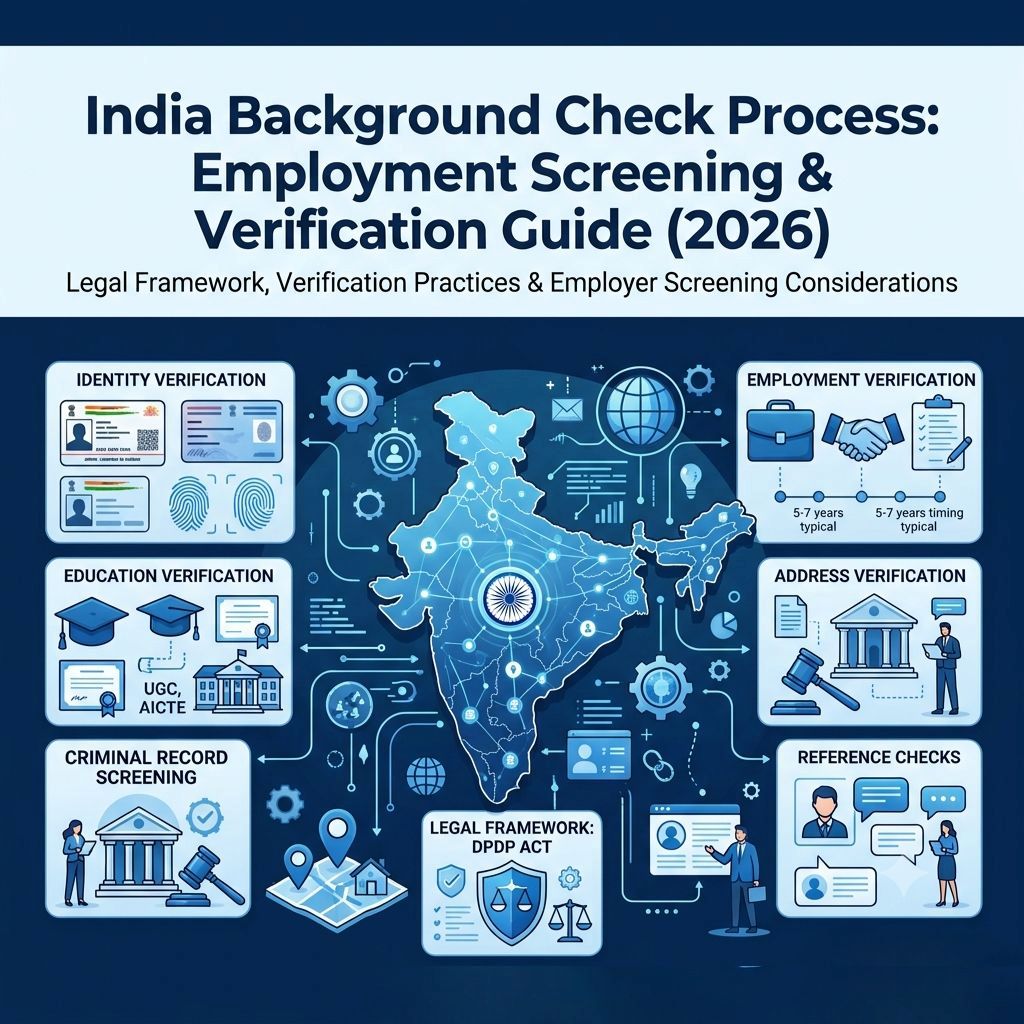
India Background Check Process: Employment Screening & Verification Guide (2026)
Legal Framework, Verification Practices & Employer Screening Considerations India is one of the largest and most complex employment markets in Asia, with high hiring volumes, diverse institutional practices, and a wide range of verification requirements. For employers, background screening in India requires a structured, scalable, and locally adapted approach.Executive Summary
Background screening is widely practiced in India and increasingly expected, particularly for multinational organizations, IT and technology companies, financial institutions, regulated industries, shared service centres, and global capability centres. However, screening must be conducted with careful consideration of evolving data protection regulations, variability in institutional verification processes, differences across states and institutions, proportionality standards, documentation requirements, and candidate participation. For regional employers, India screening should be aligned with a broader compliant background screening policy in Asia, supported by a clear background screening policy template for Asia-Pacific, and assessed against country-specific compliance guidance from eeCheck’s Asia background check compliance guide.Successful India background screening programs combine clear consent, role-based screening scope, multiple verification sources, local operational knowledge, and strong governance controls.
About This Guide
This guide was prepared by eeCheck, an Asia-focused background screening and workforce integrity specialist supporting more than 5,000 organizations across Asia. eeCheck conducts employment verification, education verification, criminal record screening, identity verification, directorship screening, and workforce integrity programs across Hong Kong, Singapore, China, India, Taiwan, Japan, South Korea, Indonesia, Malaysia, Vietnam and other jurisdictions.The guidance in this article is based on operational experience supporting India screening programs, multinational hiring initiatives, regulated industry requirements, and cross-border verification practices throughout Asia-Pacific.
What HR Leaders Need to Know
For organizations hiring in India, the most important considerations include candidate consent, education verification complexity, fragmented criminal record screening, address verification usage, institutional responsiveness, and the need to adapt global screening frameworks to local regulatory and operational requirements.| Key Consideration | Why It Matters |
|---|---|
| Candidate Consent | Consent should be properly documented before screening begins. |
| Education Verification | India’s large and diverse higher education landscape requires additional scrutiny. |
| Criminal Record Screening | Criminal record screening remains fragmented and may require multiple verification approaches. |
| Address Verification | Address verification remains more common in India than in many other Asian jurisdictions. |
| Verification Timelines | Timelines vary depending on institutional responsiveness and candidate participation. |
| Local Adaptation | Global screening frameworks should be adapted to India’s local regulatory and operational requirements. |
Key point: Organizations that understand India’s local verification realities are better positioned to build scalable, compliant, and reliable screening programs.
India Background Check – At a Glance
| Category | India Position |
|---|---|
| Legal Framework | Digital Personal Data Protection Act (DPDP Act) |
| Consent Required | Yes – explicit and purpose-based |
| Criminal Record Access | Limited and role-dependent |
| Employment Verification | Widely practiced |
| Education Verification | Common but variable |
| Credit Check | Available and role-dependent |
| Data Localization | Not mandatory but regulated |
| Cross-Border Data Transfer | Permitted with safeguards |
| Standard Coverage | 5–7 years typical |
| Typical Turnaround | 5–15 business days |
Why India Is Different From Other Asian Markets
India presents unique operational challenges compared with many other Asian jurisdictions. Its size, diversity, institutional landscape, and high hiring volumes often make screening more operationally complex than many other markets.| Area | India | Singapore | Hong Kong |
|---|---|---|---|
| Hiring Volume | Very high | Moderate | Moderate |
| Employer Verification Responsiveness | Variable | Moderate | Moderate |
| Education Verification Complexity | High | Moderate | Moderate |
| Address Verification Usage | Common | Limited | Limited |
| Criminal Record Structure | Fragmented | Structured | Structured |
| Candidate Participation Requirements | High | Moderate | Moderate |
| Language Diversity | High | Low | Low |
1. Legal Framework Governing Background Checks in India
Background screening in India is governed primarily by the Digital Personal Data Protection Act (DPDP Act). The DPDP Act establishes key principles including consent-based data processing, purpose limitation, data minimization, data security obligations, and accountability for data handling.| Compliance Principle | Employer Consideration |
|---|---|
| Consent-Based Processing | Obtain appropriate candidate consent before screening begins. |
| Purpose Limitation | Define why information is being collected and how it will be used. |
| Data Minimization | Collect only information necessary for the hiring purpose and role requirements. |
| Data Security | Apply appropriate security controls to protect candidate information. |
| Accountability | Maintain documentation, access controls, and audit trails. |
2. Consent Requirements in India
Consent is a critical requirement under the DPDP framework. Consent should clearly specify the scope of checks conducted, purpose of screening, data usage and retention, and cross-border data handling where applicable.| Consent Element | Why It Matters |
|---|---|
| Scope of Checks | Clarifies whether identity, employment, education, criminal, address, reference, or other checks will be conducted. |
| Purpose of Screening | Links the screening activity to legitimate hiring, compliance, or workforce integrity purposes. |
| Data Usage and Retention | Explains how information will be used, stored, accessed, and retained. |
| Cross-Border Handling | Important for multinational employers and regional screening programs. |
Key point: Broad or unclear consent structures may create compliance risk. Consent should be clear, purpose-based, and aligned with the screening scope.
3. Common Challenges in India Background Checks
Based on eeCheck’s operational experience supporting India screening programs, the most common challenges include information completeness during candidate data collection, education verification variability, and institutional response delays.Information Completeness During Candidate Data Collection
Background screening in India often requires a significant amount of information and supporting documentation to be collected from candidates before verification activities can commence. Incomplete or inaccurate information is one of the most common causes of delays, discrepancies, and unsuccessful verification outcomes.| Common Data Issue | Potential Impact |
|---|---|
| Incomplete Employment Histories | Omitted employers, missing dates, or inaccurate reporting structures may delay verification. |
| Underreported Residential Addresses | May affect address verification and criminal record screening processes. |
| Missing Education Documents | Missing certificates, marksheets, or transcripts may prevent timely education verification. |
| Name Variations | Differences across education records, employment records, passports, Aadhaar, PAN, or other documents may require clarification. |
| Previous or Alternate Names | Undisclosed alternate names may affect verification accuracy and matching. |
Education Verification Variability
India has thousands of universities, colleges, institutes, and training providers. Verification complexity may increase due to legacy records, multiple campuses, autonomous institutions, state-level institutions, and distance learning programs.Institutional Response Delays
Some institutions respond quickly through digital channels, while others may require manual processing, physical correspondence, local follow-up, or site visits. Employers should therefore set realistic expectations and avoid judging verification quality by speed alone. For broader regional guidance on turnaround expectations, see eeCheck’s turnaround time in Asia guide and optimize screening turnaround in Asia guide.4. India Background Check Process Flow
Given the scale of hiring in India, structured processes and documentation are essential.| Step | Action | Responsible Party |
|---|---|---|
| 1 | Role risk classification | Employer |
| 2 | Consent collection | Candidate |
| 3 | Document submission | Candidate |
| 4 | Verification initiation | Screening provider |
| 5 | Institutional outreach | Screening provider |
| 6 | Discrepancy review | HR / Compliance |
| 7 | Report issuance | Screening provider |
| 8 | Hiring decision documentation | Employer |
5. Core India Background Check Services
5.1 Identity Verification
Identity verification may include Aadhaar verification where lawfully permissible, PAN verification, passport validation, and government-issued identification review. Use of Aadhaar is regulated and must comply with applicable legal requirements.5.2 Employment Verification
Employment verification commonly verifies employment tenure, job title, organization, and reporting relationships where available. Employer responsiveness varies significantly, documentation may be required to support verification, and multiple data points are often used to validate employment history. For regional comparison, see eeCheck’s employment verification in Asia guide.5.3 Performance Reference Checks
Performance reference checks are conducted via candidate-provided referees and are common for mid-level professionals, management positions, and executive hires. Reference checks help supplement formal employment verification.5.4 Education Verification
Education verification remains one of the most important components of India background screening. It typically confirms institution attendance, degree authenticity, graduation status, and dates of study. Many institutions may require physical follow-up or site visits to expedite verification. Employers should also review institutional recognition and accreditation status where appropriate, and name variations between certificates, institutional records, passports, and government-issued identification should be carefully examined.Understanding Educational Accreditation in India
| Accreditation / Regulatory Body | Why It Matters |
|---|---|
| University Grants Commission (UGC) | Primary authority responsible for recognizing universities and degree-awarding institutions in India. |
| All India Council for Technical Education (AICTE) | Regulates many technical and professional education programs, including engineering, technology, management, and certain vocational programs. |
| National Assessment and Accreditation Council (NAAC) | Evaluates institutional quality and awards accreditation grades such as A++, A+, and A. |
| National Board of Accreditation (NBA) | Accredits specific academic programs, particularly within engineering and technical disciplines. |
Key point: Employers should not rely solely on whether a certificate was issued. A robust verification process should also consider institutional recognition, degree-awarding authority, and accreditation context where appropriate.
5.5 Criminal Record Checks
Criminal checks in India may include police verification where applicable, court record searches, address-based verification, and publicly available records. There is no single centralized national criminal database accessible for employers. For comparison with other markets, see eeCheck’s Hong Kong criminal record check guide and China background check process guide.5.6 Address Verification
Address verification remains more common in India than in many other Asian jurisdictions. It may confirm current residential address or previous residential address through documentary review, field verification, or local validation processes.5.7 Credit & Financial Checks
Credit and financial checks may be applied to finance roles, regulated positions, and senior management appointments. They require consent and should be justified by role requirements. For related regional guidance, see eeCheck’s financial background screening in Asia guide and Hong Kong credit reports in employment screening guide.5.8 Litigation & Public Records
Litigation and public record screening may include civil litigation, court case searches, and bankruptcy-related records. Coverage varies by jurisdiction and court system.5.9 Directorship & Corporate Checks
Corporate registry searches may identify directorships, company involvement, and corporate affiliations. These searches are particularly relevant for senior executives and regulated positions.Common India Background Check Mistakes
| Common Mistake | Better Approach |
|---|---|
| Assuming all educational institutions are equivalent | Assess recognition and accreditation separately from certificate authenticity. |
| Failing to review UGC or AICTE status | Review relevant recognition and approval status where applicable. |
| Relying on a single verification source | Use multiple verification sources where appropriate. |
| Underestimating candidate participation requirements | Collect required information and documents clearly at the start of the process. |
| Applying global templates without local adaptation | Adapt screening methodology to India’s regulatory and operational environment. |
| Not aligning India screening with regional or global programs | Maintain consistent screening objectives while adapting methods locally. |
Role-Based Screening Framework
Organizations should apply screening requirements based on role risk rather than using identical screening packages for every employee. For broader guidance, see eeCheck’s role-based background screening in Asia guide and risk-based background screening in Asia guide.| Role Type | Common Screening Components |
|---|---|
| Entry-Level Positions | Identity Verification, Employment Verification, Education Verification. |
| Professional Roles | Identity Verification, Employment Verification, Education Verification, Reference Checks. |
| Financial & Regulated Roles | Identity Verification, Employment Verification, Education Verification, Criminal Record Screening, Credit Checks, Litigation Searches, Sanctions Screening. |
| Senior Executives | Identity Verification, Employment Verification, Education Verification, Directorship Searches, Bankruptcy Searches, Litigation Searches, Enhanced References, Regulatory Screening. |
Turnaround Time Summary
| Check Type | Estimated Time |
|---|---|
| Identity Verification | 1–3 Business Days |
| Employment Verification | 5–10 Business Days |
| Reference Checks | 3–7 Business Days |
| Education Verification | 5–12 Business Days |
| Criminal Record Checks | 5–7 Business Days |
| Address Verification | 3–7 Business Days |
| Directorship Search | 1–3 Business Days |
| Litigation Search | 1–5 Business Days |
Data Protection & Governance Considerations
Employers should ensure proper consent and disclosure, secure handling of personal data, controlled access to information, defined retention policies, and compliance with cross-border transfer requirements.| Governance Area | Recommended Employer Approach |
|---|---|
| Consent and Disclosure | Use clear consent language explaining screening scope, purpose, and data handling. |
| Secure Handling | Apply appropriate technical and organizational controls to protect candidate information. |
| Controlled Access | Limit access to HR, compliance, and authorized decision-makers. |
| Retention Policy | Retain screening data only for appropriate periods and in line with policy requirements. |
| Cross-Border Transfers | Assess transfer requirements when using overseas providers or regional operations. |
Executive Oversight Checklist
Before implementing or reviewing a screening program, organizations should ask the following questions:| Oversight Question | Why It Matters |
|---|---|
| Is consent properly structured? | Supports lawful and transparent screening. |
| Is screening scope proportionate to role risk? | Reduces over-screening and supports role-based decision-making. |
| Are multiple verification sources being used? | Improves verification reliability in a fragmented environment. |
| Is institutional recognition being considered? | Supports more robust education verification and qualification assessment. |
| Are discrepancies reviewed consistently? | Promotes fairness, consistency, and defensible hiring decisions. |
| Is documentation sufficient for audit purposes? | Supports governance, compliance, and accountability. |
| Are India processes aligned with global screening standards? | Maintains consistency while adapting to local verification realities. |
Why Global Employers Work With eeCheck for India Screening
eeCheck supports organizations across Asia with localized background screening programs designed to balance compliance, verification accuracy, candidate experience, and operational scalability.| eeCheck Capability | Employer Value |
|---|---|
| India Employment Verification | Validates employment history across a complex and variable employer landscape. |
| India Education Verification | Supports qualification validation across India’s diverse education sector. |
| UGC and Institutional Validation Support | Helps employers understand institutional recognition and accreditation context. |
| Criminal Record Screening | Supports lawful and role-relevant criminal record screening where appropriate. |
| Identity Verification | Supports identity confirmation and documentation review. |
| Address Verification | Supports one of the most commonly used screening components in India. |
| Directorship Searches | Helps identify corporate affiliations and potential conflicts for senior or regulated roles. |
| Litigation Screening | Supports role-relevant public record review where appropriate. |
| Global Sanctions and PEP Screening | Supports regulated industry and workforce integrity requirements. |
| Cross-Border Verification Across Asia-Pacific | Supports regional hiring programs across Asia-Pacific markets. |
Asia Background Screening Perspective
As organizations continue expanding across Asia, screening programs are increasingly moving away from country-specific processes toward regionally aligned workforce integrity frameworks. India remains one of the most important hiring markets globally. However, successful screening programs require local expertise, structured verification workflows, and an understanding of India’s unique regulatory and operational environment. Organizations that can maintain consistent global hiring standards while adapting to India’s local verification realities are best positioned to manage workforce risk effectively. For a broader regional outlook, see eeCheck’s Asia background screening report, future of background checks in Asia, and AI background checks and automation risks guide.Frequently Asked Questions
Is background screening legal in India?
Yes. Background screening is generally permissible when conducted with appropriate consent and in compliance with applicable data protection requirements.
Is there a centralized criminal database available to employers?
No. Criminal record screening remains fragmented and often requires multiple verification approaches, such as court record searches, police verification where applicable, address-based checks, and public record review.
Is address verification common in India?
Yes. Address verification remains significantly more common in India than in many other Asian jurisdictions and may involve document review, field verification, or local validation processes.
Is education verification important in India?
Yes. Given the size and diversity of India’s educational landscape, education verification is a critical component of many screening programs. Employers may also need to consider institutional recognition and accreditation status.
Is India considered a complex screening market?
Yes. India’s scale, diversity, institutional structure, and verification landscape make it one of the most operationally complex screening environments in Asia.
Final Strategic Takeaway
India is one of the most important hiring markets globally, but it is also one of the most operationally complex verification environments in Asia. Successful screening programs require more than simply conducting checks. Organizations must combine regulatory compliance, candidate engagement, institutional validation, multiple-source verification, and risk-based decision-making. Employers that align local India verification practices with regional or global workforce integrity frameworks are better positioned to reduce hiring risk, improve compliance, and maintain consistent hiring standards across jurisdictions.As organizations continue expanding across Asia, India remains a critical component of any regional background screening strategy.
Recommended Approach
Organizations should:
✔ Structure consent clearly and transparently
✔ Apply risk-based screening methodologies
✔ Verify information through multiple authoritative sources
✔ Validate educational institutions and accreditation status where appropriate
✔ Maintain strong documentation and audit controls
✔ Align India screening programs with regional and global workforce integrity frameworks✔ Set realistic turnaround expectations based on verification complexity
India’s scale creates significant opportunities for employers, but effective workforce risk management requires local expertise, disciplined verification workflows, and a structured approach to compliance. 
