

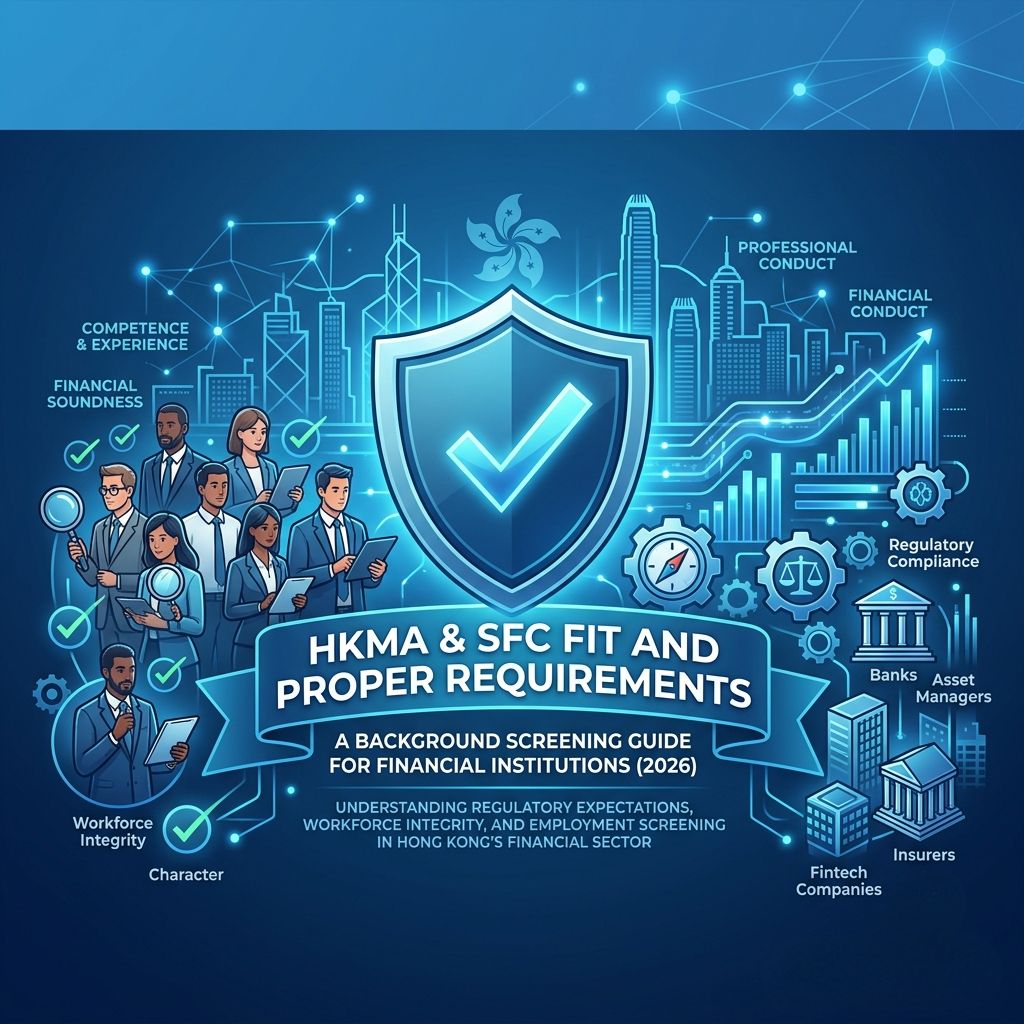
HKMA & SFC Fit and Proper Requirements: A Background Screening Guide for Financial Institutions (2026)
Understanding Regulatory Expectations, Workforce Integrity and Employment Screening in Hong Kong’s Financial Sector This guide is designed for banks, asset managers, securities firms, insurers, payment institutions, virtual asset firms, fintech companies, and other financial services employers operating in Hong Kong and across Asia-Pacific.Executive Summary
Hong Kong’s financial sector operates under some of Asia’s most stringent regulatory expectations regarding employee integrity, competence, financial soundness, and professional conduct. The Hong Kong Monetary Authority (HKMA) and Securities and Futures Commission (SFC) both place significant emphasis on whether individuals performing regulated, controlled, or risk-sensitive functions are “fit and proper”. While organizations often focus on licensing requirements and regulatory approvals, many underestimate the importance of implementing a robust workforce integrity and background screening framework to support fit and proper assessments. A well-designed screening program can help organizations identify potential risks before onboarding while supporting regulatory compliance, governance, and sound hiring practices.For broader regional planning, employers may also refer to eeCheck’s compliant background screening policy guide, Asia-Pacific background screening policy template, and Asia background check compliance guide.
About This Guide
This guide was prepared by eeCheck, an Asia-focused background screening and workforce integrity specialist supporting more than 5,000 organizations across Asia. eeCheck supports workforce integrity programs, fit and proper screening initiatives, and regulated hiring programs across Hong Kong, Singapore, China, Japan, South Korea, Taiwan, India, Indonesia, Malaysia, Vietnam and other major markets throughout Asia-Pacific.The guidance in this article is based on practical experience supporting banks, financial institutions, payment firms, fintech companies, asset managers, insurers, and regulated organizations throughout Asia.
What HR, Compliance and Risk Leaders Need to Know
For financial institutions, fit and proper assessments should not be viewed as a one-time regulatory exercise. Organizations should consider integrity, financial soundness, competence, professional conduct, regulatory history, employment history, and ongoing workforce risk.| Fit and Proper Area | Why It Matters |
|---|---|
| Integrity | Helps assess honesty, reliability, and professional conduct. |
| Financial Soundness | May be relevant for roles involving client assets, funds, financial controls, or fiduciary responsibilities. |
| Competence | Supports assessment of qualifications, experience, regulatory knowledge, and technical capability. |
| Professional Conduct | Helps identify conduct-related concerns, disciplinary history, or integrity-related issues. |
| Regulatory History | Important for licensed personnel, regulated functions, senior managers, and control roles. |
Key point: A fit and proper framework is most effective when supported by structured background screening, clear governance processes, and risk-based hiring controls.
What Does “Fit and Proper” Mean?
The concept of fit and proper generally refers to whether an individual possesses the necessary integrity, honesty, reputation, competence, capability, and financial soundness to perform a regulated or risk-sensitive role. The assessment is not based on a single factor. Regulators and employers typically consider the overall circumstances of the individual. A fit and proper assessment should therefore be holistic and risk-based rather than relying on any single screening result.Why Fit and Proper Assessments Matter
Fit and proper considerations have become increasingly important due to regulatory expectations, financial crime risks, market misconduct risks, insider threats, fraud risks, reputational risks, and increased regulatory scrutiny. For regulated financial institutions, workforce integrity has become a key component of risk management. Hiring decisions increasingly involve collaboration between Human Resources, Compliance, Risk Management, Legal, and Business Leadership.What Makes Hong Kong Different?
Compared with many jurisdictions, Hong Kong places significant emphasis on financial integrity, professional conduct, competence, and reputation when assessing individuals performing regulated functions.| Common Review Area | Typical Relevance in Hong Kong Financial Services |
|---|---|
| Employment History | Confirms career history and identifies material discrepancies. |
| Professional Qualifications | Supports competence and eligibility assessments. |
| Credit Reports | May support financial soundness reviews for relevant roles. |
| Bankruptcy Records | Relevant for finance, fiduciary, senior, and regulated positions. |
| Directorship Records | Helps identify governance risks and potential conflicts of interest. |
| Litigation Records | May provide context for risk, governance, and financial integrity review. |
| Regulatory Findings | Highly relevant for licensed or regulated roles. |
Understanding the Key Elements of Fit and Proper Assessments
Financial Status and Financial Soundness
Financial institutions may consider whether there are circumstances that could raise concerns regarding an individual’s financial soundness or ability to discharge their responsibilities appropriately.| Potential Indicator | Context for Review |
|---|---|
| Bankruptcy Records | May be relevant where the role involves financial control, fiduciary duties, or regulated responsibilities. |
| Credit Report Findings | Should be assessed in context rather than treated as a pass-or-fail indicator. |
| Significant Outstanding Judgments | May indicate circumstances requiring further review depending on severity and role relevance. |
| Serious Financial Distress Indicators | Should be reviewed alongside timing, remediation, explanation, and role sensitivity. |
Qualifications, Competence and Experience
Fit and proper assessments commonly consider whether an individual possesses the appropriate academic qualifications, professional qualifications, industry experience, regulatory knowledge, and technical competence. Education verification and employment verification are frequently used to validate information relied upon during hiring, licensing, and regulatory assessment processes. For broader regional context, see eeCheck’s employment verification in Asia guide.Honesty, Integrity and Professional Conduct
Financial institutions may consider factors relevant to an individual’s integrity and professional conduct, including employment history discrepancies, misrepresentation of qualifications, regulatory disciplinary actions, professional sanctions, and serious misconduct findings.Key point: Integrity concerns may arise from a pattern of behaviour, omissions, inaccuracies, or conduct that calls into question an individual’s honesty or reliability.
Reputation, Character, Reliability and Financial Integrity
Organizations may also consider whether there are factors that could be relevant to an individual’s reputation, reliability, or financial integrity. These may include regulatory findings, public disciplinary actions, directorship records, litigation history, bankruptcy-related matters, or credit report findings. The relevance of any finding should be assessed in the context of the role, surrounding circumstances, and overall risk profile.The Role of Background Screening in Fit and Proper Assessments
Background screening helps organizations assess whether there are indicators that may be relevant to an individual’s suitability for a role. Screening does not determine whether an individual is fit and proper. Rather, it provides information that may assist organizations in conducting a risk-based assessment. The objective is not to eliminate all risk, but to identify relevant information that supports informed hiring decisions. For a wider governance perspective, see eeCheck’s risk-based background screening guide and role-based background screening guide.Common Screening Components Supporting Fit and Proper Assessments
| Screening Component | Fit and Proper Relevance |
|---|---|
| Identity Verification | Establishes the foundation of the screening process and supports identity fraud prevention. |
| Employment Verification | Confirms employment dates, job titles, previous employers, and material employment history information. |
| Education Verification | Validates qualifications that may support competence and eligibility assessments. |
| Reference Checks | May provide additional context on conduct, performance, leadership, and workplace behaviour. |
| Criminal Record Screening | May identify relevant criminal history where legally available and proportionate. |
| Credit Report Review | Supports financial soundness review when relevant to the role. |
| Bankruptcy Searches | May be relevant for fiduciary, finance, senior management, or regulated roles. |
| Directorship Searches | May identify conflicts of interest, corporate affiliations, and governance concerns. |
| Litigation Searches | May identify publicly available records relevant to role risk, governance, or conduct concerns. |
| Regulatory Screening | Supports review of public disciplinary actions, enforcement actions, licensing issues, and public sanctions. |
Identity Verification
Identity verification establishes the foundation of the screening process. Typical objectives include confirming identity, validating personal information, detecting identity fraud, and supporting regulatory compliance.Employment Verification
Employment verification remains one of the most important components of fit and proper assessments. Verification may include employment dates, job titles, reporting lines, and previous employers. Particular attention should be paid to unexplained employment gaps, material discrepancies, and misrepresentation of employment history. For broader regional challenges, see eeCheck’s guide on why fast turnaround time does not always mean accurate screening.Education Verification
Education verification helps confirm qualification authenticity, attendance, graduation status, and professional credentials where applicable. This is particularly important where qualifications are relied upon to demonstrate competence or eligibility for regulated functions.Reference Checks
Reference checks may provide additional insight regarding professional conduct, workplace behaviour, integrity-related concerns, performance observations, leadership capabilities, and interpersonal and communication skills. While reference checks remain common within financial services, practices vary between organizations, business lines, and role types. Many financial institutions place greater reliance on independently verifiable information obtained through employment verification, regulatory screening, and HKMA Mandatory Reference Checking processes where applicable.Criminal Record Screening
Criminal record screening may assist organizations in identifying relevant criminal convictions or records where legally available. Organizations should ensure criminal screening remains proportionate and compliant with applicable legal requirements. For comparison, see eeCheck’s Hong Kong criminal record check guide and China background check process guide.Credit Report Review
Credit reports are frequently used within financial services screening programs. However, employers should avoid relying solely on a credit score or rating. A credit report should be assessed in context.| Credit Report Area | Why Context Matters |
|---|---|
| Significant Overdue Payments | May require review of severity, timing, explanation, and role relevance. |
| Debt Collection Activity | May indicate financial stress but should not be interpreted in isolation. |
| Defaults | May be relevant where the role involves sensitive financial duties. |
| Bankruptcy-Related Matters | Often more relevant for fiduciary or regulated roles than low credit ratings alone. |
| Financial Distress Indicators | Should be assessed with remediation efforts, current circumstances, and role risk. |
Key point: A credit report is generally one component of a broader financial soundness assessment rather than a standalone hiring decision tool.
Bankruptcy Searches
Bankruptcy records may be relevant when assessing financial soundness, fiduciary responsibilities, and regulatory expectations. Particular relevance may exist for individuals with authority over client assets, corporate funds, investment decisions, or financial controls.Directorship Searches
Directorship reviews may help identify current directorships, potential conflicts of interest, and governance concerns. This is particularly relevant for senior management and regulated personnel.Litigation Searches
Civil litigation screening may identify publicly available litigation records. Organizations should assess the nature of the litigation, relevance to the role, outcome of proceedings, and materiality of findings. Not all litigation has equal significance, and context remains critical.Regulatory Screening
Regulatory screening may include review of public disciplinary actions, regulatory enforcement actions, licensing issues, public sanctions, and professional disciplinary findings. This area is often highly relevant for regulated roles.Financial Soundness Does Not Mean Financial Perfection
One of the most common mistakes organizations make is assuming that any financial difficulty automatically indicates an individual is not fit and proper. In practice, fit and proper assessments are generally more nuanced.| Review Factor | How Employers Should Assess It |
|---|---|
| Nature of the Issue | Understand what happened and whether it is relevant to the role. |
| Severity | Differentiate minor, historical, or technical issues from serious concerns. |
| Timing | Consider whether the matter is recent, historical, resolved, or ongoing. |
| Remediation Efforts | Assess whether the individual has taken steps to address the issue. |
| Role Relevance | Focus on whether the finding is relevant to the responsibilities and risk exposure of the role. |
| Overall Circumstances | Review the whole case rather than relying on isolated findings. |
Key point: The objective should be to understand the facts rather than rely solely on isolated findings.
Common Employer Mistakes
Organizations frequently encounter avoidable issues when designing fit and proper screening programs.| Common Mistake | Better Approach |
|---|---|
| Treating screening as a pass-or-fail exercise | Use risk-based and contextual assessment. |
| Over-reliance on credit reports | Assess credit findings as part of a broader financial soundness review. |
| Focusing only on financial soundness | Also consider competence, qualifications, integrity, conduct, and reputation. |
| Conducting the same screening for every role | Apply role-based screening based on risk and responsibilities. |
| Failing to validate qualifications and employment histories | Independently verify information relied upon for hiring or licensing decisions. |
| Failing to document hiring decisions | Maintain clear records supporting decisions and risk assessments. |
| Viewing fit and proper assessments as a one-time exercise | Manage workforce integrity throughout the employee lifecycle. |
Role-Based Screening Framework
Different roles carry different levels of risk. A role-based screening framework helps financial institutions align screening depth with role responsibilities, regulatory expectations, and potential exposure.| Role Type | Common Screening Components |
|---|---|
| Entry-Level Roles | Identity Verification, Employment Verification, Education Verification. |
| Licensed and Regulated Personnel | Identity Verification, Employment Verification, Education Verification, Criminal Record Screening, Regulatory Screening, Reference Checks where appropriate, and additional screening based on role requirements. |
| Senior Management | Identity Verification, Employment Verification, Education Verification, Credit Report Review, Bankruptcy Search, Directorship Search, Litigation Search, Regulatory Screening, and Reference Checks where appropriate. |
Fit and Proper Assessments and HKMA MRC
As the Hong Kong Monetary Authority’s Mandatory Reference Checking (MRC) framework continues to evolve, financial institutions are increasingly adopting more structured workforce integrity frameworks. Organizations should view fit and proper assessments, reference checking, and background screening as complementary components of a broader risk management strategy.| Program Element | How It Supports Workforce Integrity |
|---|---|
| Employment Verification | Confirms the accuracy of employment history relied upon during assessment. |
| Education Verification | Supports review of qualifications and competence. |
| Reference Checks | Provides supplementary conduct and performance context where appropriate. |
| Background Screening | Identifies relevant integrity, financial soundness, litigation, and regulatory risk indicators. |
| Regulatory Review | Supports assessment of licensing, sanctions, disciplinary history, and enforcement exposure. |
| HKMA MRC Processes Where Applicable | Complements broader screening by supporting conduct-related due diligence for covered roles. |
| Risk-Based Assessment | Ensures findings are reviewed proportionately and in context. |
| Governance Controls | Supports consistent decision-making, documentation, audit readiness, and accountability. |
Why Leading Financial Institutions Work with eeCheck
eeCheck supports workforce integrity and fit and proper screening programs across Asia. We support banks, securities firms, asset managers, insurers, payment institutions, fintech companies, virtual asset businesses, and regulated organizations throughout Asia-Pacific.| eeCheck Capability | Employer Value |
|---|---|
| Employment Verification | Supports verification of work history, titles, employment dates, and potential discrepancies. |
| Education Verification | Validates academic credentials and qualifications relied upon for role suitability. |
| Criminal Record Screening | Supports lawful and proportionate review of criminal history where available. |
| Credit Report Reviews | Provides context for financial soundness assessments in relevant roles. |
| Bankruptcy Searches | Supports fiduciary, senior management, and finance-related assessments. |
| Directorship Searches | Identifies potential conflicts, corporate affiliations, and governance risks. |
| Litigation Screening | Helps organizations review publicly available litigation information in context. |
| Regulatory Screening | Supports review of public disciplinary, enforcement, licensing, and sanctions-related information. |
| Reference Checks | Provides additional context for senior, regulated, or high-risk roles where appropriate. |
| Cross-Border Verification Programs | Supports financial institutions hiring across Hong Kong, Singapore, China, Taiwan, Japan, South Korea, India, Indonesia, Malaysia, Vietnam and other Asia-Pacific markets. |
Asia Workforce Integrity Perspective
Financial institutions across Asia are increasingly moving beyond traditional background checks toward comprehensive workforce integrity frameworks. Leading organizations now evaluate financial soundness, regulatory compliance, qualifications and competence, professional conduct, reputation, governance risks, and employment integrity as part of a broader risk management strategy. Hong Kong remains one of the most mature markets in Asia for fit and proper assessments, making workforce integrity screening an increasingly important component of regulatory and hiring practices. For additional country guidance, see eeCheck’s Singapore background checks guide, Taiwan background checks guide, Japan background check guide, Vietnam background checks guide, and Indonesia background checks guide.Frequently Asked Questions
What are HKMA and SFC fit and proper requirements?
Fit and proper requirements generally assess whether an individual has the integrity, competence, capability, reputation, and financial soundness required to perform a regulated or risk-sensitive role. The assessment is usually holistic and considers the overall circumstances of the individual.
Does background screening determine whether someone is fit and proper?
No. Background screening does not decide whether an individual is fit and proper. It provides verified information and relevant risk indicators that support a structured, risk-based assessment by the financial institution.
Are credit reports commonly used in Hong Kong financial services screening?
Yes. Credit reports are commonly used for financial services roles where financial soundness may be relevant. However, employers should avoid relying solely on a credit score or rating and should assess the full report in context.
What checks may support fit and proper assessments?
Common checks may include identity verification, employment verification, education verification, reference checks, criminal record screening, credit report review, bankruptcy searches, directorship searches, litigation screening, and regulatory screening depending on the role.
Should every employee receive the same level of screening?
No. Financial institutions should use a role-based and risk-based approach. Entry-level roles, regulated personnel, and senior management positions usually require different levels of screening based on risk exposure and regulatory expectations.
How does HKMA MRC relate to background screening?
HKMA Mandatory Reference Checking processes and background screening should be viewed as complementary components of a broader workforce integrity framework. Together, they help financial institutions assess conduct, employment history, regulatory risk, and overall suitability.
Final Strategic Takeaway
Fit and proper assessments are not about identifying perfect candidates. They are about understanding relevant risks and making informed, balanced, and defensible decisions. The most effective financial institutions do not rely on a single screening component. Instead, they evaluate qualifications, competence, experience, integrity, reputation, financial soundness, employment history, professional conduct, and regulatory considerations through a structured and risk-based assessment process. Background screening, employment verification, education verification, reference checks, credit report reviews, bankruptcy searches, directorship reviews, litigation screening, and regulatory screening may each contribute to different aspects of a fit and proper assessment depending on the nature of the role and the institution’s risk framework.As regulatory expectations continue to evolve across Asia, organizations that adopt documented, proportionate, and risk-based screening programs will be better positioned to strengthen governance, reduce hiring risk, and support long-term regulatory compliance.

