

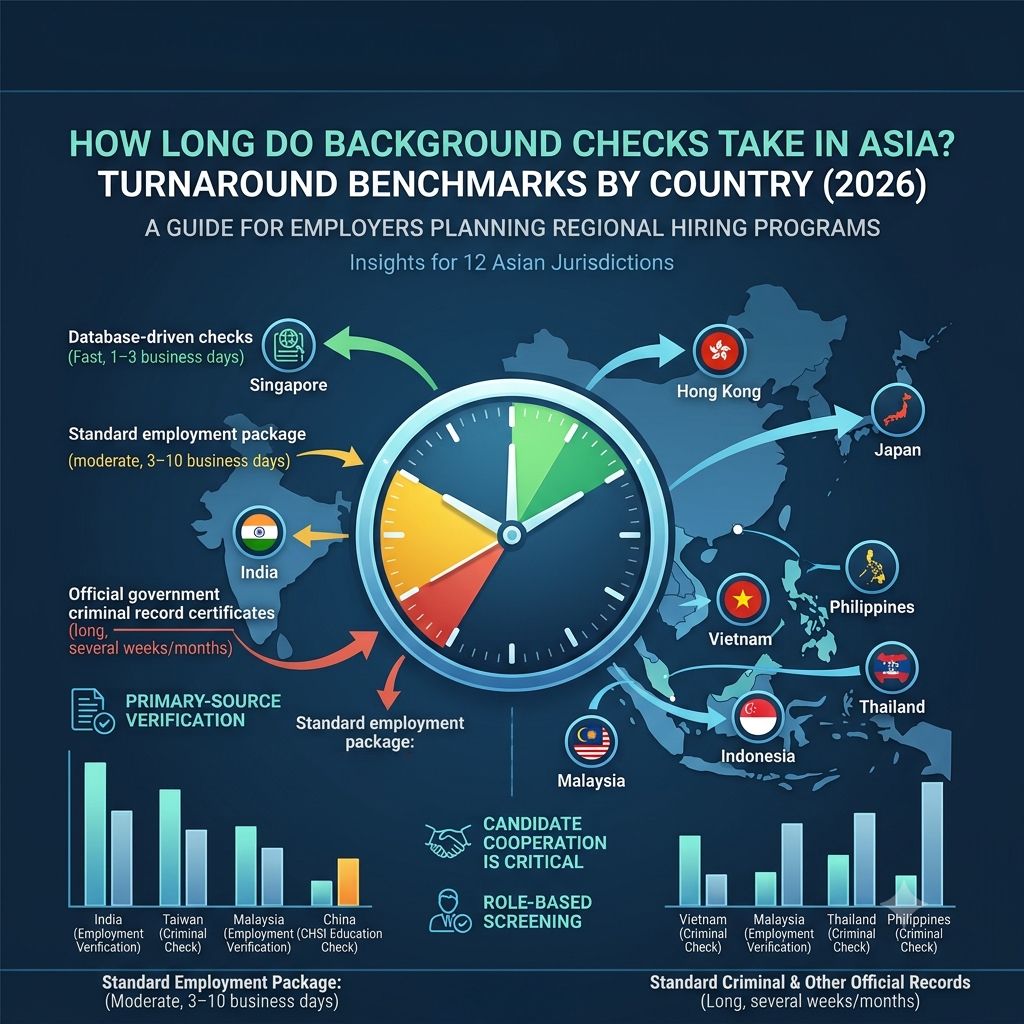
How Long Do Background Checks Take in Asia? Turnaround Benchmarks by Country (2026)
eeCheck’s annual benchmark of employment background check turnaround across 12 Asian jurisdictions, providing practical timelines for employers planning regional hiring programmes.
Published: 7 August 2026 | Last Updated: 7 August 2026
At a Glance
Most standard employment background checks across Asia are completed within 3–10 business days, assuming candidates provide complete documentation and institutions respond within their normal processing timeframes.
| Check Type | Typical Turnaround |
|---|---|
| Database-driven checks | 1–3 business days |
| Employment verification | 3–10 business days |
| Education verification | 3–10 business days |
| Standard employment screening package | 3–10 business days |
| Official government-issued criminal record certificates | Several days to several months, depending on the jurisdiction |
Practical Insight: In many Asian jurisdictions, employers manage turnaround by using court and litigation record searches, where legally appropriate, as part of routine employment screening rather than relying solely on official government-issued criminal record certificates.
Executive Summary
One of the first questions employers ask when implementing employment screening across Asia is: “How long will the background check take?”
The answer is rarely straightforward. Turnaround depends on the jurisdiction, verification components requested, government processing requirements, institutional responsiveness, privacy regulations and candidate cooperation.
As a practical 2026 benchmark, a standard employment background screening package in Asia typically completes within 3–10 business days, while database-driven searches often complete within 1–3 business days.
Many database-driven searches—including sanctions screening, global watchlists, adverse media searches, company directorship searches and identity verification—can often be completed within 1–3 business days, giving employers an early view of significant integrity and compliance risks while more complex verifications continue in parallel.
By contrast, primary-source verification—such as confirming employment directly with previous employers, verifying qualifications with educational institutions or obtaining official criminal record certificates—depends on third-party organisations and government authorities. These checks naturally require more time and, in some jurisdictions, may extend the overall turnaround to several weeks.
Understanding these differences is essential for setting realistic hiring expectations. The objective should not simply be to complete screening as quickly as possible, but to balance speed, verification depth and regulatory compliance according to the role’s level of risk.
This guide provides 2026 turnaround benchmarks across twelve Asian jurisdictions, explains why timelines differ between markets, and outlines practical strategies employers can use to reduce avoidable delays while maintaining robust due diligence.
See eeCheck’s Turnaround Time in Asia: Why “Fast” Is Not Always Accurate, Risk-Based Background Screening in Asia and Role-Based Background Screening in Asia.
Key Takeaways
| Key Finding | What It Means for Employers |
|---|---|
| Most standard checks complete in 3–10 business days | This assumes complete candidate documents and normal institutional response times. |
| Database checks often complete in 1–3 business days | Sanctions, watchlists, adverse media and identity checks can provide early risk visibility. |
| Official certificates may take much longer | Some government-issued criminal record certificates take several weeks or months. |
| Turnaround varies by market and method | Jurisdictional rules and institutional responsiveness matter more than provider branding. |
| Candidate cooperation is critical | Delayed consent or missing documents often cause the largest controllable delay. |
| Country-specific SLAs work best | Regional employers should avoid imposing one universal turnaround target. |
What Does “Background Check Turnaround Time” Actually Mean?
Background check turnaround time refers to the period from receiving completed candidate consent, obtaining all required supporting documents and initiating the verification process through to delivery of the completed screening report.
It does not include the period before the candidate returns consent forms or required documentation. In practice, this administrative stage often accounts for a significant proportion of the overall hiring timeline.
| Screening Component | Typical Dependency |
|---|---|
| Identity verification | Candidate documents and verification technology |
| Employment verification | Previous employer response |
| Education verification | University or awarding-body response |
| Professional licence verification | Regulator response |
| Criminal record searches | Court, police or authorised government process |
| Litigation and civil court searches | Court database or official source |
| Directorship and company affiliation searches | Corporate registries |
| Sanctions and watchlist screening | Structured databases |
| Adverse media screening | Public-source and media databases |
| Regulatory and financial integrity checks | Regulators and jurisdiction-specific sources |
eeCheck Insight
Employment verification, education verification, criminal record searches and regulatory checks each operate under different service models. The overall turnaround is determined by the verification requiring the longest processing time—not the fastest.
eeCheck Asia Background Check Turnaround Benchmarks (2026)
The following benchmarks provide indicative turnaround ranges for standard employment screening programmes across 12 Asian jurisdictions.
Methodology
The benchmarks are based on operational experience from more than 100,000 completed background checks conducted across 12 Asian jurisdictions during the previous 12 months. They combine observed operational turnaround with jurisdiction-specific legal requirements, verification workflows and institutional response patterns.
| Market | Employment & Education Verification | Criminal / Official Record Checks | Typical Overall Package |
|---|---|---|---|
| Singapore | Employment 5–10 business days; education 3–7 | 3–7 business days, subject to official processing (employer access is restricted) | 3–10 business days |
| Hong Kong | 3–10 business days | Limited employer access; the CNCC takes about 4 weeks and is issued only for visa or immigration purposes | 3–10 business days |
| China | Education 1–3 business days through official databases such as CHSI; employment 3–7 | 3–7 business days through compliant official channels; no direct employer access to police records | 3–10 business days |
| Taiwan | 2–6 business days | 3–5 business days for a police criminal record certificate | 3–10 business days |
| Japan | Employment 4–10 business days | Criminal record access is highly restricted; official certificates are available only for limited purposes | 7–14 business days |
| South Korea | 3–7 business days | Highly restricted; employer access is limited by the PIPA | 3–7 business days |
| India | Employment 2–7 business days; education 3–15 | 3–7 business days for court record searches | 7–15 business days |
| Philippines | Employment 5–10 business days; education 3–10 | NBI clearance 3–10 business days; additional processing may be required where records need review | 3–10 business days |
| Vietnam | Employment 5–10 business days; education 3–7 | Judicial Record Certificate 3–7 business days; candidate-initiated steps may extend this | 5–12 business days |
| Thailand | 3–8 business days | Police Clearance Certificate about 7–10 days for local applicants; 2–4 weeks for many foreign applicants | 7–15 business days |
| Malaysia | 2–6 business days | Court and civil litigation searches 3–7 business days; the Certificate of Good Conduct may take 30–90 days and is rarely required for routine employment screening | 3–10 business days |
| Indonesia | 3–8 business days | SKCK generally issued within 1–3 days locally; overseas and cross-regional applications may take longer | 5–10 business days |
For country-specific details, refer to eeCheck’s Singapore Background Checks Guide, Hong Kong Background Check Guide, China Background Check Process, Taiwan Background Checks Guide and Japan Background Check Guide.
Database Searches vs. Primary-Source Verification
One of the most important distinctions employers should understand is the difference between database-driven screening and primary-source verification.
| Verification Model | Examples | Typical Turnaround | Primary Limitation |
|---|---|---|---|
| Database-driven screening | Sanctions, watchlists, PEP, adverse media, directorships, identity and selected litigation databases | Often 1–3 business days | May not replace direct primary-source verification |
| Primary-source verification | Employment, education, professional licences and official certificates | Usually several days or longer | Controlled by employers, universities, regulators or government agencies |
eeCheck Insight
Running database searches and primary-source verification simultaneously allows organisations to identify significant integrity risks early while official verifications continue in parallel.
Turnaround Should Be Measured by Verification Quality, Not Just Speed
Employers should be cautious of providers advertising “24-hour background checks,” as these timelines often refer only to database-driven searches rather than comprehensive primary-source verification.
The better question is not simply which provider is fastest, but which provider delivers reliable, verified results within realistic turnaround times. Related reading: Turnaround Time in Asia: Why “Fast” Is Not Always Accurate.
Why Background Check Turnaround Times Differ Across Asia
No two Asian jurisdictions operate under the same employment screening framework.
Although employers often compare turnaround times between providers, the reality is that most delays originate outside the screening provider’s control. Government authorities, universities, former employers and regulators ultimately determine how quickly information can be verified.
Understanding these structural differences enables organisations to set realistic hiring expectations and design more effective recruitment timelines.
1. Government Processing Is Structural, Not Operational
The single largest contributor to turnaround differences across Asia is government-controlled processing.
Official criminal record certificates, judicial records and certain regulatory confirmations are issued directly by government authorities. Their processing times are determined by legislation, internal procedures and administrative workload—not by the screening provider.
Examples:
- Court and litigation searches are commonly used for employment screening and can usually be completed within a few business days.
- Malaysia’s Certificate of Good Conduct is used for specific purposes such as immigration, visas or certain regulatory requirements and is not the standard criminal screening method for most employers because of its longer processing time.
- Taiwan Police Criminal Record Certificates are often issued within 3–5 business days.
- Hong Kong’s Certificate of No Criminal Conviction is available only for limited immigration or visa purposes rather than routine employment screening.
- Japan and South Korea significantly restrict employer access to criminal record information.
eeCheck Insight
Employers sometimes assume that selecting a different screening provider will significantly reduce turnaround. In reality, provider efficiency primarily affects case management, communication and follow-up. Government-issued documents continue to follow the same statutory processing timelines regardless of who submits or manages the request.
2. Institutional Responsiveness Varies More Than Many Employers Expect
Employment and education verification depends almost entirely on the responsiveness of third-party organisations.
Some multinational employers maintain dedicated HR verification teams capable of responding within one or two business days. Others require requests to pass through multiple departments before confirmation is provided.
Educational institutions show similar variation. Many universities now operate online verification platforms or dedicated verification offices, while others rely on archived records, manual processing or faculty-level approval, particularly for older qualifications.
Examples:
- One university may respond within 24 hours.
- Another institution in the same city may require two weeks.
- A previous employer with a centralised HR verification team may respond quickly, while a smaller employer may need management approval before confirming details.
eeCheck Insight
Based on our operational experience across Asia, turnaround is often influenced more by the responsiveness of individual employers or educational institutions than by the country itself. Two organisations located only a few kilometres apart may differ by more than a week in their verification response time.
3. Privacy Laws Shape Verification Workflows
Asia has experienced significant regulatory development in data protection over recent years.
Jurisdictions including Singapore under the PDPA, Hong Kong under the PDPO, China under the PIPL, Japan under the APPI and South Korea under the PIPA impose legal obligations regarding the collection, processing and disclosure of personal information.
Examples of common requirements:
- Obtaining explicit candidate consent.
- Limiting disclosure to authorised parties.
- Verifying requester identity.
- Retaining evidence of consent.
- Restricting cross-border transfers of personal data.
eeCheck Insight
Faster is not always better. A verification completed unusually quickly may indicate that fewer primary sources were consulted rather than that the process was more efficient. Responsible employment screening balances operational efficiency with regulatory compliance and verification quality.
For more information, see Asia Background Check Compliance and Compliant Background Screening Policy in Asia.
4. Candidate Cooperation Remains the Largest Controllable Delay
While government processing and institutional response are largely outside an employer’s control, candidate cooperation is not.
Most screening programmes cannot begin until candidates have signed consent forms, submitted identification documents, provided employment history, supplied qualification details and completed any country-specific requirements.
Examples of additional candidate participation:
- Attending fingerprint appointments.
- Applying personally for official police certificates.
- Obtaining notarised documentation.
- Authorising universities to release academic records.
eeCheck Insight
Across many Asia-wide screening programmes, the period between issuing consent documents and receiving complete candidate information often exceeds the time required to perform the actual verification. Employers that integrate consent collection into the offer process frequently shorten overall hiring timelines without changing any verification methodology.
5. Cross-Border Careers Increase Verification Complexity
Modern professionals increasingly build careers across multiple jurisdictions.
Example: A single candidate may have studied in Malaysia, worked in Singapore, held previous employment in Japan, served as a director of a Hong Kong company and relocated from Australia.
Each jurisdiction introduces different legal requirements, privacy obligations, verification procedures, language considerations and response timelines. Rather than one background check, employers are effectively managing several independent verification processes simultaneously. The overall turnaround therefore follows the slowest jurisdiction involved.
eeCheck Insight
Cross-border recruitment should be viewed as a coordinated regional project rather than a single verification exercise. Employers should identify every relevant jurisdiction at the start of the process and set expectations according to the longest likely verification component.
Employers managing regional programmes may also find eeCheck’s MNC Background Screening in Asia and Asia Background Check Guide useful.
How Employers Can Reduce Background Check Turnaround Time
Although official processing cannot be accelerated, employers can significantly reduce avoidable delays through better planning.
| Best Practice | Why It Matters |
|---|---|
| Initiate screening immediately after offer acceptance | Allows verification to run during notice periods and onboarding preparation rather than afterwards. |
| Collect consent with the offer package | Eliminates one of the most common administrative delays. |
| Request complete supporting documents upfront | Prevents repeated candidate follow-up later in the process. |
| Identify long-lead verifications early | Enables official certificates to begin immediately while other checks continue in parallel. |
| Apply role-based screening | Avoids unnecessary deep screening for lower-risk positions while maintaining appropriate due diligence for sensitive roles. |
| Use country-specific service expectations | Reflects actual regulatory differences instead of relying on unrealistic regional averages. |
See also How to Optimise Screening Turnaround in Asia.
Adopt a Risk-Based Screening Strategy
One of the most effective ways to maintain recruitment momentum is to separate high-priority screening components from longer-running official verifications.
Many employers complete identity verification, sanctions screening, adverse media screening, employment verification and education verification before a candidate’s start date. Longer official certificates may continue in parallel where organisational policy, applicable laws and the role’s risk profile permit.
The level of screening should always reflect the risks associated with the position. Applying the same screening package to every employee often increases turnaround without proportionately improving risk management.
eeCheck Insight
The fastest organisations are not necessarily those with the quickest screening providers. They are typically the organisations that integrate background screening into recruitment planning, collect complete documentation early and align screening depth with business risk rather than applying identical checks to every role.
Related guidance: Risk-Based Background Screening in Asia and Role-Based Employment Screening Framework.
Provider Speed Should Be Evaluated Holistically
When comparing screening providers, turnaround should never be assessed in isolation.
| Evaluation Area | Why It Matters |
|---|---|
| Primary-source verification capability | Shows whether results are directly verified rather than database-only. |
| Jurisdictional expertise | Supports compliant local workflows and realistic timelines. |
| Regulatory compliance | Protects candidate privacy and reduces legal risk. |
| Quality assurance | Helps ensure accuracy and consistency. |
| Communication during delays | Allows employers to manage hiring decisions proactively. |
| Report clarity | Makes results easier for HR and compliance teams to assess. |
| Regional operational coverage | Supports candidates with cross-border histories. |
Employers reviewing providers may refer to Background Screening Vendor Questions in Asia, In-House vs Outsourced Screening in Asia and Choosing a Top Background Check Firm in Asia.
Frequently Asked Questions
How long does a standard background check take in Asia?
A standard package typically takes 3–10 business days, assuming candidates submit complete documentation promptly and institutions respond within normal processing timeframes.
Which Asian countries have the fastest background check turnaround?
Singapore, Hong Kong, Taiwan, South Korea and Malaysia are generally among the faster markets for standard employment screening, although individual cases still vary.
Which background check components usually take the longest?
Official government-issued criminal record certificates, archived education records and slow employer responses are often the longest components.
Why is my background check taking longer than expected?
Common causes include incomplete candidate documentation, delayed consent, slow responses from former employers or universities, government queues, public holidays, cross-border requirements and discrepancy review.
Can employers speed up government processing?
No. Government authorities determine their own statutory timelines. Employers can only reduce avoidable delays by initiating screening early and collecting complete documents upfront.
Should employees start work before every background check is complete?
This depends on organisational risk appetite, internal policy and applicable law. Many employers use a risk-based approach, allowing lower-risk components to continue in parallel where appropriate.
Are database searches sufficient on their own?
Usually not. Database screening is valuable for early risk visibility but normally should be combined with primary-source employment, education and other role-specific verification.
Do background checks take longer for international candidates?
Yes. International candidates often require separate verification activities across several jurisdictions, and the slowest component determines the overall turnaround.
Final Strategic Takeaway
There is no universal turnaround time for employment background screening across Asia.
For most employers, a standard package completes within 3–10 business days, while database-driven integrity checks are often completed within 1–3 business days.
The most successful organisations begin screening early, collect complete documentation, align verification depth with role risk, understand jurisdictional differences and balance speed with verification quality.
Background screening should ultimately support confident hiring decisions—not merely fast hiring decisions.
Why Employers Across Asia Work With eeCheck
Employment screening across Asia requires more than simply collecting information. It requires understanding how verification systems differ between jurisdictions, how privacy laws affect workflows and how multiple components can be coordinated efficiently.
| eeCheck Capability | How It Supports Employers |
|---|---|
| Primary-source employment and education verification | Supports accurate confirmation of candidate history. |
| Identity verification | Helps establish candidate identity and document authenticity. |
| Criminal and litigation searches | Supports role-appropriate checks where legally available. |
| Sanctions, watchlist and adverse media screening | Provides early visibility into integrity and compliance risks. |
| Professional licence and regulatory verification | Supports regulated and higher-risk roles. |
| Risk-based programme design | Aligns screening depth with role and business risk. |
| Country-specific guidance | Helps employers navigate jurisdictional differences across Asia. |
Continue Your Asia Background Screening Guide
Regional Guides
| Guide | Internal Link |
|---|---|
| The Ultimate Guide to Background Checks in Asia | Read guide |
| Background Check Compliance in Asia | Read guide |
| Risk-Based Background Screening in Asia | Read guide |
| Role-Based Employment Screening Framework | Read guide |
| Why Background Checks Fail in Asia | Read guide |
| Employment Verification Across Asia | Read guide |
| Financial Background Screening in Asia | Read guide |
| Asia Background Screening Executive Briefing | Read guide |
Country Guides
| Country Guide | Internal Link |
|---|---|
| Singapore Background Checks | Read guide |
| Hong Kong Background Checks | Read guide |
| China Background Check Guide | Read guide |
| Taiwan Background Check Guide | Read guide |
| Japan Background Check Guide | Read guide |
| South Korea Background Check Guide | Read guide |
| India Background Check Guide | Read guide |
| Philippines Background Check Guide | Read guide |
| Vietnam Background Check Guide | Read guide |
| Thailand Background Check Guide | Read guide |
| Malaysia Background Check Guide | Read guide |
| Indonesia Background Check Guide | Read guide |

