

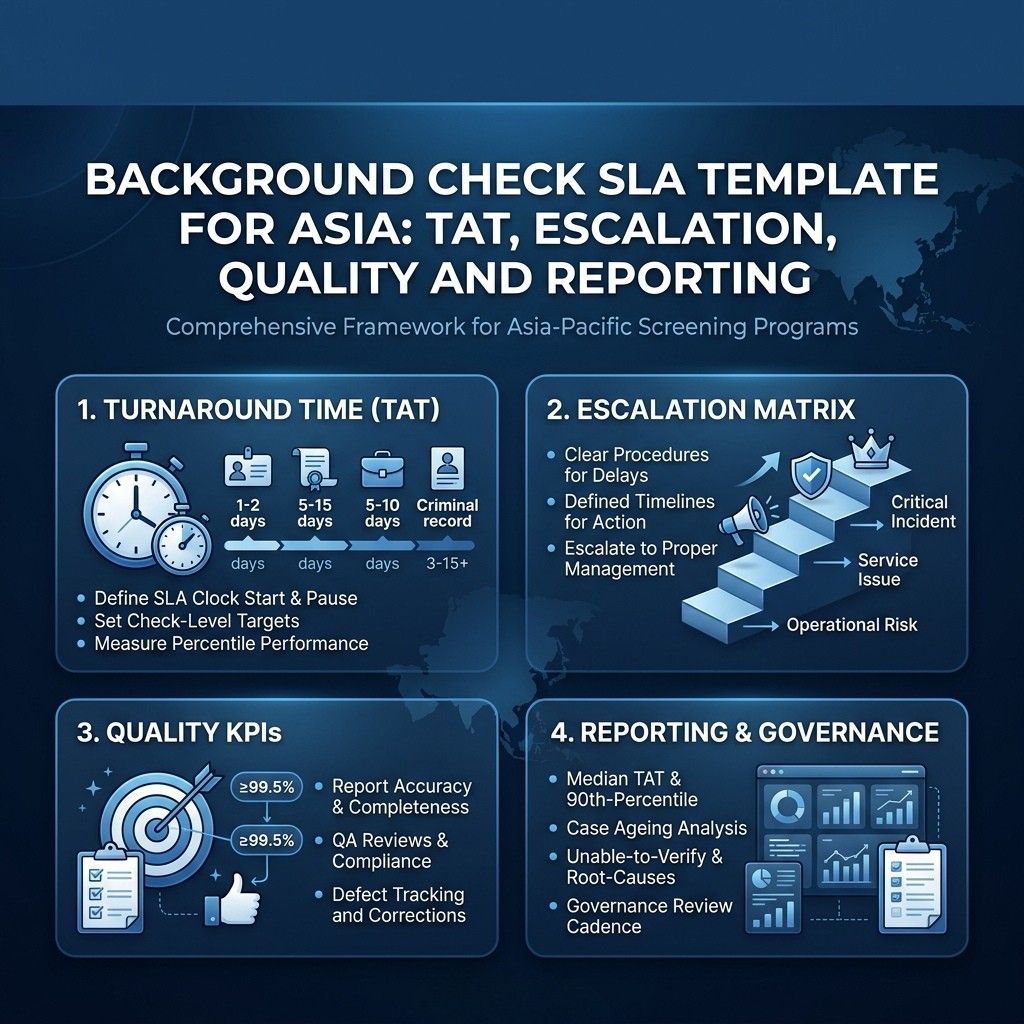
Background Check SLA Template for Asia: TAT, Escalation, Quality and Reporting
Published: 1 September 2026 | Last updated: 1 September 2026
A background check service-level agreement should do more than state that checks will be completed in “five working days.” Across Asia, completion times can depend on employers, universities, government authorities, courts, databases, public holidays, language requirements, institutional fees and candidate responsiveness.
A screening provider may control how quickly it initiates, follows up, quality-checks and reports a case, but it cannot always control when a third-party source responds. A useful SLA therefore separates provider-controlled actions from external dependencies, defines when the TAT clock starts and pauses, sets escalation and follow-up rules, measures quality and requires meaningful management reporting.
Executive Summary
A strong background screening SLA for Asia should define exactly what is being measured. It should distinguish case initiation, report issuance and successful verification; set check-level turnaround targets rather than one blanket case-wide promise; document clock-pause rules; define source follow-up and closure standards; and require clear escalation when cases age beyond target.
Speed should never be measured in isolation. Quality KPIs such as report accuracy, completeness, correction timeliness and required QA should sit alongside TAT attainment. Monthly reporting should show median and 90th-percentile TAT, open-case ageing, pause reasons, unable-to-verify rates, defects, incidents and corrective actions.
The figures in this guide are illustrative procurement benchmarks rather than guaranteed service times for every jurisdiction. Final SLAs should be validated against the exact country, check type, source, service method and screening depth.
For wider programme design, see eeCheck’s Compliant Background Screening Policy in Asia, Background Screening Policy Template for Asia-Pacific, Risk-Based Background Screening in Asia and Asia Background Check Compliance.
What Should a Background Screening SLA Cover?
| Area | What the SLA Should Define |
|---|---|
| Scope | Which countries, candidate populations and check types are included. |
| Turnaround time | How TAT is calculated and what counts as complete. |
| Dependencies | Missing information, candidate action and third-party response times. |
| Escalation | When and how delayed, sensitive or disputed cases are escalated. |
| Quality | How accuracy, completeness, corrections and quality assurance are measured. |
| Reporting | The operational and management information supplied to the employer. |
Security, privacy, incident management, business continuity, subcontracting, retention and deletion are also important, but these may sit in the master services agreement, data-processing agreement or security schedule rather than the operational SLA.
1. Define the SLA Terminology First
Many screening disputes result from unclear definitions rather than poor service. The following terms can be incorporated directly into an SLA.
| Term | Recommended Definition |
|---|---|
| Case | A screening order for one candidate, containing one or more checks. |
| Check | An individual screening component, such as employment, education, criminal-record or sanctions screening. |
| Business day | A normal working day for the delivery team and, where relevant, the verification source. The applicable time zone and treatment of public holidays should be stated. |
| SLA start time | The time at which the provider has received the order, required information, applicable documents and confirmation of the lawful basis or candidate authorisation required to begin. |
| Turnaround time (TAT) | The number of business days from SLA start time to completion, excluding documented clock-pause periods. |
| Completed check | A check for which the required search or verification steps have been completed and the result has passed the provider’s quality process. |
| Unable to verify / closed inconclusive | The prescribed attempts have been completed, but the source could not confirm or refute the information. This is a completion status, not a positive verification. |
| Interim report | A report showing completed results and checks still in progress. |
| Final report | The report issued when all checks are completed or closed under the agreed closure rules. |
| Clock pause | A documented period excluded from measured TAT because an agreed dependency prevents progress. |
| External dependency | A candidate, employer, institution, authority, court, data source or other third party whose action is required to progress a check. |
Do Not Confuse These Three Events
- Case initiation: the provider has started work.
- Report issuance: an interim or final report has been delivered.
- Successful verification: the source has affirmatively confirmed the information.
A check may be properly completed as “unable to verify” after all agreed attempts have been exhausted. Providers should not be encouraged to label an inconclusive result as verified merely to meet a completion KPI.
2. Use Check-Level TAT Instead of One Case-Wide Promise
A case may combine an instant sanctions search with an employment verification requiring several follow-ups. Applying one TAT to the entire package hides the real source of delay. A better approach is to set targets by check type and separately measure the percentage of complete cases delivered within the expected package TAT.
| Check Type | Illustrative Standard Target* | Common Dependencies |
|---|---|---|
| Identity / document validation | 1–2 business days | Document quality, name mismatch, liveness or resubmission. |
| Sanctions, watchlist and PEP screening | 1–2 business days | Potential-match review, DOB data, transliteration and common names. |
| Adverse media | 2–5 business days | Search scope, languages, source review and identity resolution. |
| Criminal-record check | 3–15+ business days | Jurisdiction, authority process, fingerprints, attendance or certificate issuance. |
| Bankruptcy / insolvency search | 2–5 business days | Record accessibility, identifiers and local search process. |
| Civil litigation / court-record search | 3–10+ business days | Court coverage, manual retrieval, common names and archives. |
| Directorship / company search | 2–5 business days | Registry access, identifiers and historic records. |
| Employment verification | 5–10+ business days | Former-employer response, HR contact, archives and authorisation. |
| Education verification | 5–15+ business days | Institution response, holidays, archives, fees and consent. |
| Professional qualification | 3–10+ business days | Licensing-body process and record availability. |
| Professional reference | 5–10+ business days | Referee availability and candidate-approved contact details. |
| Credit check, where legally appropriate | 2–5 business days | Permitted purpose, consent, bureau process and identity matching. |
*These are illustrative procurement benchmarks, not guaranteed eeCheck service times for every jurisdiction.
For current regional timing context, see Asia Background Check Turnaround Benchmarks and Turnaround Time in Asia: Why “Fast” Is Not Always Accurate.
Recommended TAT Commitment Wording
The Provider shall use commercially reasonable efforts to complete each Check within the applicable Target TAT in Schedule 1. Target TAT is measured from the SLA Start Time and excludes approved Clock-Pause periods. TAT is a service target and does not guarantee that an external source will respond, that a record will be available, or that a Check will produce a positive verification outcome.
For stronger accountability, consider adding a percentile commitment such as: At least [90–95%] of eligible Checks shall be completed within the applicable Target TAT during each measurement month, excluding agreed exclusions and Clock-Pause periods.
3. Specify Exactly When the Clock Starts and Pauses
The SLA clock should start only after the provider has received a valid order, candidate identifiers and history, legible supporting documents, required authorisation, country-specific forms and clarification of any obvious inconsistency preventing the check from starting.
| Permitted Clock-Pause Event | Example |
|---|---|
| Missing candidate information | Required document, identifier or consent is outstanding. |
| Candidate action required | The candidate must attend an appointment or complete an authority process. |
| Client clarification required | The client must clarify scope or supplied information. |
| Additional form / fee approval | An employer, university or authority requests an extra form or charge. |
| Source closure | Public holiday, institutional break or exceptional disruption. |
| Client hold | The client asks the provider to suspend the case. |
| Other agreed dependency | Another expressly agreed event prevents progress. |
Every clock pause should record the reason, start date and time, required action, responsible party, notification sent and resume date and time. Avoid blanket exclusions for “third-party delay”; the provider should still remain responsible for timely initiation, follow-up, status updates and escalation.
4. Set Follow-Up and Closure Rules
Without defined follow-up rules, a case can remain “in progress” indefinitely. For employment, education and professional-reference checks, the parties may agree that the provider will make first contact within one business day, perform 8–12 reasonable attempts, use different channels where appropriate, validate independently obtained contacts where required, assess alternative routes and close only after the agreed attempt standard is met.
| Case Age | Recommended Action |
|---|---|
| 50% of target TAT consumed | Internal review of progress and dependencies. |
| Target TAT reached | Client status notice, delay reason and next action. |
| 2 business days beyond target | Operational escalation and alternative-route review. |
| 5 business days beyond target | Management escalation with recovery plan. |
| Agreed maximum age reached | Client decision: continue, close inconclusive or amend scope. |
5. Build an Escalation Matrix That Reflects Risk
| Level | Trigger Examples | Provider Response | Client Update |
|---|---|---|---|
| Level 1: Routine operational | Missing document, ordinary source delay, minor clarification | Case owner investigates and records next action. | Within 1 business day or through agreed case updates. |
| Level 2: SLA risk | Target TAT reached, repeated non-response, volume backlog | Team leader reviews recovery plan and alternative route. | Within 1 business day of escalation. |
| Level 3: Material service issue | Significant backlog, repeated quality defect, high-priority hire at risk, systemic integration issue | Service manager leads remediation and root-cause review. | Promptly; initial update within [4–8] business hours. |
| Level 4: Critical | Suspected data incident, material unauthorised disclosure, major outage, integrity concern | Activate incident or business-continuity process and senior governance. | According to incident schedule and applicable law. |
The contract should identify named roles and communication channels, not only individuals. Roles such as Account Manager, Operations Manager, Data Protection Officer and Executive Sponsor remain usable even when personnel change.
6. Measure Quality, Not Only Speed
| Metric | Definition | Illustrative Target |
|---|---|---|
| Report accuracy | Reports without a provider-caused material factual or transcription error. | ≥99.5% |
| Report completeness | Reports containing all required checks, statuses, source details and applicable notes. | ≥99.5% |
| On-time initiation | Eligible checks initiated within the agreed initiation period. | ≥95% |
| TAT attainment | Eligible checks completed within target TAT. | 90–95% |
| Quality-review compliance | Required QA completed with evidence of review. | 100% |
| Correction timeliness | Confirmed provider-caused errors corrected within the applicable severity target. | ≥95% |
| Client-query response | Operational enquiries acknowledged or substantively answered within target. | ≥95% |
A “material error” should be defined, and the SLA should distinguish provider error, source error, candidate/client input error and new information. These categories should not be used to avoid accountability.
Correction Severity Example
| Severity | Example | Target Action |
|---|---|---|
| Critical | Result associated with the wrong individual; sensitive data disclosed to an unauthorised recipient. | Immediate containment and incident escalation. |
| High | Material result omitted or materially misreported. | Acknowledge promptly; corrected report targeted within 1 business day. |
| Medium | Non-material factual or formatting issue that may affect interpretation. | Correct within 2 business days. |
| Low | Cosmetic issue with no effect on the result. | Correct in the next agreed release or within 3–5 business days. |
7. Require Transparent Status and Outcome Reporting
Each check should show case and check reference, candidate identifier, country, check type, order date, SLA start date, current status, last action, current dependency, clock status, target completion date, next action, completion date, outcome classification and whether an interim or final report has been issued.
Status labels should be defined. “Pending” alone is insufficient. More useful statuses include pending candidate, pending client, pending source, under provider review, quality review, completed and closed unable to verify.
Monthly Service Report
| Reporting Area | Recommended Information |
|---|---|
| Volumes | Orders and completed checks by country and check type. |
| TAT | Median TAT, 90th-percentile TAT and percentage completed within target. |
| Ageing | Open-case ageing bands and long-running exceptions. |
| Pauses | Clock-pause volume and reasons. |
| Outcomes | Unable-to-verify rate and main causes. |
| Dependencies | Candidate response delays and source-response performance. |
| Quality | Corrections, defects, complaints, disputes and material incidents. |
| Improvement | Root-cause analysis, corrective actions, upcoming holidays and capacity forecast. |
Report both the median and a tail measure such as the 90th percentile. The median shows typical experience; the 90th percentile reveals long-running cases that an average can conceal.
8. Add Governance and Review Cadence
| Meeting | Suggested Frequency | Purpose |
|---|---|---|
| Operational review | Weekly during implementation or high-volume periods; otherwise as agreed | Review urgent and aged cases, dependencies and upcoming demand. |
| Service review | Monthly | Review KPI performance, quality, complaints and corrective actions. |
| Governance review | Quarterly | Review trends, scope, countries, capacity, risk and improvement roadmap. |
| Formal SLA review | Annually or after material scope change | Recalibrate targets, exclusions, methodology and reporting. |
9. Treat Service Credits Carefully
Service credits can be appropriate for sustained provider-controlled failures, but they should not encourage rushed or incomplete screening. A balanced model should apply only after a reasonable measurement volume, exclude documented client/candidate and uncontrollable third-party delays, still hold the provider accountable for initiation and follow-up, focus on repeated or material underperformance, cap credits reasonably and preserve separate remedies for privacy, security or serious misconduct.
Quality and data protection should never be traded for speed.
Copy-and-Adapt Background Screening SLA Schedule
| Section | Suggested Wording / Requirement |
|---|---|
| A. Service objective | The Provider shall perform the Screening Services in accordance with the agreed scope, documented methodology, applicable law and the service levels in this Schedule, prioritising accuracy, lawful processing and fair reporting alongside timely delivery. |
| B. Measurement period | Service levels shall be measured monthly in the time zone of [insert time zone]. A minimum of [insert volume] eligible Checks per metric is required before a percentage-based service level is applied. |
| C. Turnaround time | Target TAT shall be measured in Business Days from SLA Start Time until completion and applicable quality review, excluding approved Clock-Pause periods. |
| D. Initiation and missing information | The Provider shall review new orders within [one Business Day] and notify the Client or candidate of materially missing information. |
| E. Follow-up standard | For source-dependent verification, the Provider shall make [8–12] reasonable contact attempts across [the agreed period] unless the source has prescribed a different process. |
| F. Delays and clock pauses | When Target TAT is reached without completion, the Provider shall state the reason, last action, responsible dependency, next action and expected update date. |
| G. Quality | Report Accuracy ≥[99.5%], Report Completeness ≥[99.5%], TAT Attainment ≥[90–95%] and mandatory quality reviews at [100%]. |
| H. Reporting | Provide [weekly case-ageing reports] and a [monthly service report] with volumes, TAT, ageing, pauses, inconclusive outcomes, defects, incidents and corrective actions. |
| I. Escalation | Operational, SLA-risk, material and critical issues shall follow the agreed escalation matrix. |
| J. Continuous improvement | For material or repeated misses, provide a corrective-action plan containing owner, action, due date and effectiveness check. |
| K. Exclusions | Excluded time and events shall be limited to documented circumstances specified in the Schedule. |
Asia-Specific Considerations When Finalising the SLA
- different consent, notification and permitted-purpose requirements;
- restrictions affecting criminal, credit, medical and other sensitive checks;
- cross-border transfer and data-location requirements;
- local-language and transliteration searches;
- common-name identification and limited identifiers;
- national, regional and institution-specific holidays;
- authority, court and university processing methods;
- whether candidates must apply personally for certificates;
- archive availability for older employment or education records;
- mandatory institutional or government fees; and
- local rules on candidate access, correction, retention and deletion.
For country-specific context, see eeCheck’s Singapore Background Checks Guide, Hong Kong Background Check Guide, China Background Check Process, Thailand Background Checks Guide and Malaysia Background Check Guide.
eeCheck Operational Perspective
In regional background screening, the fastest check is not always the best predictor of full-case completion. Database checks can often be completed relatively quickly, while direct employment and education verifications depend on third-party response.
| Employer-Side Practice | Why It Helps |
|---|---|
| Order checks as early as lawfully permitted | Creates more time for source-dependent verification. |
| Collect complete names, dates and documents upfront | Reduces avoidable clock pauses. |
| Tell candidates promptly when action is required | Reduces candidate-caused delay. |
| Distinguish delayed source from provider inactivity | Makes accountability clearer. |
| Review aged checks by check type and country | Highlights structural bottlenecks. |
| Use interim reports only where policy permits | Supports risk-based decision-making without misrepresenting completion. |
eeCheck generally recommends agreeing the TAT methodology before agreeing the headline number. A well-designed SLA makes delays visible, assigns ownership and protects report quality. A poorly designed SLA simply rewards premature closure.
Related reading: ATS Background Check Integration Workbook, Adverse Media & Sanctions Screening in Asia, In-House vs Outsourced Screening in Asia and Background Screening Vendor Questions in Asia.
Frequently Asked Questions
What is a reasonable SLA for a background check in Asia?
There is no single reasonable TAT for every check. Database-based searches may take one to several business days, while direct employment, education, court or authority checks may take considerably longer. Set targets by country and check type, supported by clock-pause and escalation rules.
Should weekends and public holidays count toward TAT?
Normally, TAT is measured in business days. The SLA should state the governing time zone and explain how local public holidays and source closures are handled.
Can TAT pause while waiting for a candidate?
Yes, if candidate action is genuinely required and the provider records the pause, required action and notification. The provider should still be measured on how quickly it identifies and communicates the requirement.
Does “completed” mean the information was verified?
Not necessarily. A check can be completed with a verified, discrepant, clear, potential-match, no-record-located or unable-to-verify outcome, depending on the check. Status and outcome should be reported separately.
Should the SLA use average TAT?
Average TAT alone is insufficient. Use the percentage completed within target, median TAT, 90th-percentile TAT and open-case ageing.
Who should own the screening SLA internally?
Procurement may own the contract, but operational governance usually requires HR or talent acquisition, compliance, privacy, information security and the screening provider. For regulated or high-risk roles, legal and risk stakeholders may also participate.
Final Strategic Takeaway
A strong background check SLA for Asia does not promise that every university, employer, court or authority will respond within the same number of days. It defines the actions the provider must control: prompt initiation, diligent follow-up, accurate reporting, transparent status updates, quality assurance and timely escalation.
The best SLA is therefore not simply the shortest. It is the one that gives the employer reliable visibility, protects candidates, maintains report integrity and makes responsibility clear when a check cannot progress as expected.
For broader programme governance, see eeCheck’s Asia Background Check Guide, Asia Background Screening Executive Briefing and Choosing a Top Background Check Firm in Asia.
Need help benchmarking an Asia background screening SLA? eeCheck supports multi-country screening programmes across Asia, including service design, country-specific workflows, operational reporting and integration requirements.
About This Guide
Prepared by:
eeCheck Research & Editorial Team
Operationally reviewed by:
Cora Chang, Manager, Internal Audit & Operational Assurance, eeCheck
Last reviewed:
August 2026
Methodology:
Based on eeCheck’s operational experience delivering background screening
across Asian markets, combined with review of official privacy-regulator
guidance. Illustrative targets should be validated against the agreed country,
check type, source and scope.
Limitations:
TAT varies by jurisdiction, source accessibility, candidate responsiveness,
public holidays and case complexity. This article provides operational guidance
and does not constitute legal advice.

