

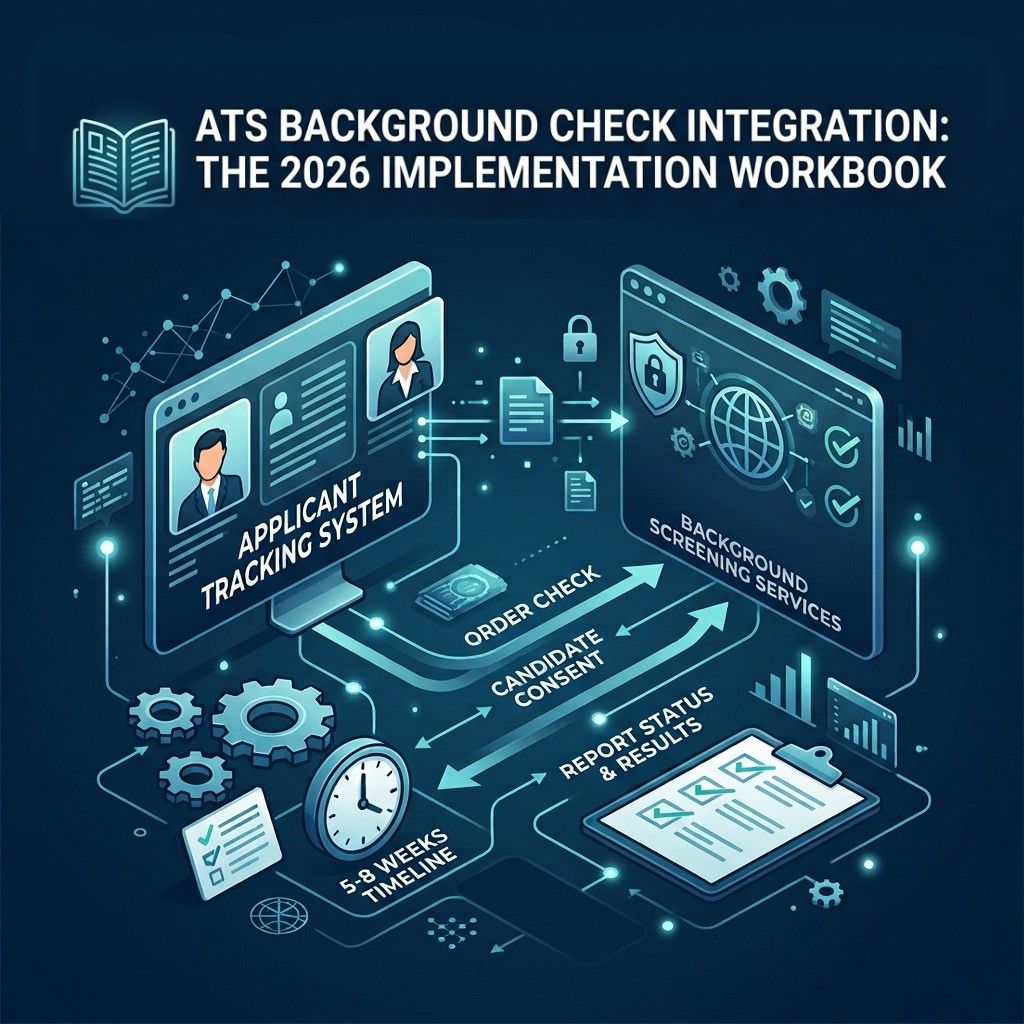
ATS Background Check Integration: The 2026 Implementation Workbook
Published: 21 August 2026 | Last Updated: 21 August 2026
Your recruiters already live in your ATS. So why are they leaving it a dozen times a day to chase background checks — exporting candidate details, re-keying data into a vendor portal, and refreshing their inbox for status updates?
If that sounds familiar, you’re running screening the manual way. This workbook covers when an ATS–background check integration is worth building, exactly how the integrated workflow runs, a realistic 5–8 week implementation timeline, and the tips that separate smooth go-lives from never-ending IT projects — drawn from eeCheck’s integrations with ATS platforms including Workday, SAP SuccessFactors, Greenhouse and Lark.
Executive Summary
Integrating background checks into an Applicant Tracking System can reduce manual administration, improve data accuracy and give recruiters better visibility over screening status without forcing them to leave the systems they already use.
The strongest business case typically exists where organisations make 300+ hires per year, hire across multiple countries, have multiple recruiters ordering checks, or already experience duplicate orders, re-keying errors and poor screening visibility.
A realistic implementation generally takes 5–8 weeks, covering scope definition, API implementation, user acceptance testing and go-live. The most successful projects keep version one focused on the minimum viable workflow, minimise unnecessary data transfer and maintain an offline fallback for exceptions and outages.
For broader programme design, see eeCheck’s Compliant Background Screening Policy in Asia, Background Screening Policy Template for Asia-Pacific, Role-Based Background Screening in Asia and Risk-Based Background Screening in Asia.
Why Integrate Background Checks Into Your ATS?
| Reason | Practical Benefit |
|---|---|
| Save Time | No more copying candidate data between systems or logging into a separate screening portal. A check is triggered from the same ATS workflow where the recruiter moves a candidate to offer. |
| Reduce Errors & Increase Efficiency | Manual re-entry is where typos, missed candidates and duplicated orders happen. Integration transfers structured data once and consistently. |
| Create a Seamless Experience | Recruiters can order checks, monitor progress and access final reports within the ATS, while candidates complete consent and document submission through the screening provider. |
Is Integration Right for Your Firm?
Integration is a project, not a plug-in, so hiring volume and operational complexity should justify the investment.
| Your Situation | Fit |
|---|---|
| 1,000+ annual hires | Ideal — the ROI case is usually clear. |
| 300+ annual hires | Sufficient — particularly where hiring is recurring or distributed. |
| Hiring across multiple countries with many recruiters | Strong fit — consistency and visibility matter most here. |
| Already using an ATS, or implementing a new one | Ready — a new ATS rollout is an efficient time to build screening into the workflow. |
Below roughly 300 hires a year, a well-run manual process with a responsive screening partner is usually the better investment.
Decision Checklist: Should You Integrate?
| Checklist | Status |
|---|---|
| We make 300+ hires per year (1,000+ makes this a clear yes) | ☐ |
| We hire in multiple countries | ☐ |
| Multiple recruiters order background checks, not one coordinator | ☐ |
| We already use an ATS, or are implementing a new one | ☐ |
| Recruiters currently re-key candidate data into a separate screening portal | ☐ |
| We have had errors, duplicated orders or delays caused by the manual handoff | ☐ |
| Hiring managers ask for better visibility on screening status | ☐ |
| We have, or our vendor provides, technical resources for a 5–8 week project | ☐ |
How to read your score: 6–8 boxes — integrate; the ROI case is clear. 4–5 — likely worth it; validate against check volume per recruiter. 3 or fewer — optimise the manual process first and revisit when volume grows.
How the Integrated Workflow Runs
| Step | Workflow |
|---|---|
| 1 | Recruiter sends the candidate from the ATS with one click at the relevant stage — no exports, no forms. |
| 2 | The background check provider handles consent and data collection directly with the candidate. |
| 3 | Status updates and the completed report push back to the ATS candidate record. |
| 4 | The recruiter is notified automatically when the case is complete or action is required. |
| 5 | Users view everything in the ATS as the central system of record. |
Notice what the recruiter actually does: step one. Everything else is automated or managed by the screening provider.
Before You Start: Pre-Project Checklist
Scope & Stakeholders
| Checklist Item | Status |
|---|---|
| Countries, check types and candidate volumes agreed and documented | ☐ |
| RACI matrix drafted | ☐ |
| Executive sponsor identified for sign-offs and blockers | ☐ |
| Out-of-scope-for-v1 list agreed | ☐ |
Technical
| Checklist Item | Status |
|---|---|
| ATS API documentation and sandbox access secured | ☐ |
| Integration flow chosen: ATS native API, screening provider API or custom | ☐ |
| Data fields mapped and trimmed to the minimum required | ☐ |
| Decision made on who collects candidate consent and documents | ☐ |
Compliance & Operations
| Checklist Item | Status |
|---|---|
| Privacy/legal review of the data flow completed | ☐ |
| UAT scenarios and test candidates prepared | ☐ |
| Training material owner assigned | ☐ |
| Offline fallback process defined | ☐ |
| Go-live criteria agreed | ☐ |
For regional compliance planning, see eeCheck’s Asia Background Check Compliance Guide and MNC Background Screening in Asia.
The Implementation Timeline: 5–8 Weeks
| Phase | Duration | What Happens |
|---|---|---|
| Scope Definition & Approval | 1–2 weeks | Agree checks, countries, data fields, flows and sign-off. |
| API Implementation | 2–4 weeks | Build and connect — typically the longest and most variable phase. |
| UAT & Changes | 1–2 weeks | Test realistic scenarios and fix issues surfaced through testing. |
| Training & Go-Live | 1 week | User training, production deployment and live testing. |
Real-world benchmark: a fast-growing global technology client making 1,000+ hires a year across multiple countries and dozens of recruiters went live with eeCheck in six weeks. A tightly agreed week-one scope and MVP-first build kept the project on the fast end of the range.
After Go-Live
| Recommendation | Why It Matters |
|---|---|
| Regroup weekly for the first 2–3 weeks | Early issues are easier to resolve when reviewed quickly. |
| Schedule a review 3–4 months after implementation | Assess performance and identify improvements or additional features. |
| Keep an offline process available | Provide a fallback for outages, edge cases and non-standard candidates. |
Five Tips for a Smooth Implementation
| Tip | Implementation Guidance |
|---|---|
| Minimise data transfer | Send only what the check requires. Less data means lower privacy risk, simpler compliance and a cleaner build. |
| Focus on the MVP | Launch the core flow first; add features later. |
| Set an achievable timeline | Use clear project-management principles and a RACI matrix. |
| Take scope definition seriously | The first stage often determines whether this is a six-week project or a never-ending build. |
| Do not shortcut UAT and training | Testing with real scenarios and proper training turns a technically live integration into one recruiters actually use. |
Six Questions to Ask Any Screening Vendor Before You Integrate
| Question | Why It Matters |
|---|---|
| Is your API production-ready today, or built per project? | A production-ready API reduces implementation risk. |
| Which ATS platforms have you already integrated with? | Proven implementation patterns reduce uncertainty. |
| Can you work with our ATS’s native API as well as your own? | Flexibility can reduce build time. |
| Who collects candidate consent and documents? | A well-designed flow can keep sensitive data out of the ATS. |
| What does your UAT process look like, and who writes the training material? | Clarifies whether operational implementation support is included. |
| What is the fallback when the integration is unavailable? | Every integration should have an offline contingency process. |
For broader vendor evaluation, see eeCheck’s Background Screening Vendor Questions for Asia, In-House vs Outsourced Screening in Asia and Choosing a Top Background Check Firm in Asia.
Integrating With eeCheck
| eeCheck Capability | How It Supports Integration |
|---|---|
| REST API | Documented and production-tested — no waiting on a build. |
| Proven ATS Experience | Integrations delivered with Workday, SAP SuccessFactors, Greenhouse and Lark. |
| Flexible Integration Flows | Can work through the ATS native API, eeCheck API or a customised workflow. |
| Broad Technical Compatibility | Support extends beyond REST to technologies including SOAP for legacy or enterprise systems. |
| Regional Screening Coverage | Supports multi-country hiring and cross-border screening across Asia-Pacific. |
| Governance & Compliance | Supports structured consent, secure data handling and consistent regional workflows. |
Related reading: Asia Background Check Guide, Asia Background Check Turnaround Benchmarks, AI Background Checks & Automation Risks, and Future of Background Checks in Asia.
Frequently Asked Questions
How long does an ATS background check integration take?
Typically 5–8 weeks: 1–2 weeks for scope definition, 2–4 weeks for API implementation, 1–2 weeks for UAT and 1 week for training and go-live.
What hiring volume justifies an ATS integration?
1,000+ annual hires is ideal; 300+ is sufficient, especially for teams hiring across multiple countries with many recruiters.
Does candidate data have to pass through the ATS?
No. In a well-designed flow, the screening provider collects consent and documents directly from the candidate, minimising the sensitive data stored in the ATS.
What if the integration goes down or a candidate does not fit the flow?
Keep an offline process available as a fallback. This should be part of the go-live design.
Which ATS platforms support background check integrations?
Most modern ATS platforms do. eeCheck has delivered integrations with Workday, SAP SuccessFactors, Greenhouse and Lark, among others, via REST or SOAP APIs.
Final Strategic Takeaway
If your organisation makes 300+ hires a year — and particularly if it operates at 1,000+ hires across multiple countries — ATS integration can significantly reduce recruiter administration, duplicate entry and screening delays.
The strongest implementations are not the most complex. They are the ones that define scope early, launch a practical MVP, minimise unnecessary data movement, test properly and retain a fallback process for exceptions.
Budget around 5–8 weeks for a realistic implementation and treat the integration as a structured business process rather than a simple technical plug-in.
For related digital-screening strategy, see eeCheck’s AI Background Checks & Automation Risks and Future of Background Checks in Asia.
Planning an integration in 2026? Tell eeCheck your ATS and hiring volume, and we can map the integration flow and timeline for your setup.

