

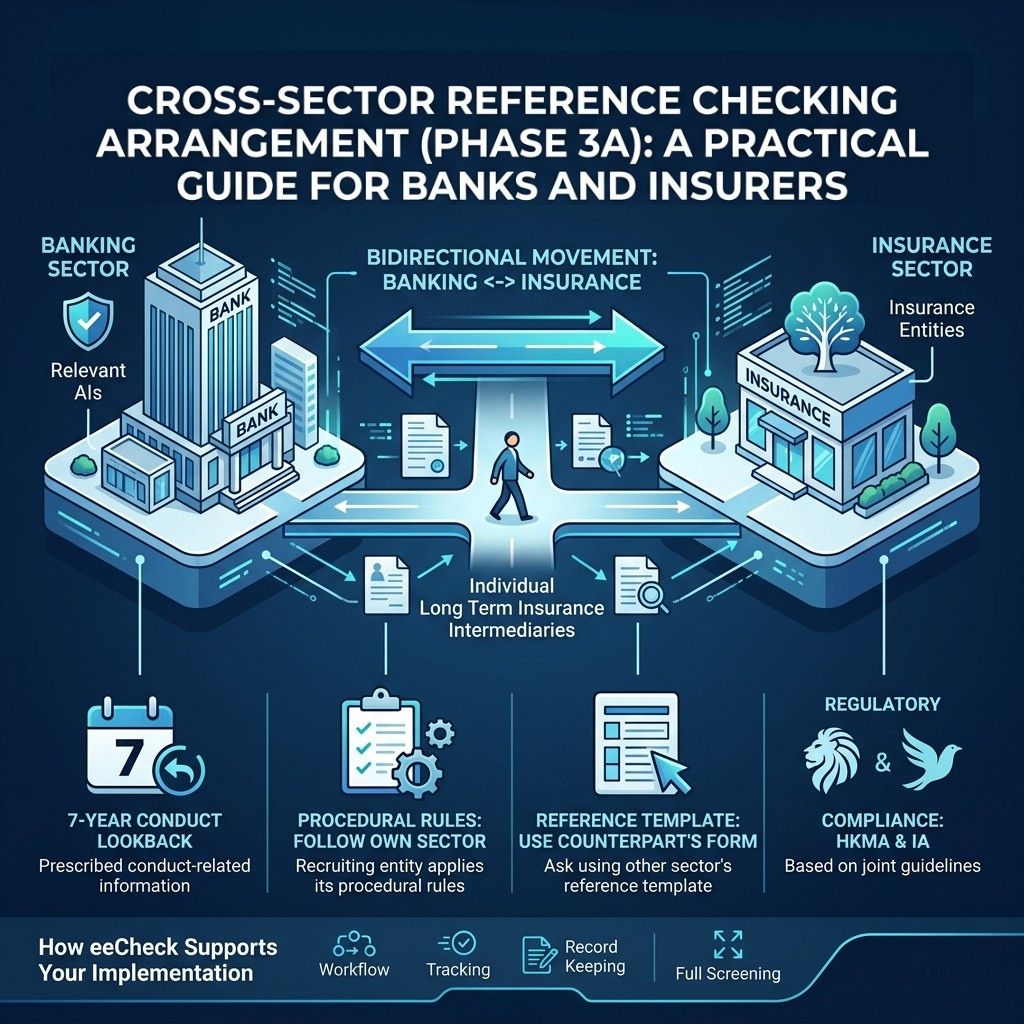
Cross-sector Reference Checking Arrangement (Phase 3A): A Practical Guide for Banks and Insurers
Published: 18 August 2026 | Last Updated: 18 August 2026
Executive Summary
On 13 May 2026, the HKMA and the IA jointly announced Phase 3A of the Cross-sector Reference Checking Arrangement between banking and insurance, effective from 1 July 2026. Phase 3A does not create a new reference checking scheme. It connects the existing Banking Mandatory Reference Checking (MRC) Scheme and Insurance Reference Checking (RC) Scheme when an in-scope individual moves between the two sectors. The arrangement is bidirectional and focuses on individual insurance intermediaries carrying on long term insurance business. Conduct-related reference information is considered over a seven-year lookback. Recruiting firms must identify whether the hire is in scope, apply their own sector’s procedural rules and use the counterpart sector’s reference template. Phase 3A should sit alongside—not replace—a broader risk-based background screening programme. Firms may also refer to eeCheck’s Compliant Background Screening Policy in Asia, Background Screening Policy Template for Asia-Pacific and Asia Background Check Compliance Guide.At a Glance
| Item | Details |
|---|---|
| Effective date | 1 July 2026 |
| Regulators | Hong Kong Monetary Authority (HKMA) and Insurance Authority (IA) |
| Industry associations | Banking: HKAB and DTCA. Insurance: HKFI, HKCIB and PIBA |
| Key development | Mandatory cross-sector reference checking between the banking and insurance sectors |
| Scope | Individual insurance intermediaries carrying on long term insurance business |
| Direction | Bidirectional — banking to insurance and insurance to banking |
| Lookback | 7 years |
| Who should read this | HR, Compliance, Legal, Risk and Talent Acquisition teams in authorized institutions and insurance entities |
1. Background: How the Two Schemes Developed
| Scheme | Phase | Effective | Coverage |
|---|---|---|---|
| Banking MRC Scheme | Phase 1 | May 2023 | Senior positions in authorized institutions under the Banking Ordinance |
| Banking MRC Scheme | Phase 2 | 30 September 2025 | A substantially wider group of staff, including those licensed or registered to carry on securities, insurance or MPF regulated activities |
| Insurance RC Scheme | Phase 1 | September 2024 | Appointment of individual insurance agents carrying on long term business by authorized insurers |
| Insurance RC Scheme | Phase 2 | 1 January 2026 | Extended to technical representatives (agent) and technical representatives (broker) carrying on long term business |
| Cross-sector Arrangement | Phase 3A | 1 July 2026 | Individual insurance intermediaries carrying on long term business, moving between the two sectors |
2. Scoping Framework
Phase 3A does not apply to every applicant joining a bank or insurer. The arrangement applies to all authorized institutions and insurance entities, but whether a particular hire triggers an obligation depends on the entity, the role and the candidate’s history.Entity Scope
Relevant AIs (banking): Authorized institutions under the Banking Ordinance that are also licensed insurance agencies under the Insurance Ordinance to carry on long term insurance business. Insurance entities: Authorized insurers, licensed insurance agencies other than AIs, and licensed insurance broker companies carrying on long term insurance business.Individual Scope
Phase 3A is engaged when recruiting individuals who will carry on regulated activities in long term insurance business.| Sector | In Scope for Phase 3A | Outside Phase 3A |
|---|---|---|
| Relevant AIs (banking) | Staff to be licensed to carry on long term insurance business, i.e. technical representatives | General banking staff; operations, IT and HR personnel |
| Insurance entities | Individuals to be licensed as individual insurance agents, technical representatives (agent) or technical representatives (broker), carrying on long term business | General insurance-only agents and brokers; non-regulated corporate staff |
Important: Falling outside Phase 3A does not mean falling outside reference checking altogether. Many bank staff who are not long term insurance intermediaries may still be subject to Phase 1 or Phase 2 of the Banking MRC Scheme, and insurance intermediaries moving within their own sector remain subject to the Insurance RC Scheme.
3. Trigger Conditions and the Seven-Year Lookback
Before initiating a cross-sector reference check, the recruiting entity should first determine whether the Phase 3A trigger conditions are met. This requires looking at both the role the individual is being appointed to and the individual’s relevant history within the preceding seven years.When Is a Cross-sector Check Triggered?
A cross-sector check is required where both of the following conditions apply:- The recruiting entity intends to appoint the individual to carry on long term insurance business; and
- The individual is currently, or was within the previous seven years, appointed by an entity in the counterpart sector to carry on long term insurance business.
What Does the Seven-Year Lookback Mean?
The reference checking framework considers prescribed conduct-related information covering the seven years preceding the application. The recruiting entity should therefore review whether the candidate has relevant counterpart-sector appointment history during that period. If the candidate has no relevant counterpart-sector history within the seven-year window, the cross-sector arrangement under Phase 3A is not triggered. However, this does not necessarily mean that no reference check is required. The recruiting entity’s existing Banking MRC Scheme or Insurance RC Scheme requirements may still apply depending on the role and circumstances.How Phase 3A Fits with the Existing Schemes
Phase 3A does not replace the Banking Mandatory Reference Checking (MRC) Scheme or the Insurance Reference Checking (RC) Scheme. Instead, it creates a mechanism for the two existing schemes to work together when an in-scope individual moves between the banking and insurance sectors. The key principle is that the recruiting entity continues to follow the procedural requirements of its own sector’s scheme, while using the counterpart sector’s reference template when making the request. Accordingly, there is no separate Phase 3A or “cross-sector” reference checking form. The applicable Banking MRC or Insurance RC template is used depending on which sector is providing the reference.4. Applying the Correct Framework: Rules vs. Templates
This is one of the most operationally important aspects of Phase 3A. The recruiting entity follows its own sector’s procedural rules, but uses the reference-providing sector’s template.| Item | Insurance → Banking | Banking → Insurance |
|---|---|---|
| Recruiting entity | Relevant AI | Insurance entity |
| Reference-providing entity | Insurance entity | Relevant AI |
| Recruiting entity follows | Banking MRC Scheme rules | Insurance RC Scheme rules |
| Request submitted on | Insurance RC Scheme template | Banking MRC Scheme template |
| Provider responds under | Insurance RC Scheme | Banking MRC Scheme |
| Expected response time | Typically within 15 calendar days | As soon as practicable, and in any case within one month |
5. Worked Examples
| Scenario | Trigger | Process |
|---|---|---|
| Relevant AI → life insurer | Candidate carried on long term business at a counterpart-sector entity within the past seven years. | Recruiting insurer follows Insurance RC Scheme rules and submits the Banking MRC Scheme template. The bank responds under the Banking MRC Scheme, in any case within one month. |
| Insurance agency → relevant AI | Candidate carried on long term business at an insurance entity within the past seven years. | Recruiting bank follows Banking MRC Scheme rules and submits the Insurance RC Scheme template. The agency responds under the Insurance RC Scheme, typically within 15 calendar days. |
6. Practical Recruitment Workflow
| Step | Practical Action |
|---|---|
| 1. Conditional offer & scoping | Issue a conditional offer. Assess whether the target role is in scope and whether the candidate’s seven-year history includes a counterpart-sector appointment in long term business. |
| 2. Candidate consent | Obtain written consent for cross-sector conduct reference checking, consistent with the Personal Data (Privacy) Ordinance (Cap. 486). |
| 3. Dispatch request | Send the correct template to the counterparty’s designated MRC or RC contact point. |
| 4. Track turnaround | Monitor against the applicable expectation: typically 15 calendar days for insurance responders and within one month for bank responders. |
| 5. Assess | Evaluate conduct disclosures against fit and proper considerations before confirming the appointment. |
| 6. Retain records | Archive consents, templates, correspondence and assessment rationale for governance and supervisory review. |
7. Governance and Supervisory Expectations
Authorized institutions and insurance entities are expected to establish the internal controls, policies and procedures required for smooth implementation. In practice, this means documented procedures, a named contact point for inbound requests, defined escalation paths for late responses and an auditable record of each check. Repeated or systematic failure may indicate weaknesses in corporate governance or internal controls and may prompt supervisory follow-up.8. Common Misconceptions
| Misconception | What Phase 3A Actually Requires |
|---|---|
| Our institution can choose whether to take part. | No. The arrangement applies to authorized institutions and insurance entities; whether a particular hire triggers a check depends on entity, role and candidate history. |
| Phase 3A replaces pre-employment background screening. | No. It addresses conduct-related reference checking. Employment, education, identity, licence, sanctions, adverse media, directorship and legally permissible criminal checks remain separate. |
| Anyone joining a bank is caught. | No. Phase 3A concerns long term insurance intermediary roles, although other bank staff may fall under Banking MRC Phase 1 or Phase 2. |
| General insurance staff are covered. | No. Phase 3A is limited to long term business. |
Frequently Asked Questions
Does Phase 3A apply to existing employees?
The arrangement is triggered by an intended appointment, so it applies prospectively to hiring rather than as a retrospective review of current staff. A new appointment or licensing of an existing employee into an in-scope long term insurance role should be assessed against the trigger conditions.What if the candidate worked overseas or outside the regulatory perimeter?
Those periods sit outside the arrangement, but firms should not treat the resulting gap as cleared. Broader employment screening remains appropriate.Does a negative response automatically block the hire?
No. The information supports a fit and proper assessment. The recruiting entity makes the hiring decision and should document its reasoning.Where are the operational details?
The joint circular sets the scope. Detailed procedures, templates and contact protocols sit in the guidelines issued by the respective industry associations.9. Looking Ahead: Phase 3B
The regulators will conduct a post-implementation review at the end of 2026. Industry feedback and Phase 3A implementation experience will inform the refinement and expansion of the arrangement. The stated common goal for Phase 3B is to extend cross-sector reference checking to all authorized institutions and insurance entities, covering remaining individuals already subject to the Banking MRC Scheme and Insurance RC Scheme who are not captured by Phase 3A. The precise scope and timing will follow the review.10. How eeCheck Supports Implementation
| Capability | Practical Support |
|---|---|
| Directional routing | Requests can be matched to the correct scheme’s rules and the counterpart sector’s template based on the direction of the hire. |
| Turnaround monitoring | Tracking and alerting against the 15-calendar-day and one-month response expectations. |
| Consent & audit trail | Structured consent capture and retrievable records for governance and supervisory review. |
| Full screening coverage | Reference checking alongside employment, education, identity and licence verification, sanctions and adverse media screening, and directorship searches. |
Final Strategic Takeaway
Phase 3A is not a standalone background check and it does not replace the Banking MRC or Insurance RC schemes. It is a cross-sector bridge designed to ensure that prescribed conduct information follows in-scope long term insurance intermediaries when they move between banking and insurance. For HR, Compliance, Legal, Risk and Talent Acquisition teams, the operational priorities are clear: identify scope correctly, apply the seven-year trigger, obtain written consent, follow the recruiting entity’s own scheme rules, use the counterpart sector’s template, track the correct response timeline and maintain an auditable record. Embedding these requirements within a broader risk-based background screening framework can help institutions strengthen governance while keeping regulated hiring workflows consistent and scalable.
Source: Joint HKMA / IA Circular dated 13 May 2026 (HKMA Ref: B1/15C, B9/202C).
This guide is provided for general information only and does not constitute legal or compliance advice. Organisations should refer to the joint HKMA / IA circular of 13 May 2026 and the guidelines issued by the relevant industry associations, and take their own advice on application to their circumstances.

