

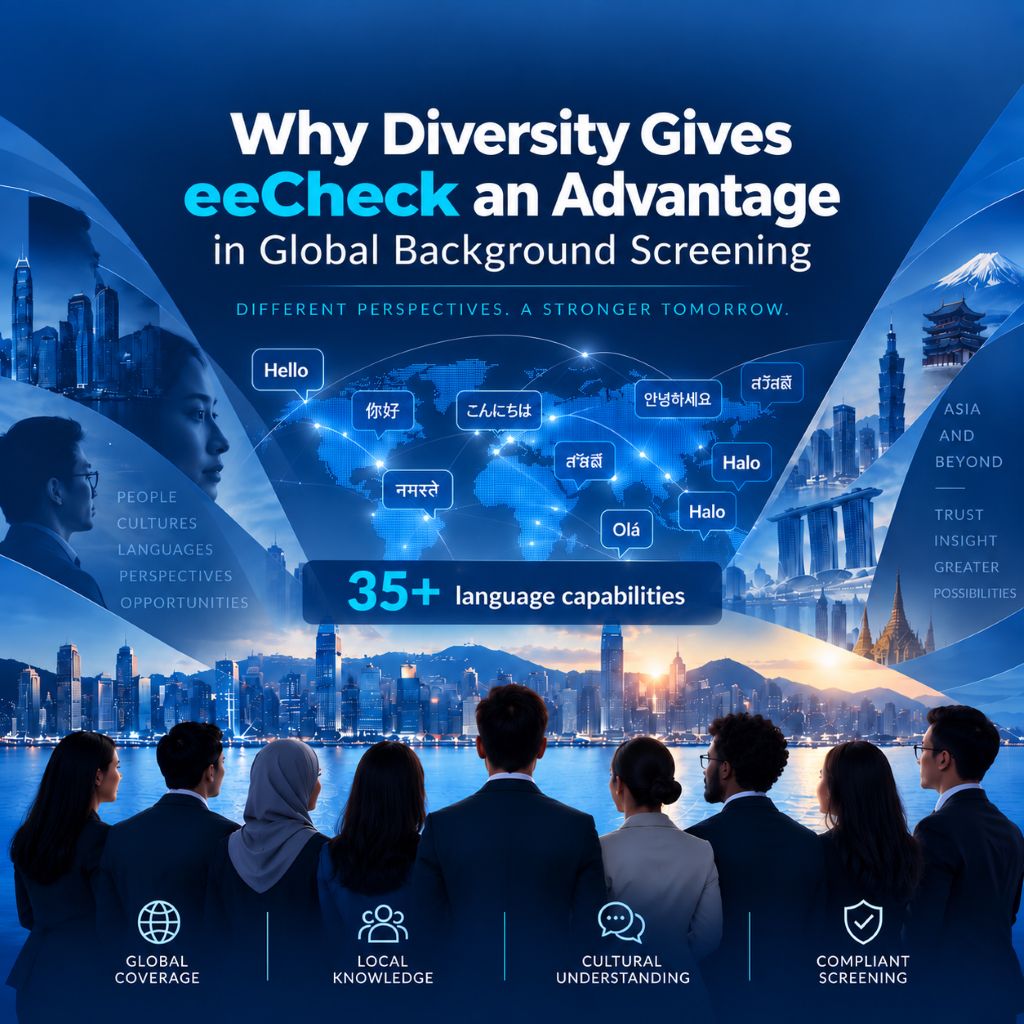
Why Diversity Gives eeCheck an Advantage in Global Background Screening
35+ languages and dialects. Different cultures and perspectives. One team built for cross-border screening.
International background screening is fundamentally a cross-border business. A candidate may live in Singapore, have studied in Australia, previously worked in Hong Kong and India, and hold qualifications issued by institutions operating in entirely different languages and regulatory environments.
For a background screening company, global coverage therefore means much more than having access to databases. It requires language capability, local knowledge, cultural understanding and people who know how to navigate different institutions and markets.
Executive Summary
At eeCheck, we believe our international team is part of the infrastructure behind our cross-border screening capabilities. Our people come from different countries, cultures and professional backgrounds, with capabilities spanning 35+ languages and dialects across our cross-border operations.
That diversity has a practical purpose: it helps teams interpret local context, communicate across markets, share country knowledge and strengthen verification workflows. It complements the principles behind a compliant background screening policy in Asia and the need for screening programmes to account for differences between jurisdictions.
Diversity as a Business Advantage
There is a tendency for growing companies to think that building teams across different countries and cultures makes an organisation more complicated. Our experience has often been the opposite.
When someone joins eeCheck with a different background, they bring knowledge that may not previously have existed within the organisation: another language, another market, another educational system, another culture, another professional experience—or simply another way of approaching a problem.
The value becomes greater when those perspectives interact. A colleague’s experience in one country can help another team understand a difficult verification. An operational practice developed for one market can inspire an improvement elsewhere. Different perspectives can challenge assumptions that may otherwise go unnoticed.
One person’s knowledge becomes part of the organisation’s collective knowledge. That process has been an important part of how eeCheck has developed its regional capabilities across Asia and built the foundation for further international growth.
Why 35+ Languages and Dialects Matter in Background Screening
Language capability has a particularly practical application in employment background checks. International screening can involve communication with employers, universities, professional bodies and other information sources across multiple jurisdictions.
Names and addresses may appear differently across languages. Institutions may communicate primarily in local languages. Terminology, qualifications and employment practices can vary significantly between countries.
A multilingual team does not remove all of these complexities. But it gives an international background screening provider a stronger foundation for dealing with them.
At eeCheck, our 35+ language and dialect capabilities help support our cross-border screening operations and the increasingly international workforces of our clients. For us, multilingual capability isn’t simply about translation. It is about understanding context.
This is particularly relevant to checks such as employment verification across Asia, where local communication practices and source procedures can materially affect how a verification is completed.
Meet the eeCheck Team: 9 Countries, 9 Voices, One Team
Behind eeCheck’s cross-border screening capabilities are people with experience across different markets, languages and cultures.
In this short video, meet nine members of the eeCheck team from nine countries across Asia—each saying hello in their own language.
These nine colleagues represent only part of our international team. Across eeCheck, our people collectively bring capabilities spanning 35+ languages and dialects, together with knowledge and experience from different markets.
For a company conducting background screening across borders, that diversity has a practical purpose. It helps us understand the people, institutions, languages and local contexts behind the checks we conduct every day.
Nine countries. Nine voices. One team.
Local Knowledge Matters in a Global Background Check
Technology has made international background screening faster and increasingly connected. AI will accelerate that transformation further. But technology does not make every country identical.
Education systems remain different. Employment practices remain different. Data availability and verification processes differ. Regulatory requirements differ. Even the way organisations communicate can vary substantially from one market to another.
This is why we believe the future of global background screening will combine technology with local knowledge and human expertise. Employers building multi-country programmes may also find eeCheck’s Asia Background Check Guide and Asia background check compliance guide useful when considering country-specific requirements.
Our objective is not to make everyone within eeCheck think alike. It is to create an organisation where different perspectives can be connected—and where technology helps that collective knowledge travel faster across the business.
From Diversity to Organisational Intelligence
This has become increasingly important as eeCheck has grown. A regional company cannot scale effectively if knowledge remains with individual people or individual markets. The challenge is to turn individual experience into organisational intelligence.
When teams share what they learn, document local knowledge, challenge one another’s assumptions and build on ideas developed elsewhere, diversity becomes more than representation. It becomes a learning engine.
And as the organisation expands into more markets, the knowledge base becomes broader again. This is one of the foundations on which we want to continue building eeCheck across Asia and globally.
eeVoices Supports the Racial Diversity & Inclusion Charter for Employers
This philosophy is also reflected at eeVoices, the overarching brand behind eeCheck.
We are pleased to share that eeVoices Limited supports the Racial Diversity & Inclusion Charter for Employers, an initiative of Hong Kong’s Equal Opportunities Commission.
The Charter sets out commitments including racial equality and diversity policies, fair recruitment and employment practices, inclusive workplace practices, employee engagement, grievance mechanisms and monitoring of progress.
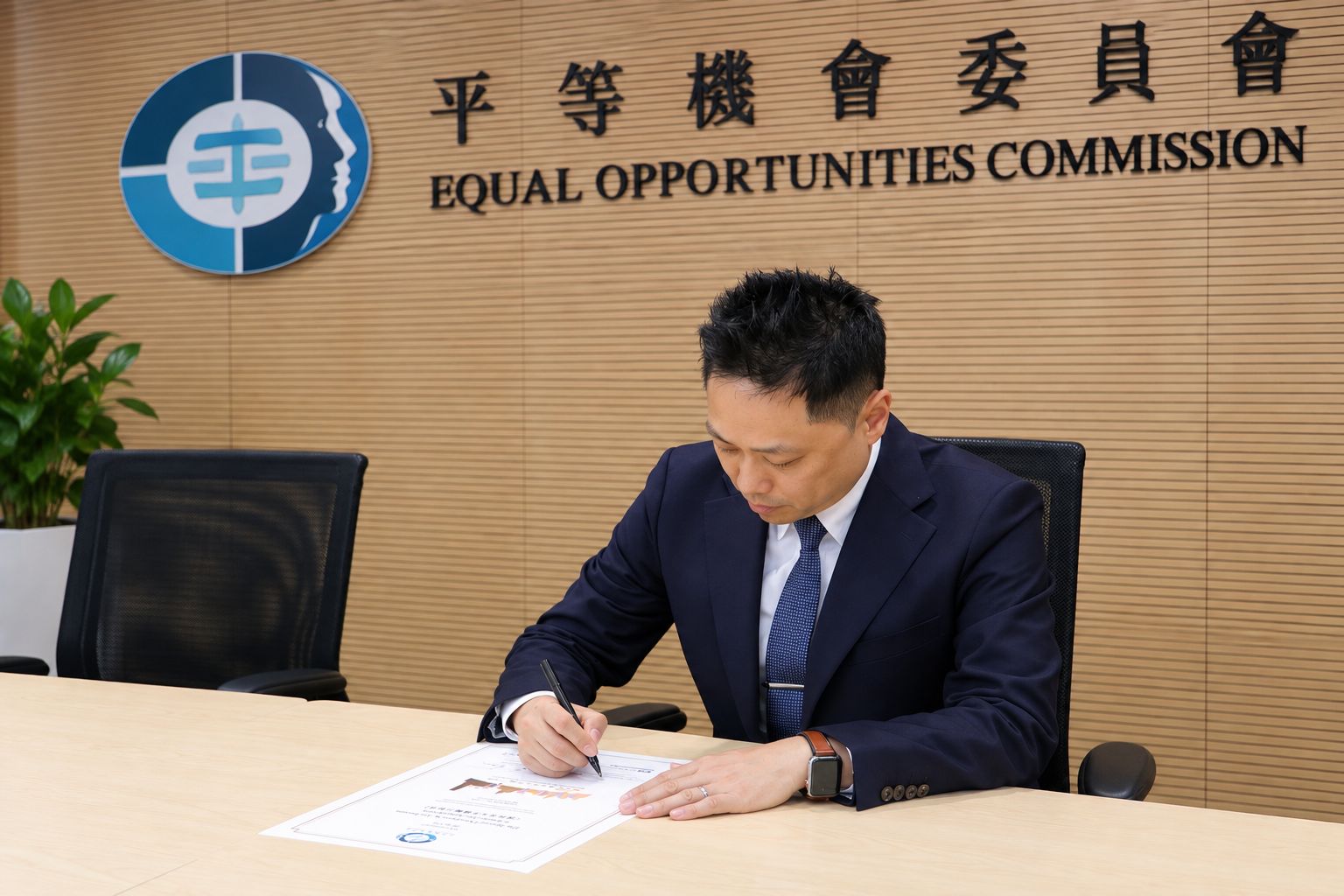
For us, supporting these principles is consistent with something we have learned through building an international organisation:
Different backgrounds don’t weaken a common culture. When brought together effectively, they can make that culture—and the organisation behind it—stronger.
A Message from Our CEO
“Adding someone from a different background can sometimes introduce complexity. But at eeCheck, we have learned to see that complexity differently: every new perspective is an opportunity to make our foundation stronger.”
“Someone may bring another language, another culture, knowledge of another market, or simply a way of thinking that the rest of us haven’t considered. The important part is what happens next—we learn from each other and build new ideas on top of each other’s experience.”
“That has been one of the engines behind our growth across Asia. As we grow internationally, I believe it will become even more important.”
“Our 35+ language capabilities are one visible example. But the bigger advantage is the collective mindset behind them. The more perspectives we can connect, the more we can understand the markets and people we serve.”
Many backgrounds. One team.
— Leo Ma, CEO, eeCheck
Building an Asian Background Screening Company for the World
The workforce is becoming increasingly international. Employers are hiring across borders. Candidates are studying and working in multiple jurisdictions. Businesses are expanding into markets where they may have limited local experience.
Background screening providers need to evolve alongside them. At eeCheck, our approach is to combine technology, regional expertise, multilingual capabilities and people with different perspectives.
Our diversity isn’t separate from that strategy. It is one of the foundations supporting it.
As eeCheck continues its journey across Asia and internationally, we want to keep expanding not only the number of markets we can serve, but also the knowledge, perspectives and capabilities inside our organisation.
Because in a business built around understanding people’s backgrounds, having people from many different backgrounds within our own team makes sense.
Many backgrounds. One team. One increasingly connected world.
Frequently Asked Questions
Why does language capability matter in international background screening?
International checks can require communication with employers, universities, professional bodies and other sources in different jurisdictions. Local-language capability can support communication and help teams understand terminology and context.
Does a multilingual team eliminate cross-border screening complexity?
No. Country-specific differences in institutions, data availability, verification processes and regulation remain. Multilingual and local-market capabilities provide a stronger foundation for navigating those differences.
Why is local knowledge important if screening technology is improving?
Technology can improve speed and connectivity, but education systems, employment practices, source accessibility and regulatory requirements still differ by market. eeCheck’s approach is to combine technology with local knowledge and human expertise.
How can diversity contribute to organisational knowledge?
Different backgrounds can introduce knowledge of languages, markets, education systems, cultures and professional practices. When that knowledge is shared and documented, individual experience can become part of an organisation’s collective capability.
How should employers approach screening across multiple Asian jurisdictions?
Programmes should account for the role, risk, purpose and applicable jurisdiction rather than assuming that one process works identically everywhere. Our Asia-Pacific background screening policy template provides a useful starting framework.
Final Takeaway
Global background screening is not only about access to technology or databases. Cross-border work also requires people who can understand different languages, institutions, cultures and market practices.
At eeCheck, diversity helps us connect those perspectives. As our organisation continues to grow across Asia and internationally, our aim is to keep turning individual market knowledge into shared organisational intelligence—combining technology, regional expertise, multilingual capability and human judgement.
Many backgrounds. One team. One increasingly connected world.
About This Guide
Prepared by: eeCheck Research & Editorial Team
Subject-matter reviewed by: Leo Ma, CEO, eeCheck
Reviewed date: September 2026
Methodology: This article draws on eeCheck’s experience building and operating multi-country background screening capabilities across Asia, including its multilingual workforce and cross-border verification operations. It also references eeVoices Limited’s support of Hong Kong’s Racial Diversity & Inclusion Charter for Employers.
Limitations: This article describes eeCheck’s operational perspective and experience. Screening requirements, source availability and regulatory obligations vary by jurisdiction, role and purpose and should be assessed accordingly.

