

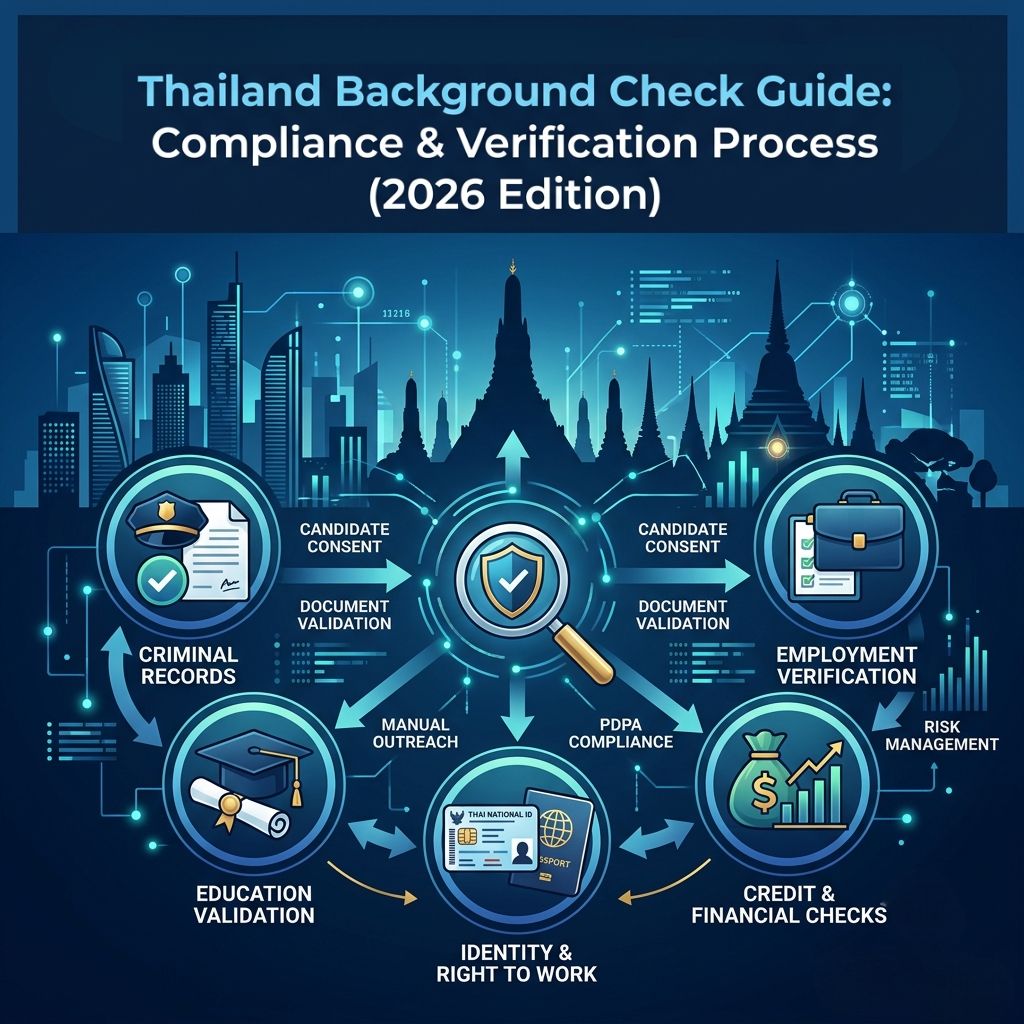
Thailand Background Check Guide: Compliance & Verification Process (2026 Edition)
For employers conducting background checks in Thailand, the key challenge is balancing reliable verification with the country’s privacy, consent and candidate-participation requirements. This guide explains the practical framework for employment screening in Thailand, including criminal record checks, employment and education verification, identity checks, financial screening and cross-border data considerations.
Executive Summary
Background checks in Thailand operate within a consent-driven and privacy-regulated environment, where employers must balance compliance with the Personal Data Protection Act (PDPA) and the practical realities of document-based and manual verification processes.
While Thailand is more structured than some Southeast Asian markets, access to official records—particularly criminal records—remains limited without candidate involvement. As a result, employers typically rely on a combination of candidate-provided documents, direct verification with institutions, and multi-source validation.
Effective background screening in Thailand requires a balanced approach between compliance, candidate cooperation, and verification reliability.
For organisations developing a consistent regional framework, see eeCheck’s Compliant Background Screening Policy in Asia, Background Screening Policy Template for Asia-Pacific and Asia Background Check Guide.
Thailand Background Screening at a Glance
Thailand combines strong privacy requirements with a verification environment that still depends heavily on candidate cooperation, manual outreach and document validation. The table below summarises the main considerations for employers.
| Area | Thailand Background Screening Consideration |
|---|---|
| Privacy and Consent | Strong PDPA-driven consent and data-handling requirements. |
| Criminal Record Checks | Official Police Clearance Certificates generally require candidate involvement. |
| Employment Verification | Generally feasible, but employer responsiveness and internal HR policies can affect completion. |
| Education Verification | Usually conducted through direct institution contact and document validation. |
| Identity and Right to Work | Thai National ID, passport and work permit documentation may be reviewed as applicable. |
| Credit and Financial Checks | Typically limited to relevant financial or sensitive roles and must be proportionate. |
| Cross-Border Screening | Additional care is required when data is shared with overseas entities or regional screening providers. |
Legal Framework Governing Background Checks in Thailand
Employers conducting background checks in Thailand should establish a clear legal and governance framework before collecting or verifying candidate information. Screening should be relevant to the role, transparent to the candidate and supported by appropriate privacy controls.
1. Personal Data Protection Act
Thailand’s PDPA is the primary legislation governing personal data collection, use, and disclosure.
| Key Principle | Employer Requirement |
|---|---|
| Clear and informed consent | Obtain appropriate consent before conducting screening activities. |
| Specific and lawful purpose | Collect candidate data only for a clearly defined employment-related purpose. |
| Relevant and proportionate processing | Limit the scope of screening to information relevant to the position. |
| Data security | Protect personal data through appropriate organisational and technical controls. |
| Limited access | Restrict access to screening data to authorised personnel. |
| Appropriate retention | Retain personal information only for an appropriate and defined period. |
For background checks, employers must disclose the scope of checks, the purpose of screening, and how the data will be used.
2. Employment & Data Use Considerations
Background checks must be role-based and justified. Over-collection of personal or sensitive data may create compliance risk, and screening practices should align with fair employment principles.
| Consideration | Recommended Approach |
|---|---|
| Role relevance | Select checks according to the responsibilities and risks associated with the position. |
| Proportionality | Avoid collecting information that is not reasonably connected to the hiring decision. |
| Sensitive data | Apply additional care where screening involves criminal, financial or other sensitive information. |
| Fair employment | Assess findings objectively and in context rather than treating every discrepancy as automatically negative. |
Related reading: Role-Based Background Screening in Asia and Risk-Based Background Screening in Asia.
Key Risk Factors in Thailand Background Checks
Thailand’s screening environment presents several distinct operational characteristics. Employers should understand these factors before setting turnaround expectations or defining a screening package.
For regional planning context, see eeCheck’s Asia Background Check Turnaround Benchmarks and Turnaround Time in Asia: Why “Fast” Is Not Always Accurate.
| Risk Factor | Practical Impact |
|---|---|
| Strong privacy and consent requirements | Screening may be delayed if candidate consent is incomplete or unclear. |
| Limited direct employer access to criminal records | Official criminal screening may require the candidate to obtain supporting documentation. |
| Reliance on candidate-provided official documents | The process may depend on how quickly the candidate provides the required documents. |
| Continued need for manual verification | Employment and education checks may require direct outreach rather than instant database results. |
| Variable responsiveness from employers and institutions | Completion times may differ significantly between sources. |
Criminal Record Checks in Thailand
Criminal record screening in Thailand requires careful planning because official criminal information is generally not available through unrestricted employer access. Employers should select the methodology according to the role, risk level, regulatory requirements and recruitment timeline.
Police Clearance Certificate
In Thailand, the Police Clearance Certificate issued by the Royal Thai Police is the primary official document used to demonstrate an individual’s criminal record status for employment and immigration purposes.
As the certificate is issued directly to the individual through official procedures, employers generally rely on the candidate to obtain and provide the certificate when an official criminal clearance is required.
Practical Challenges
From an employer’s perspective, official criminal screening may present practical challenges.
| Challenge | Potential Impact |
|---|---|
| Dependence on candidate cooperation | The check cannot progress until the candidate completes the required application steps. |
| Varying government processing times | Recruitment timelines may be affected by the time needed for official processing. |
| Additional steps for international or cross-border candidates | Extra administrative requirements may apply depending on the candidate’s circumstances. |
These factors may affect recruitment timelines, particularly where organisations require pre-employment screening before onboarding.
Alternative Methodology: Court Record Search
Where an official Police Clearance Certificate is not immediately available, some employers choose to supplement their screening programme with court record searches using legally available judicial records.
Unlike an official police clearance, court record searches focus on identifying judicial proceedings that may be publicly accessible. Depending on record availability and applicable legal restrictions, this methodology can provide additional insight without requiring the candidate to obtain an official certificate.
| Court Record Search Characteristic | Practical Meaning |
|---|---|
| May be conducted independently of the candidate application process | Can support earlier-stage risk assessment. |
| Useful when employers require earlier risk insight | May help recruitment teams assess potential issues before an official certificate is available. |
| Not equivalent to an official Police Clearance Certificate | Should not be represented as a substitute for official police clearance. |
| Should be interpreted together with other verification results | Findings should be assessed in the broader context of the candidate’s background. |
For positions involving regulated activities, financial responsibility, senior management or heightened security requirements, organisations may adopt a layered approach by combining official police clearance, court record searches and other relevant background checks to achieve a more comprehensive assessment.
Executive Insight
Rather than relying on a single verification method, leading employers increasingly design criminal screening programmes based on the level of organisational risk.
In Thailand, this often means selecting the most appropriate methodology according to the role, regulatory requirements, and recruitment timeline, balancing official government documentation with other legally available verification sources where appropriate.
For broader regional context, see Asia Background Check Compliance and Government Background Checks in Asia.
Employment Verification in Thailand
Employment checks are generally feasible in Thailand but are not standardised. The quality and speed of verification often depend on the responsiveness of the former employer and its internal HR policies.
| Area | Thailand Consideration |
|---|---|
| Employer responsiveness | Some employers respond quickly while others require repeated follow-up. |
| Internal HR policies | Certain employers may limit the type of information they are willing to confirm. |
| Limited confirmation | Some organisations may confirm only dates of employment and job title. |
| Detailed disclosure | Some employers may decline to provide additional information. |
| Best practice | Use a combination of direct employer verification and supporting documents such as contracts and payslips. |
Related reading: Employment Verification in Asia.
Education Verification in Thailand
Education verification is typically conducted through direct institution contact and document review with source validation. Although Thailand is more structured than highly fragmented markets, the process is still not fully centralised.
| Area | Thailand Consideration |
|---|---|
| Verification method | Direct institution contact and document review with source validation. |
| Market structure | More structured than highly fragmented markets. |
| Centralisation | Not fully centralised. |
| Turnaround time | May vary depending on the institution and its response process. |
| Compared with Singapore | Less centralised and more reliant on manual confirmation. |
Identity & Right-to-Work Verification
Identity and right-to-work verification help employers confirm that the individual being screened is correctly identified and, where applicable, legally entitled to work in Thailand.
| Document / Check | Purpose |
|---|---|
| Thai National ID card | Supports identity validation for Thai nationals. |
| Passport | Supports identity verification for foreign nationals. |
| Work permit | Supports confirmation of work eligibility where applicable. |
| Identity validation | Confirms consistency between the candidate and supporting documents. |
| Work eligibility | Assesses whether the candidate has appropriate documentation to work in Thailand. |
Credit & Financial Checks
Credit and financial checks should generally be limited to roles where financial integrity is directly relevant. Employers should avoid applying such checks indiscriminately across all positions.
| Suitable Use | Requirement |
|---|---|
| Financial roles | The check should be relevant to the responsibilities of the role. |
| Sensitive positions | The employer should be able to justify why financial information is necessary. |
| PDPA requirements | Appropriate consent and data-protection controls should be applied. |
| Job relevance | The scope should remain proportionate to the employment risk. |
Related reading: Financial Background Screening in Asia.
Data Privacy & Consent Requirements
Under the PDPA, employers should ensure that candidates understand what information will be collected, why it is needed and how it will be handled.
| Requirement | Employer Action |
|---|---|
| Explicit consent | Obtain clear and informed consent before conducting the relevant checks. |
| Purpose of data collection | Clearly explain why the information is being collected. |
| Scope of checks | Tell candidates which checks will be conducted. |
| Secure data handling | Protect screening data through appropriate security controls. |
| Controlled access | Limit access to authorised personnel only. |
| Compared with Japan | Thailand may be less restrictive culturally, but screening remains strongly consent-driven. |
Cross-Border Data Transfer Considerations
Cross-border hiring and regional screening arrangements require additional care when candidate information is transferred outside Thailand or accessed by overseas entities.
| Scenario | Consideration |
|---|---|
| Sharing data with overseas entities | Transfers should comply with applicable PDPA requirements and internal governance standards. |
| Using regional screening providers | Employers should understand where data is processed, stored and accessed. |
| Multi-country candidate histories | Screening methodology should also comply with the rules of the jurisdiction being searched. |
Regional employers may also find MNC Background Screening in Asia useful.
Comparison with Other Asian Markets
Thailand shares certain characteristics with neighbouring Asian markets, but its verification environment remains distinct in terms of candidate involvement and manual processing.
| Market | Comparison with Thailand |
|---|---|
| Malaysia | Similar structure, with Thailand showing slightly more reliance on candidate-provided documents. |
| Indonesia | Thailand generally has a more structured verification environment and better institutional consistency. |
| Hong Kong | Thailand is less centralised and relies more heavily on manual processes. |
Explore eeCheck’s country guides for Hong Kong, Singapore, China, Indonesia, Taiwan, India, Philippines, Vietnam and Malaysia.
Best Practices for Employers
To conduct effective background checks in Thailand, employers should combine legal compliance with practical verification planning.
| Best Practice | Why It Matters |
|---|---|
| Use clear, PDPA-compliant consent forms | Supports transparency and lawful processing. |
| Apply risk-based and role-based screening | Keeps screening proportionate to the actual responsibilities of the role. |
| Rely on candidate-provided official certificates where required | Supports official checks where direct employer access is limited. |
| Combine document review with direct verification | Improves confidence in the reliability of the information collected. |
| Allow for manual processes and realistic timelines | Reduces pressure to close cases before reliable verification is complete. |
Further reading: Asia Background Check Guide, Asia Background Screening Executive Briefing and Optimise Screening Turnaround Time in Asia.
Conclusion
Thailand presents a consent-driven and moderately structured background screening environment where successful employment screening depends on balancing regulatory compliance, candidate cooperation, and practical verification methodologies.
Leading organisations increasingly recognise that background screening is not simply a recruitment activity, but an important component of enterprise risk management, workforce integrity, and corporate governance. A well-designed screening programme should combine appropriate consent, role-based screening, multi-source verification, and documented governance controls.
By combining local regulatory knowledge with internationally recognised screening best practices, organisations can make more informed hiring decisions while maintaining compliance with Thailand’s Personal Data Protection Act. At eeCheck, we believe this balanced, risk-based approach enables organisations to build more resilient and trustworthy workforces throughout Thailand and across Asia.
Why Organisations Across Asia Work with eeCheck
Organisations choose eeCheck because we combine local verification expertise with consistent regional governance across Asia. Our approach is designed to help employers navigate varying legal requirements while maintaining high standards of hiring integrity, operational efficiency, and candidate experience.
| eeCheck Capability | Employer Value |
|---|---|
| PDPA-compliant background screening methodologies | Supports privacy-conscious and proportionate screening programmes. |
| Candidate-assisted and independent verification solutions, where legally appropriate | Allows methodology to adapt to local access and practical requirements. |
| Official Police Clearance Certificate arrangement workshops and court record search methodologies | Provides flexible options according to circumstances and requirements. |
| Cross-border screening programmes across Asia | Supports candidates with multi-jurisdiction employment and education histories. |
| Risk-based screening frameworks tailored to different industries and workforce profiles | Aligns screening scope with actual organisational risk. |
| Regional governance supported by internationally recognised quality and information security standards | Helps employers maintain consistency across multiple markets. |
Employers evaluating screening partners may also review Background Screening Vendor Questions for Asia, In-House vs Outsourced Screening in Asia and Choosing a Top Background Check Firm in Asia.
Related Thailand & Asia Background Screening Resources
| Resource | Why It Is Relevant |
|---|---|
| Asia Background Check Guide | Regional framework for multi-country screening. |
| Employment Verification in Asia | Cross-border employment verification considerations. |
| Asia Background Check Turnaround Benchmarks | Country-specific planning benchmarks for screening timelines. |
| Risk-Based Background Screening in Asia | Guidance on matching screening depth to role risk. |
| MNC Background Screening in Asia | Useful for employers managing regional hiring programmes. |
Frequently Asked Questions
The following questions summarise common employer considerations when conducting background checks in Thailand.
Are background checks permitted in Thailand?
Background checks may be conducted subject to applicable privacy and data-protection requirements, including appropriate transparency, relevance and secure handling of candidate information.
Is candidate consent important for Thailand background checks?
Yes. Thailand’s screening environment is strongly consent-driven, particularly where personal or sensitive information is collected, verified or transferred.
Can employers directly obtain an official Thai criminal record?
Employers generally rely on the candidate to obtain and provide a Police Clearance Certificate when official criminal clearance is required. Court record searches may supplement the process where legally available, but they are not equivalent to an official police clearance.
What can affect turnaround time in Thailand?
Candidate cooperation, government processing, employer responsiveness, institutional procedures and manual verification requirements can all affect completion times.
How do employers conduct background checks in Thailand?
Employers typically combine candidate consent, identity verification, direct employment and education verification, and role-relevant checks such as criminal, financial or professional verification where appropriate. The scope should remain proportionate to the role and compliant with Thailand’s PDPA requirements.
Should every employee receive the same screening package?
No. Screening should be role-based and proportionate to the responsibilities, access, risk profile and regulatory requirements of the position.
Final Strategic Takeaway
Thailand presents a consent-driven and moderately structured background screening environment. Strong programmes combine appropriate consent, role-based screening, multi-source verification and documented governance controls while allowing for manual verification and candidate-dependent processes.
For employers operating across several jurisdictions, the objective should be consistent governance with locally adapted screening methodology rather than one identical process in every market.
For further regional context, see eeCheck’s Asia Background Screening Executive Briefing and Future of Background Checks in Asia.

