

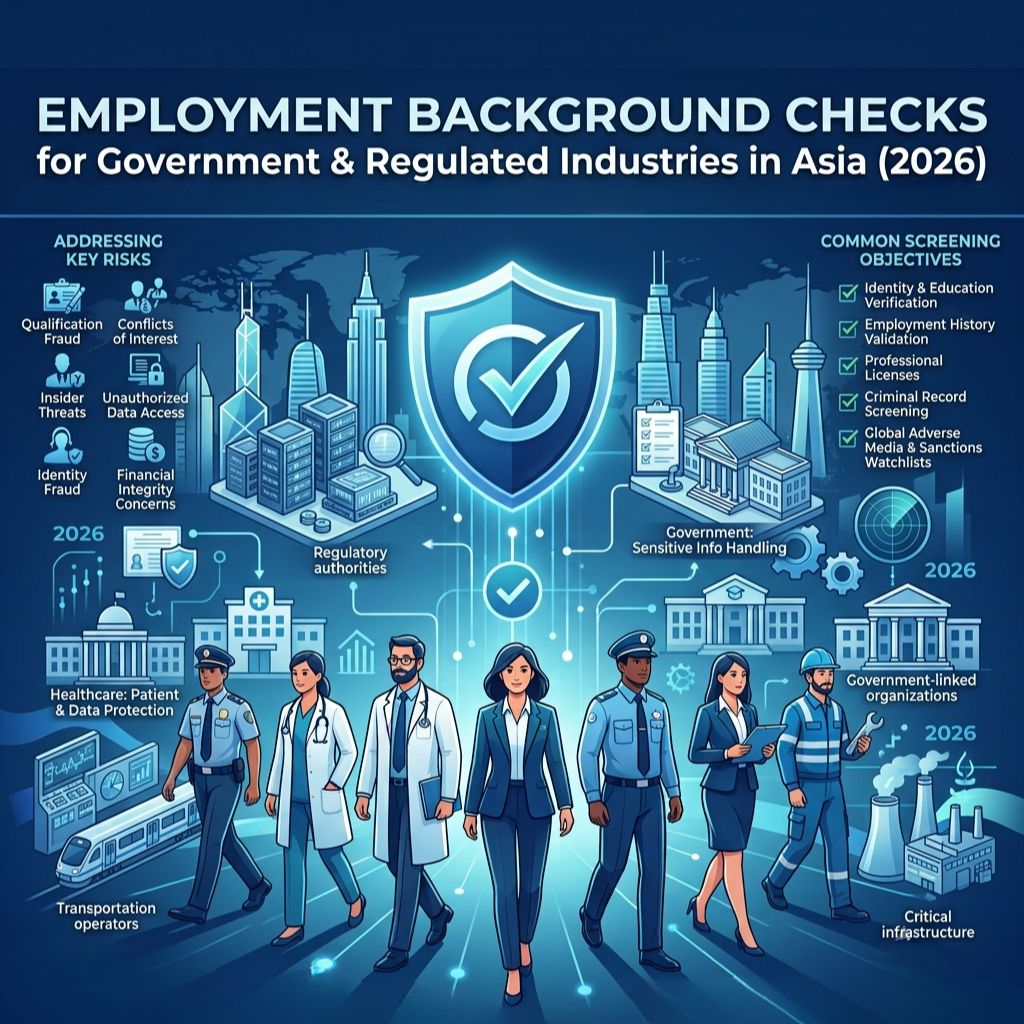
Employment Background Checks for Government & Regulated Industries in Asia (2026)
A practical guide to workforce integrity, governance, compliance, and hiring risk management for government agencies, statutory boards, public institutions, healthcare organizations, universities, financial regulators, transportation operators, utilities providers, and regulated industries across Asia.Executive Summary
Government agencies, regulators, statutory boards, public institutions, universities, healthcare organizations, and other regulated entities face unique hiring risks and governance responsibilities. Unlike many commercial organizations that primarily focus on hiring efficiency and operational needs, government and regulated sector employers must balance workforce integrity, public accountability, information security, regulatory compliance, and operational effectiveness. As governments across Asia continue strengthening workforce governance frameworks, employment background checks have become an increasingly important component of hiring risk management. Beyond verifying qualifications and employment history, background screening programs help organizations protect public trust, support governance objectives, and make informed hiring decisions for positions involving access to sensitive information, public resources, and regulated activities.For broader program design, employers may also refer to eeCheck’s compliant background screening policy guide, Asia-Pacific background screening policy template, and Asia background check compliance guide.
About This Guide
This guide was prepared by eeCheck, an Asia-focused background screening and workforce integrity specialist supporting more than 5,000 organizations across Asia. eeCheck supports employment background screening programs across government-related organizations, statutory bodies, education institutions, healthcare providers, financial institutions, technology firms, regulated industries, and multinational corporations throughout Asia-Pacific.The guidance in this article is based on practical experience supporting cross-border verification programs, regulated hiring projects, public sector-related screening requirements, and workforce integrity initiatives across Hong Kong, Singapore, China, Japan, South Korea, Taiwan, India, Indonesia, Malaysia, Vietnam and other major markets in Asia.
Why Employment Background Checks Matter in Government and Regulated Industries
Government organizations often oversee responsibilities that extend far beyond traditional commercial operations. These may include the administration of public funds, regulatory supervision and enforcement, national infrastructure, healthcare services, education systems, immigration and workforce administration, public safety functions, and management of sensitive citizen information. An inappropriate hire may expose organizations to operational, financial, reputational, compliance, and public trust risks. As a result, employment background screening is increasingly viewed as a governance and workforce integrity function rather than simply an administrative hiring activity. Organizations commonly implementing structured background screening programs include government ministries, regulatory authorities, statutory boards, public universities, healthcare institutions, government-linked organizations, financial regulators, transportation operators, utilities providers, and critical infrastructure operators.| Organization Type | Why Screening Matters |
|---|---|
| Government Ministries | Protects public accountability, policy delivery, and sensitive information handling. |
| Regulatory Authorities | Supports integrity, impartiality, compliance, and public confidence in regulatory decisions. |
| Statutory Boards | Strengthens governance for public services, infrastructure, and regulated activities. |
| Public Universities | Supports academic integrity, safeguarding, credential validation, and institutional trust. |
| Healthcare Institutions | Helps protect patients, sensitive health information, and professional standards. |
| Government-Linked Organizations | Supports governance, accountability, and workforce integrity in public-interest operations. |
| Financial Regulators | Supports regulatory integrity, independence, and public confidence in financial supervision. |
| Transportation Operators | Helps protect safety, operational continuity, and public service reliability. |
| Utilities Providers | Supports workforce integrity for essential public services and critical infrastructure. |
| Critical Infrastructure Operators | Reduces insider threat, security, and operational continuity risks. |
Employment Background Screening Objectives in Government and Regulated Industries
Government and regulated organizations often implement employment background checks to achieve multiple objectives, including protecting public trust, verifying qualifications and employment history, reducing workforce integrity risks, supporting governance requirements, protecting sensitive information and assets, promoting fair hiring practices, reducing reputational and operational risks, and strengthening accountability across the workforce.| Screening Objective | Practical Value |
|---|---|
| Protecting Public Trust | Helps ensure individuals in sensitive roles meet integrity expectations. |
| Verifying Candidate Credentials | Confirms academic qualifications, professional licences, and employment history. |
| Reducing Workforce Integrity Risk | Supports early identification of misrepresentation, conflicts, or relevant adverse information. |
| Supporting Governance Requirements | Creates documented, consistent, and auditable hiring controls. |
| Protecting Sensitive Information | Supports risk management for roles accessing confidential, citizen, financial, health, or operational data. |
| Promoting Fair and Consistent Hiring | Helps organizations apply structured screening criteria across comparable roles. |
| Reducing Reputational and Operational Risks | Helps prevent avoidable hiring risks that may affect public confidence, service continuity, or organizational credibility. |
| Strengthening Accountability Across the Workforce | Supports governance expectations and reinforces a consistent workforce integrity culture. |
Common Risks Addressed Through Employment Background Checks
Government and regulated organizations frequently use employment background screening programs to mitigate risks such as qualification fraud, employment history misrepresentation, identity fraud, regulatory misconduct, conflicts of interest, financial integrity concerns, insider threats, unauthorized access to sensitive information, data security risks, and reputational and public confidence risks.| Risk Area | How Background Screening Helps |
|---|---|
| Qualification Fraud | Confirms whether claimed academic and professional credentials are genuine. |
| Employment Misrepresentation | Validates prior roles, employers, dates, and experience relied upon during hiring. |
| Identity Fraud | Confirms identity and supports detection of inconsistent or fraudulent documentation. |
| Regulatory Misconduct | May identify publicly available disciplinary, enforcement, or regulatory findings where relevant. |
| Conflicts of Interest | May identify directorships, corporate interests, or affiliations relevant to role risk. |
| Financial Integrity Concerns | Supports review of bankruptcy, credit, financial probity, or other relevant indicators where legally permissible. |
| Insider Threats | Supports risk assessment for roles involving security-sensitive access or critical infrastructure. |
| Unauthorized Access to Sensitive Information | Helps assess suitability for roles with access to citizen data, confidential records, financial information, or protected systems. |
| Data Security Risks | Supports workforce controls for roles involving IT systems, privileged access, or sensitive data handling. |
| Reputational and Public Confidence Risks | Helps reduce avoidable hiring risks that could undermine public trust or organizational credibility. |
Common Employment Background Checks Used by Government and Regulated Organizations
The scope of employment background checks varies depending on the role, level of responsibility, regulatory requirements, and organizational policies.| Background Check Type | Purpose |
|---|---|
| Identity Verification | Confirms candidate identity and supporting documentation. |
| Employment Verification | Validates employment history and professional experience. |
| Education Verification | Confirms academic qualifications and credentials. |
| Professional License Verification | Verifies licences, registrations, and certifications. |
| Criminal Record Screening | Assesses legal and integrity-related risks where permitted by law. |
| Reference Checks | Obtains independent insights regarding employment performance and conduct. |
| Global Adverse Dataset Screening | Screens against sanctions, watchlists, politically exposed persons, adverse media, enforcement actions, and other risk intelligence datasets where relevant. |
| Credit or Financial Integrity Screening | Assesses suitability for financial or sensitive positions where legally permissible. |
| Directorship and Corporate Interest Checks | Identifies potential conflicts of interest and corporate affiliations. |
Key Considerations When Implementing an Employment Background Screening Program
Government organizations often evaluate employment background screening programs across multiple dimensions beyond simply the checks being conducted.| Consideration | Why It Matters |
|---|---|
| Information Security | Protects candidate and employee information. |
| Compliance | Supports regulatory, policy, privacy, and governance obligations. |
| Candidate Experience | Improves hiring efficiency and employer reputation. |
| Turnaround Time | Supports workforce planning and onboarding timelines. |
| Auditability | Strengthens accountability, transparency, and governance review. |
| Regional Coverage | Supports multi-country hiring requirements across Asia-Pacific. |
| Scalability | Supports large recruitment exercises and ongoing workforce programs. |
| Reporting | Supports management oversight and decision-making. |
| Operational Flexibility | Helps the program adapt to changing hiring and procurement requirements. |
| Quality Assurance | Improves consistency and reliability of screening outcomes. |
Why Employment Background Checks Are Different in Government and Regulated Industries
Government and regulated sector background screening programs often operate under significantly different requirements compared with commercial organizations.| Commercial Sector Screening | Government & Regulated Sector Screening |
|---|---|
| Often focused on hiring efficiency. | Focused on workforce integrity and public trust. |
| Screening scope determined by business needs. | Screening scope often influenced by regulatory, governance, and policy requirements. |
| Speed is often a primary objective. | Speed is important, but must also take into account compliance, governance, and accountability. |
| Hiring decisions managed by business leaders. | Hiring decisions may involve multiple stakeholders and oversight functions. |
| Lower documentation requirements. | Higher documentation and auditability requirements. |
| Internal business risk. | Potential public, regulatory, and reputational risk. |
| Commercial impact of hiring mistakes. | Broader impact on public confidence and organizational integrity. |
Information Security and Data Protection Expectations
Employment background screening providers routinely handle highly sensitive information, including identification documents, employment histories, educational records, verification reports, regulatory information, and personal data. Government organizations therefore place significant emphasis on information security governance and data protection controls.| Security Area | Why It Is Evaluated |
|---|---|
| Information Security Management Systems | Demonstrates structured controls over information handling and governance. |
| Access Control Procedures | Limits sensitive data access to authorized personnel only. |
| Data Encryption Standards | Protects data during storage, transmission, and processing. |
| Incident Response Capabilities | Supports timely response to security or privacy incidents. |
| Data Retention Controls | Ensures personal data is retained only as long as necessary. |
| Cross-Border Data Transfer Procedures | Supports compliance for regional and international verification programs. |
| Vendor Confidentiality Obligations | Ensures service providers are contractually bound to protect sensitive information and maintain confidentiality. |
Common Challenges in Government Employment Background Screening Programs
Government screening initiatives frequently involve additional complexity compared with traditional corporate hiring programs.| Challenge | Potential Impact |
|---|---|
| Cross-Border Verification Requirements | May extend turnaround times and require local-language support. |
| Data Privacy Restrictions | May require additional consent, data transfer, and compliance controls. |
| Multiple Stakeholders | Can create longer decision-making cycles and more complex approvals. |
| Large-Scale Hiring Campaigns | May increase operational demands and require scalable workflows. |
| Regulatory Oversight | Creates higher documentation and audit expectations. |
| Legacy Procurement Procedures | May extend implementation timelines and vendor onboarding cycles. |
| Public Accountability | Increases scrutiny of screening decisions and governance controls. |
| Complex Reporting Requirements | May require customized reporting, management oversight, audit records, and stakeholder-specific outputs. |
| Additional Governance Obligations | May require stronger escalation procedures, decision logs, approval workflows, and compliance documentation. |
Why Candidate Experience Matters
Government recruitment processes are often perceived as lengthy and administrative. Poor candidate experience may result in candidate withdrawal, delayed onboarding, increased HR workload, lower completion rates, and negative employer perception. Many organizations are therefore modernizing their employment background screening processes through digital candidate workflows, mobile-friendly portals, electronic consent collection, real-time status updates, centralized communications, and improved transparency throughout the screening process.Balancing Speed, Accuracy and Compliance
One of the most common misconceptions in employment background screening is that faster always means better. For government and regulated organizations, successful screening programs must balance accuracy, compliance, security, auditability, candidate experience, operational efficiency, and cost effectiveness.| Evaluation Factor | Importance |
|---|---|
| Accuracy | Critical |
| Compliance | Critical |
| Security | Critical |
| Auditability | Critical |
| Candidate Experience | High |
| Turnaround Time | High |
| Cost Efficiency | High |
Why Government and Regulated Organizations Work With eeCheck
Government agencies and regulated organizations often require a combination of security, compliance, operational agility, regional expertise, flexible implementation support, and cost efficiency.| Capability | eeCheck Approach |
|---|---|
| Information Security | ISO/IEC 27001 certified Information Security Management System. |
| Quality Management | ISO 9001 certified Quality Management System. |
| Cybersecurity | UK Cyber Essentials certified security controls. |
| Government Experience | Experience supporting public sector and regulated industry projects across Asia. |
| Singapore Experience | Ministry of Manpower listed verification vendor since 2023. |
| Regional Coverage | Multi-country screening support across Asia-Pacific. |
| Candidate Experience | Candidate-focused digital workflows and communication. |
| Turnaround Time | Optimized operational processes supported by quality assurance controls. |
| Scalability | Support for pilot programs through large-scale workforce projects. |
| Regulatory Knowledge | Experience supporting financial institutions, education, healthcare, and government-related organizations. |
| Flexibility | Customized workflows aligned with procurement and compliance requirements. |
| Cost Efficiency | Competitive and scalable pricing structures. |
Frequently Asked Questions
Why are employment background checks important for government organizations?
How are government background checks different from commercial sector checks?
What checks are commonly used for regulated industries?
Should all government roles receive the same screening package?
Why is information security important when selecting a screening provider?
Can employment background checks improve candidate experience?
Final Strategic Takeaway
Employment background checks within government and regulated industries are fundamentally about workforce integrity, governance, risk management, and public trust. The most effective screening programs are not necessarily the fastest or the least expensive. Rather, they are those that successfully balance compliance, security, candidate experience, operational efficiency, auditability, and accountability while supporting informed hiring decisions.As governments and regulated organizations across Asia continue strengthening workforce governance requirements, implementing structured employment background screening programs and selecting experienced screening partners can play an important role in protecting organizational integrity, reducing hiring risks, and maintaining public confidence.

