

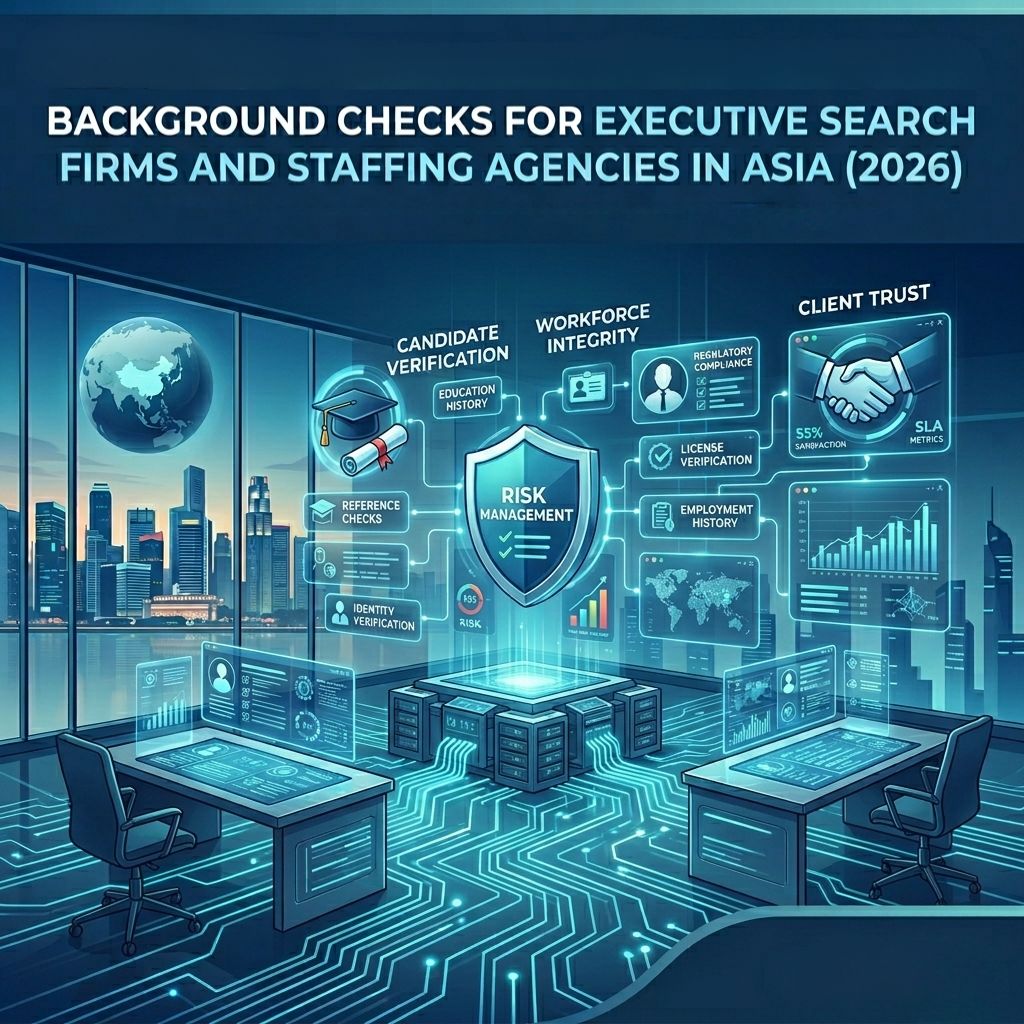
Background Checks for Executive Search Firms and Staffing Agencies in Asia (2026)
A Practical Guide to Workforce Integrity, Client Expectations and Risk Management How leading executive search firms, recruitment consultancies and staffing agencies leverage background screening to strengthen client trust and hiring outcomes.Executive Summary
Executive search firms and staffing agencies play a critical role in helping organizations identify and hire talent. However, as hiring risks, regulatory expectations and workforce integrity concerns continue to increase, clients increasingly expect recruiters to provide not only talent acquisition expertise, but also confidence that candidates have been appropriately vetted. As a result, background screening has become an important component of the recruitment process, particularly for executive search firms, leadership advisory firms, professional recruitment consultancies, staffing agencies, recruitment process outsourcing providers and talent acquisition partners. The most successful recruitment firms do not view background screening as a transactional service. Instead, they treat it as a strategic component of client service, workforce integrity and risk management.For wider regional planning, recruiters may also refer to eeCheck’s compliant background screening policy guide for Asia, background screening policy template for Asia-Pacific and Asia background check compliance guide.
About This Guide
This guide was prepared by eeCheck, an Asia-focused background screening and workforce integrity specialist supporting more than 5,000 organizations across Asia. eeCheck works closely with executive search firms, recruitment consultancies, staffing agencies and talent acquisition teams across Hong Kong, Singapore, China, Japan, South Korea, Taiwan, India, Indonesia, Malaysia, Vietnam and other major markets throughout Asia-Pacific. The guidance in this article is based on practical experience supporting executive recruitment projects, leadership hiring initiatives, confidential searches, regulated industry hiring and cross-border recruitment assignments throughout Asia. For broader market context, recruiters may also review eeCheck’s Asia Background Check Guide, Asia Background Screening Report and MNC Background Screening in Asia guide.Why Background Screening Matters for Search Firms
Executive recruiters are often engaged to identify candidates for senior management, C-suite executives, directors, regulated personnel, finance leaders, technology leaders, country heads and regional leadership roles. These hires frequently carry significant responsibilities involving strategic decision-making, financial authority, regulatory obligations, governance responsibilities, client relationships and brand reputation.A single senior hiring mistake can create legal, financial, operational and reputational consequences for the client.
As a result, clients increasingly expect recruitment firms to understand and advise on workforce integrity considerations before candidates are fully onboarded.
| Role Type | Why Screening Matters |
|---|---|
| C-Suite Executives | High decision-making authority and reputational exposure. |
| Finance Leaders | Access to company funds, financial reporting and fiduciary duties. |
| Regulated Personnel | Fit and proper expectations, licensing and regulatory requirements. |
| Country Heads | Local market accountability and regional business leadership. |
| Technology Leaders | Access to sensitive systems, intellectual property and cybersecurity risk. |
What Clients Expect from Search Firms Today
The expectations placed on executive recruiters have evolved significantly. Clients increasingly expect recruiters to identify suitable candidates, understand hiring risks, anticipate potential screening challenges, manage candidate expectations, coordinate background screening efficiently, provide guidance on verification outcomes and support informed hiring decisions. This is particularly true for regulated and risk-sensitive industries such as banking, financial services, insurance, asset management, fintech, healthcare, education and government-linked organizations.| Client Expectation | Recruiter Implication |
|---|---|
| Candidate Quality | Recruiters must go beyond profile matching and support confidence in candidate integrity. |
| Risk Awareness | Recruiters should anticipate employment, education, regulatory and cross-border verification issues. |
| Process Coordination | Recruiters may need to help candidates provide documents and respond promptly. |
| Outcome Interpretation | Recruiters should understand how to explain delays, discrepancies and adverse findings responsibly. |
Why Search Firms Need More Than a Screening Vendor
One of the most common mistakes organizations make is treating background screening as a simple vendor relationship. Leading executive search firms increasingly seek a long-term screening partner who can act as a workforce integrity advisor, operational support partner, country-specific subject matter expert, escalation point for complex cases and client education resource.The objective is not simply to complete checks. It is to help search firms solve client problems and deliver a better hiring experience.
For recruitment firms comparing internal and external delivery models, eeCheck’s In-House vs Outsourced Screening in Asia guide provides additional considerations.
Common Challenges Executive Recruiters Face
1. Candidate Cooperation
Many background checks require active candidate participation. Examples include criminal record certificates, identity verification, education documentation, regulatory documentation and professional licence verification.Without proper candidate engagement, delays frequently occur.
2. Missing Documentation
One of the most common causes of delays is incomplete document collection during the recruitment process. Missing degree certificates, missing transcripts, missing employment records, name variations and incomplete employment histories can all delay screening completion.3. Cross-Border Hiring
Many executive searches involve candidates who have worked in multiple countries, studied overseas or held regional responsibilities. Cross-border verification often introduces additional complexity and requires careful planning. Recruitment teams handling regional assignments may benefit from eeCheck’s country-specific resources, including the Hong Kong Background Check Guide, Singapore Background Checks Guide, China Background Check Process Guide, Vietnam Background Checks Guide, Japan Background Check Guide and Indonesia Background Checks Guide.4. Managing Client Expectations
A common challenge for recruiters is explaining why certain checks take longer than expected. Candidate-driven delays, government processing times, university response delays, criminal record application requirements and country-specific restrictions can all affect turnaround time. For more on this topic, see eeCheck’s guide on why “fast” is not always accurate in Asia background checks and how to optimize screening turnaround time in Asia.The Importance of Candidate Education
One of the most overlooked aspects of successful screening programs is candidate education. Experienced screening partners frequently work alongside recruiters to explain why information is required, what documents are needed, expected turnaround times, country-specific requirements and candidate responsibilities.Good candidate education reduces misunderstanding, improves completion rates and helps protect the candidate experience.
| Candidate Education Area | Why It Helps |
|---|---|
| Document Requirements | Reduces incomplete submissions and repeated follow-ups. |
| Consent Requirements | Improves compliance and transparency. |
| Country-Specific Processes | Helps candidates understand local procedures such as criminal certificate applications. |
| Turnaround Time Expectations | Reduces pressure caused by unrealistic assumptions. |
Why Some Background Checks Take Longer Than Others
Many hiring managers assume background checks should always be completed within a few days. In reality, turnaround times vary significantly depending on country, institution responsiveness, candidate cooperation, regulatory requirements and verification method. Certain checks may require candidate applications, manual verification, government processing, university confirmations or local-language communication. A strong screening partner helps recruiters proactively manage these expectations.Helping Recruiters Navigate Adverse Findings
One of the most valuable services a screening partner can provide is helping recruiters understand and contextualize adverse findings. Examples may include employment discrepancies, name variations, qualification issues, credit report concerns, litigation records and criminal record findings. The objective is not to make hiring decisions on behalf of the client. Instead, organizations should focus on understanding severity, context, relevance, materiality and candidate explanations.A whole-case review approach is often more effective than focusing on individual findings in isolation.
The Whole-Case Review Approach
Leading organizations rarely make hiring decisions based on a single screening result. Instead, they evaluate the nature of the finding, candidate explanation, role requirements, supporting evidence and overall risk profile.| Review Factor | Practical Consideration |
|---|---|
| Nature of Finding | Is it factual, administrative, historical, ongoing or material? |
| Candidate Explanation | Has the candidate provided a reasonable explanation or supporting documentation? |
| Role Requirements | Is the issue relevant to the responsibilities of the role? |
| Overall Risk Profile | Does the complete screening file suggest a broader concern or only a limited discrepancy? |
Creating Effective Screening Protocols for Recruitment Firms
Successful executive search firms often develop standardized screening protocols covering candidate document collection, candidate communication, client communication, escalation procedures, adverse finding management, country-specific requirements and turnaround time expectations.Clear protocols improve consistency, reduce delays and create a more professional client experience.
For designing screening protocols, recruitment firms may refer to eeCheck’s role-based background screening guide and risk-based background screening guide.
The Role of Independence
One of the most important characteristics of a screening partner is independence. While executive recruiters and screening providers often work closely together, background screening should remain objective and evidence-based. A reputable screening provider should operate in a manner similar to an independent third-party auditor. The objective is to verify facts, present findings accurately, maintain consistency and support defensible decision-making rather than influence outcomes.Independence helps strengthen credibility with clients, candidates, regulators and stakeholders.
What Leading Executive Search Firms Look For in a Screening Partner
Leading firms typically seek partners that can provide fast response times, dedicated support, country-specific expertise, executive-level screening capability, cross-border verification expertise, workforce integrity advisory support, escalation management, consistent turnaround times and independent reporting.| Partner Capability | Why It Matters |
|---|---|
| Country-Specific Expertise | Asia has different legal, language and employer-response practices by jurisdiction. |
| Executive-Level Screening Experience | Senior hires require careful handling, discretion and contextual review. |
| Escalation Management | Complex cases require timely guidance and practical next steps. |
| Independent Reporting | Objective reporting protects credibility and supports defensible decisions. |
| Client Education Support | Recruiters can better explain findings, limitations and timelines to clients. |
Why Executive Search Firms Work with eeCheck
eeCheck works closely with executive search firms, leadership advisory firms, recruitment consultancies and staffing agencies throughout Asia. We support clients by providing rapid response times, supporting urgent executive hiring projects, advising on country-specific verification requirements, assisting with candidate communication, managing complex cross-border verifications, providing guidance on adverse findings, supporting workforce integrity frameworks and educating recruiters and hiring organizations on best practices.| eeCheck Support Area | Value for Search Firms |
|---|---|
| Urgent Executive Hiring Support | Supports time-sensitive senior hiring projects while maintaining verification quality. |
| Cross-Border Verification | Helps manage candidates with multi-country work and education histories. |
| Adverse Finding Guidance | Supports contextual, balanced and defensible interpretation. |
| Candidate Communication | Improves candidate experience and reduces delays. |
| Independent Third-Party Reporting | Strengthens credibility with clients and candidates. |
Asia Workforce Integrity Perspective
Executive search firms are increasingly becoming trusted advisors to their clients rather than simply candidate providers. As hiring risks continue to evolve across Asia, organizations increasingly expect recruiters to understand workforce integrity, hiring risk management, regulatory expectations, verification challenges and cross-border screening complexities.Recruitment firms that successfully integrate workforce integrity capabilities into their service offerings are often best positioned to strengthen client relationships and differentiate themselves in the market.
Recruiters should also monitor how technology and automation affect screening practices. For related guidance, see eeCheck’s AI Background Checks and Automation Risks guide and Future of Background Checks in Asia.
Frequently Asked Questions
Why should executive search firms care about background screening?
Clients increasingly expect recruiters to support not only candidate identification, but also hiring confidence, risk awareness and workforce integrity. Screening helps strengthen trust and reduce hiring risk.
What checks are most relevant for executive search assignments?
Common checks include employment verification, education verification, professional qualification checks, reference checks, directorship searches, litigation screening, bankruptcy checks, credit report review where relevant, regulatory checks and criminal record checks where legally permissible.
Why do some executive background checks take longer?
Turnaround time may depend on country-specific procedures, candidate cooperation, university or employer response times, government processing, manual verification requirements and local-language communication.
Should recruiters make hiring decisions based on screening results?
No. Recruiters and screening providers should not make the final hiring decision. Their role is to support the client with accurate, objective and contextual information so the client can make an informed decision.
Why is independence important in background screening?
Independence helps ensure that findings are reported objectively and consistently. This strengthens credibility with clients, candidates, regulators and other stakeholders.
How can eeCheck support executive search firms in Asia?
eeCheck supports search firms with cross-border verification, candidate communication, country-specific screening guidance, executive-level checks, adverse finding support, rapid response and independent third-party reporting across Asia-Pacific.
Final Takeaway
Background screening is no longer simply an administrative step conducted after a candidate is selected. For executive search firms and staffing agencies, it has become an important component of client advisory, workforce integrity and risk management. The most successful recruitment firms work with screening partners who can provide not only verification services, but also practical guidance, candidate education, country-specific expertise, escalation support and independent assessments.As hiring becomes increasingly complex across Asia, strong collaboration between executive recruiters and workforce integrity specialists will continue to play a critical role in helping organizations make informed, balanced and defensible hiring decisions.

