

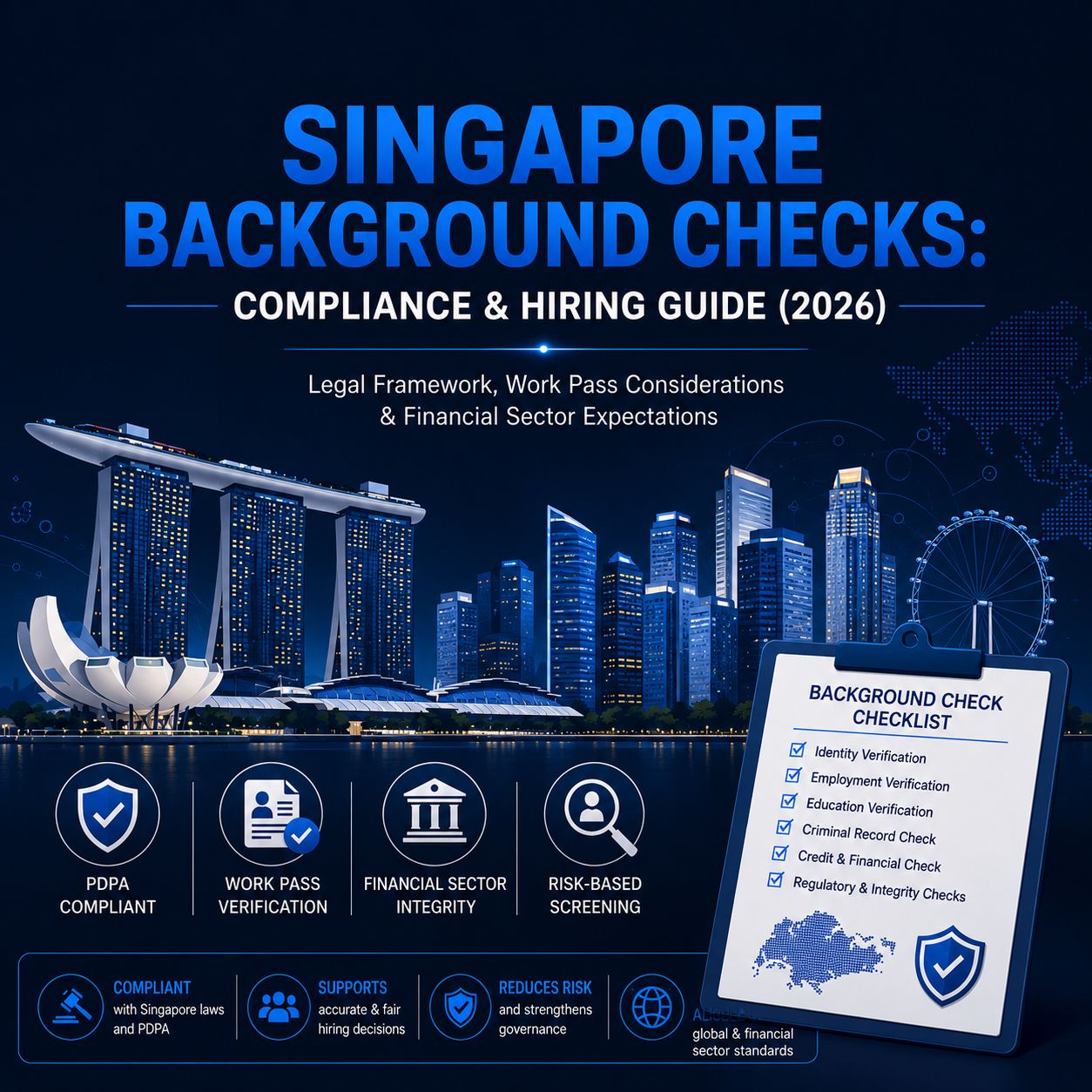
Singapore Background Checks: Compliance & Hiring Guide (2026)
Executive Summary
Singapore is one of Asia’s most compliance-driven employment markets. Background screening is widely practiced and increasingly expected, especially for regulated roles, financial institutions, senior appointments, and work pass-related hiring. Employers must ensure that background checks are aligned with the Personal Data Protection Act (PDPA), employment and work pass requirements, financial sector integrity expectations, and proportionality principles. A structured role-based background screening approach helps employers balance hiring risk, privacy obligations, and regulatory expectations.Introduction
Singapore is a highly regulated and compliance-focused employment environment. Background screening is common across multinational companies, financial institutions, technology firms, professional services, and employers sponsoring foreign talent. However, screening must be conducted in alignment with:- The Personal Data Protection Act (PDPA)
- Employment and work pass regulatory requirements
- Financial sector integrity and “fit and proper” expectations
- Proportionality and data minimization principles
- Documented consent and transparent candidate communication
Singapore Background Check – At a Glance
| Category | Singapore Position |
|---|---|
| Legal Framework | Personal Data Protection Act (PDPA) |
| Consent Required | Yes – explicit and informed |
| Criminal Record Access | Certificate of Clearance (COC), subject to controlled access |
| Employment Verification | Widely practiced |
| Education Verification | Common and institutionalized |
| Financial Sector Requirements | Fit and proper assessment expectations |
| Work Pass Relevance | Education and employment accuracy are critical |
| Cross-Border Data Transfer | Permitted with safeguards |
| Standard Employment Coverage | 5–7 years, depending on industry and role |
| Typical Turnaround | 3–10 business days depending on check type |
1. Legal Framework Governing Background Checks in Singapore
Background screening in Singapore is governed primarily by the Personal Data Protection Act (PDPA). The PDPA establishes key obligations for organizations that collect, use, disclose, retain, or transfer personal data. Core PDPA obligations relevant to background screening include:- Consent obligation
- Purpose limitation
- Data minimization
- Accuracy obligation
- Protection obligation
- Retention limitation
- Transfer limitation
Official PDPA guidance: Personal Data Protection Commission – Data Protection Obligations
2. Financial Sector Regulatory Context
For financial institutions and regulated roles, employers should also consider expectations set by Singapore’s financial regulatory environment. These expectations often emphasize fitness and propriety, integrity, honesty, reputation, governance, and risk management. In this context, background screening should support broader “fit and proper” assessments rather than operate as a standalone administrative process. Relevant checks may include employment verification, reference checking, regulatory history screening, sanctions screening, credit-related checks where justified, and conflict of interest review. For finance-sensitive roles, employers may also refer to this guide on financial background screening in Asia.3. MOM Employment Pass Verification & Qualification Verification in Singapore
In Singapore, educational and employment records can play an important role beyond standard background screening. This is especially relevant to Employment Pass (EP) applications administered by the Ministry of Manpower (MOM).3.1 When is qualification verification required for an Employment Pass?
Under COMPASS C2 (Qualifications), an EP candidate may receive points for qualifying educational or professional qualifications. If the candidate does not need points from C2, MOM states that the employer does not need to submit the candidate’s qualifications and verification proof. Where C2 qualification points are required, verification proof must be submitted with the declared qualification.Official source: Singapore Ministry of Manpower – Employment Pass eligibility and COMPASS C2
3.2 What must MOM verification proof confirm?
For educational qualifications, verification proof should establish the authenticity of the qualification and, where applicable, the accreditation status of the institution. MOM does not treat an education certificate, a notarised document or a school letter by itself as acceptable verification proof. Where proof is obtained from a background screening company, MOM requires it to come from a selected company and to contain an MOM verification reference number. MOM also states that a candidate’s qualification generally needs to be verified only once, subject to specific exceptions.Official sources: MOM – Documents required for Employment Pass | MOM – Verification proof requirements
3.3 MOM verification at a glance
| MOM / EP Question | 2026 Position |
|---|---|
| Must every EP candidate declare qualifications? | No. If C2 qualification points are not needed, MOM states that the candidate’s qualifications and verification proof do not need to be submitted. |
| When is verification proof required under COMPASS C2? | When the candidate needs points from the C2 Qualifications criterion, the declared qualification must be supported by verification proof. |
| What does educational verification confirm? | The authenticity of the qualification and, where applicable, the accreditation status of the institution. |
| Is a degree certificate alone accepted as verification proof? | No. MOM does not accept education certificates, notarised documents or school letters by themselves as verification proof. |
| Can a background screening company provide verification proof? | Yes, if it is one of the background screening companies selected and listed by MOM. |
| Does BSC verification proof need an MOM reference number? | Yes. Verification proof from a selected background screening company must contain an MOM verification reference number. |
| Does a qualification need to be verified for every subsequent application? | Generally no. MOM states that the candidate’s qualification only needs to be verified once, subject to specific exceptions. |
3.4 How eeCheck supports MOM verification
eeCheck is listed by Singapore’s Ministry of Manpower among the background screening companies able to verify qualifications and employment records from most countries and regions. Employers can therefore use eeCheck for relevant verification support where MOM requires proof from a selected background screening company.Official source: MOM – Selected background screening companies and verification requirements
4. Core Singapore Background Check Components
4.1 Identity Verification
Identity verification may include NRIC validation where lawfully permissible, passport verification, and work pass status confirmation. NRIC handling must be carefully managed in line with PDPA advisory expectations.4.2 Employment Verification
Employment verification confirms employment tenure, job title, nature of employment, and departure status where permissible. This check is widely used in Singapore and is especially important for regulated, senior, and work pass-related roles. Typical turnaround: 5–10 business days, depending on employer responsiveness.4.3 Performance Reference Check
Performance reference checks are particularly relevant for senior hires, regulated roles, financial institutions, and positions of trust. Structured reference checks may assess integrity, conduct, reason for departure, and disciplinary matters where legally appropriate. Typical turnaround: 3–7 business days.4.4 Education Verification
Singapore places strong emphasis on qualification accuracy. Education checks typically confirm degree authenticity, institution accreditation, and graduation date. These checks are common for work pass applicants, professional roles, and executive positions.4.5 Criminal Record Check
Criminal record checks are generally conducted through the Certificate of Clearance (COC), issued by the Singapore Police Force for immigration or overseas employment purposes. Access is controlled and typically requires candidate involvement. Typical turnaround: 3–7 business days, subject to official processing.4.6 Credit & Financial Checks
Credit and financial checks may be requested for finance-sensitive roles, senior executives, risk, treasury, compliance, or fiduciary positions. These checks must be proportionate, role-relevant, and supported by explicit consent.4.7 Regulatory & Integrity Checks
For financial institutions and regulated financial roles, integrity expectations are heightened. Employers may conduct regulatory history checks, sanctions and watchlist screening, conflict of interest reviews, and structured reference checks. Financial institutions should integrate screening into broader governance and risk management systems rather than treating it as a one-time hiring formality.5. Sensitivity Level of Singapore Screening Checks
| Check Type | Sensitivity Level | Legal Review Recommended |
|---|---|---|
| Identity | Moderate | No |
| Employment | Low | No |
| Education | Low | No |
| Criminal | High | Yes |
| Credit | High | Yes |
| Regulatory History | High | Yes |
| Sanctions | Moderate–High | Yes |
| Social Media | High | Yes |
6. Turnaround Time Summary – Singapore
| Check Type | Estimated Time |
|---|---|
| Identity | 1–3 business days |
| Employment | 5–10 business days |
| Performance Reference | 3–7 business days |
| Education | 3–7 business days |
| Criminal | 3–7 business days |
| Credit | 3–5 business days |
| Regulatory / Sanctions | 1–3 business days |
7. Risk-Based Screening in Singapore
Organizations commonly adopt tiered screening frameworks to ensure that checks are proportionate to role risk.| Tier | Role Type | Screening Depth |
|---|---|---|
| Tier 1 | Administrative | Identity, employment, education |
| Tier 2 | Professional | Identity, employment, education, license if applicable |
| Tier 3 | Finance / Sensitive | Criminal, credit, regulatory checks where justified |
| Tier 4 | Executive / Key Control | Comprehensive screening and enhanced governance review |
8. Data Protection & Cross-Border Considerations
Under PDPA, employers must ensure screening data is collected, processed, stored, retained, and transferred lawfully.- Use personal data only for clearly defined hiring purposes
- Collect only data necessary for the role and screening scope
- Apply secure storage and controlled access
- Maintain a defined retention schedule
- Use lawful safeguards for cross-border data transfers
- Document candidate consent and disclosure notices
Official PDPA guidance: PDPC – Advisory Guidelines on Key Concepts in the PDPA
9. Common Compliance Mistakes in Singapore
| Mistake | Risk Created |
|---|---|
| Using generic global consent | PDPA non-compliance |
| Over-screening junior roles | Proportionality risk |
| Failing to verify qualifications for work passes | Regulatory exposure |
| Undocumented escalation decisions | Audit risk |
| Improper NRIC handling | Regulatory penalty |
| Weak vendor oversight | Accountability and governance risk |
10. Executive Oversight Checklist – Singapore
| Governance Question | Yes / No |
|---|---|
| Is consent PDPA-compliant? | |
| Are work pass accuracy checks integrated? | |
| Is role-based screening applied? | |
| Is the criminal record check process structured correctly? | |
| Are financial sector integrity expectations addressed? | |
| Are discrepancy decisions documented? | |
| Are vendor responsibilities clearly defined? |
Frequently Asked Questions
Is background screening legal in Singapore?
Yes. Background screening is legal in Singapore when conducted in compliance with the PDPA, supported by proper consent, and limited to checks that are relevant and proportionate to the role.
Are financial institutions subject to higher screening expectations?
Yes. Financial institutions and regulated roles often require enhanced integrity, employment history, reference, sanctions, regulatory, and financial checks where appropriate.
Can Singapore background checks be conducted digitally?
Yes. Consent collection, document submission, verification workflows, and reporting can be conducted digitally, provided data protection and security obligations are met.
Are criminal record checks available in Singapore?
Criminal record checks are typically handled through the Certificate of Clearance process, which is controlled and generally requires candidate involvement.
Why are education checks important in Singapore?
Education checks are important for general hiring accuracy and may also support work pass applications where qualification verification is required.
Does MOM require qualification verification for every Employment Pass application?
No. Under COMPASS C2, if the candidate does not need qualification points, MOM states that the qualifications and verification proof do not need to be submitted. Where C2 qualification points are required, verification proof must support the declared qualification.
What is MOM verification proof for an Employment Pass?
For educational qualifications, verification proof confirms the authenticity of the qualification and, where applicable, the accreditation status of the awarding institution. MOM accepts proof only from specified sources.
Can a background screening company provide MOM qualification verification?
Yes. MOM accepts verification proof from background screening companies on its published list, subject to its requirements. Proof from a selected background screening company must contain an MOM verification reference number.
Is eeCheck listed by Singapore MOM for verification services?
Yes. eeCheck is included on MOM’s published list of background screening companies able to verify qualifications and employment records from most countries and regions.
Does MOM accept a degree certificate as verification proof?
No. MOM states that education certificates, notarised documents and school letters by themselves are not accepted as verification proof.
Does a candidate’s qualification need to be verified again for every work pass application?
Generally no. MOM states that a candidate’s qualification only needs to be verified once, although specific exceptions apply, including certain verification proofs issued before 1 September 2023.
Final Strategic Takeaway
Singapore background screening operates within a structured compliance environment. Employers must align screening with PDPA obligations, work pass accuracy requirements, financial sector integrity expectations, and role-based proportionality. Recommended approach: use clear consent, verify qualifications and employment history carefully, apply risk-based screening tiers, document discrepancy decisions, and maintain strong vendor governance. In Singapore’s highly regulated hiring environment, structured and defensible screening processes are essential for compliant recruitment and long-term workforce risk management.Related Resources
- Asia Background Check Guide
- Asia Background Check Compliance
- Compliant Background Screening Policy in Asia
- Background Screening Policy Template Asia Pacific
- In-House vs Outsourced Screening in Asia
- Top Background Check Firm in Asia
- Hong Kong Background Check Guide
- Global Background Check Firms in Asia: Common Mistakes

