

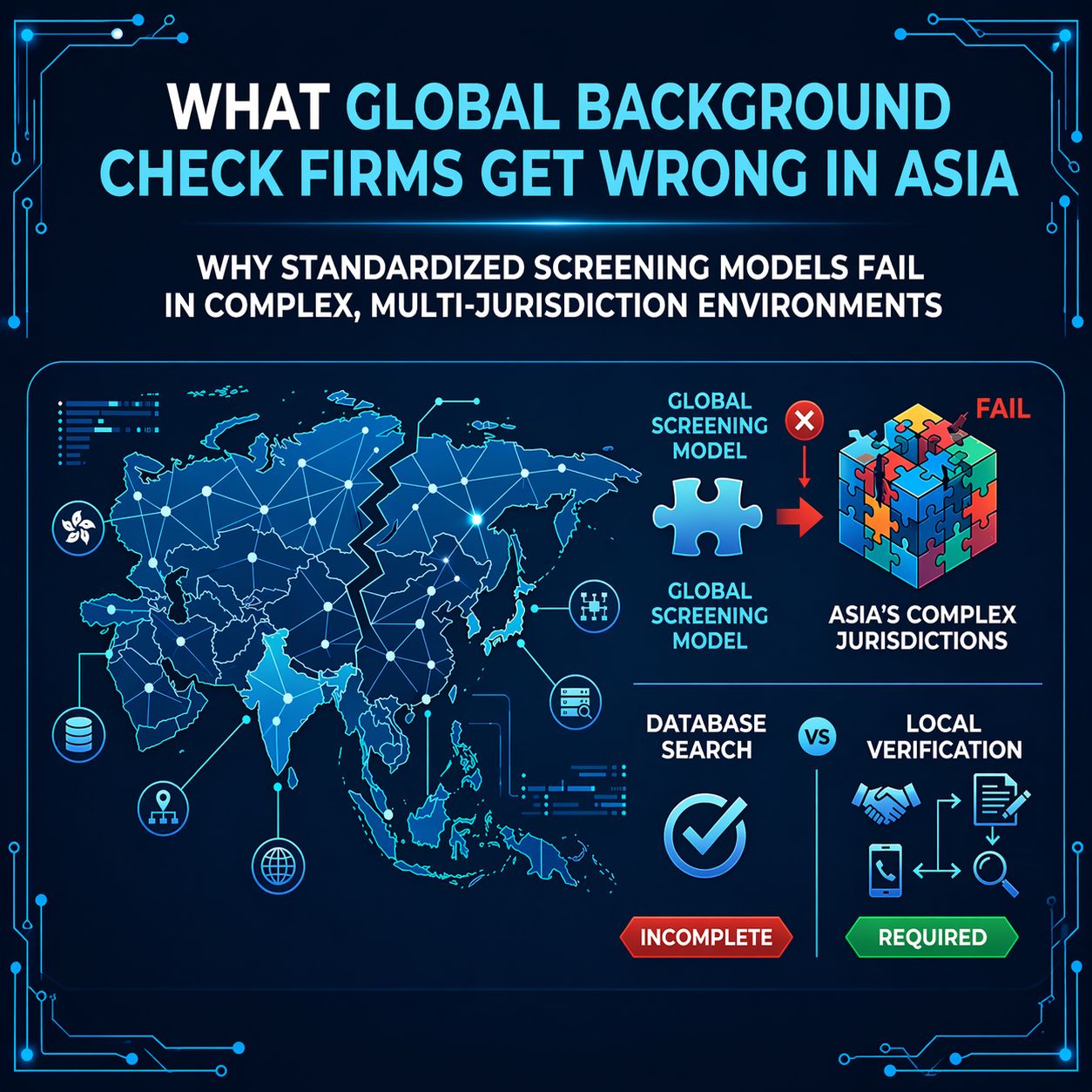
What Global Background Check Firms Get Wrong in Asia
Why Standardized Screening Models Fail in Complex, Multi-Jurisdiction Environments
Executive Summary
Global background check firms often apply standardized screening models designed for centralized, data-rich markets. In Asia, this approach can fail because legal frameworks, data access, institutional verification practices, and compliance requirements vary significantly by jurisdiction.
Effective screening in Asia requires localized execution, compliance-driven workflows, regional governance, and strong verification methodology. For broader regional guidance, see our Asia Background Screening Executive Briefing and Asia Background Check Guide.
Key Takeaways
| Issue | Why It Matters in Asia |
|---|---|
| Global screening models are designed for centralized markets | Asia is fragmented across legal, regulatory, language, and verification environments. |
| Over-reliance on databases | Database-only screening can create incomplete or misleading outcomes. |
| Lack of local execution | Institutional engagement and local process knowledge are often required. |
| Compliance added too late | Compliance must be built into screening workflows from the start. |
| Standardization over regional adaptation | Effective Asia screening requires regional execution, not global templates alone. |
Introduction
Global background screening firms have developed strong capabilities in markets with centralized data infrastructure, standardized verification processes, and predictable regulatory environments.
However, when applied to Asia, these models often encounter structural limitations.
Asia is not a single market — it is a collection of distinct legal, operational, and verification environments.
1. Over-Reliance on Databases
In many Western markets, background checks rely heavily on centralized criminal databases, credit bureaus, and digital identity systems.
| Western-Market Assumption | Asia Reality | Potential Result |
|---|---|---|
| Centralized databases provide reliable coverage | Data is often fragmented or restricted | Incomplete verification |
| Database results are sufficient for decision-making | Verification often requires direct institutional engagement | False confidence in results |
| Digital records are consistently available | Record access varies by jurisdiction and institution | Increased compliance and accuracy risk |
Database-only screening approaches are often insufficient in Asian markets.
2. Applying Standardized Global Workflows
Global providers often operate using fixed workflows, uniform SLAs, and centralized process design.
| Market | Local Screening Complexity |
|---|---|
| Hong Kong | Controlled criminal record access and strong data protection expectations. See also Hong Kong Background Check Guide. |
| Singapore | Regulatory-driven verification requirements and structured consent expectations. |
| India | Variable institutional responsiveness and decentralized verification processes. |
| Japan / Korea | Strict privacy frameworks and cultural sensitivity around candidate data. |
Standardization without localization leads to inefficiency and inconsistency.
3. Underestimating Local Execution Complexity
Successful verification in Asia often depends on direct institutional engagement, language capability, understanding of local processes, and on-the-ground execution.
| Execution Gap | Impact |
|---|---|
| Centralized operations without local expertise | Slower turnaround times |
| Dependence on intermediaries | Inconsistent verification quality |
| Limited local infrastructure | Reduced reliability and weaker escalation handling |
4. Treating Compliance as a Layer, Not a Foundation
Many providers build workflows first and adapt compliance later.
This approach often fails in Asia, where data protection laws, role-based proportionality expectations, and regulatory scrutiny require compliance to be embedded into process design.
| Compliance Area | Asia Consideration |
|---|---|
| Data protection | PDPO, PDPA, PIPL, PIPA and other local frameworks may apply. |
| Consent | Consent must be clear, informed, and aligned with the jurisdiction. |
| Proportionality | Checks should match role risk and legitimate business need. |
| Cross-border transfer | Candidate data movement must be transparent and legally structured. |
For additional guidance, see Compliant Background Screening Policy in Asia, Background Screening Policy Template: Asia-Pacific, and Background Check Compliance in Asia.
5. Fragmented Delivery Models
A common structure involves different teams handling different countries, disconnected workflows, and inconsistent reporting standards.
| Fragmentation Issue | Client Impact |
|---|---|
| Different country teams | Communication gaps |
| Disconnected workflows | Inconsistent service quality |
| Different reporting formats | Lack of unified control and audit difficulty |
Clients may experience multiple providers rather than a single integrated solution.
6. Misunderstanding Cross-Border Hiring
Many firms assume that if they can operate locally, they can scale regionally. In reality, cross-border hiring requires a distinct capability.
| Cross-Border Requirement | Why It Matters |
|---|---|
| Data transfer compliance | Candidate data may cross legal boundaries. |
| Multi-jurisdiction coordination | Different checks may require different legal and operational handling. |
| Consistent reporting | Regional HR and compliance teams need comparable outputs. |
| Standardized verification frameworks | Governance should be consistent even when execution is localized. |
7. Prioritizing Speed Over Accuracy
Automation-driven models often emphasize faster turnaround and high-volume processing.
| Speed-First Risk | Potential Consequence |
|---|---|
| Incomplete verification | Important information may be missed. |
| Missed discrepancies | Hiring decisions may rely on incomplete evidence. |
| Reduced defensibility | Reports may be harder to justify during audits or disputes. |
Speed without verification depth introduces hidden risk.
What Actually Works in Asia
| Effective Model Component | Purpose |
|---|---|
| Localized execution | Supports institutional verification and local process navigation. |
| Central governance | Maintains consistency across jurisdictions. |
| Structured workflows | Improves reporting, escalation, and audit readiness. |
| Compliance-driven design | Reduces regulatory exposure and supports defensible hiring. |
The most effective approach integrates local expertise with scalable systems. For practical screening models, see Role-Based Background Screening in Asia and Risk-Based Background Screening in Asia.
Conclusion
Global background check firms do not fail in Asia due to lack of capability. They fail due to misalignment of operating models.
Asia requires a fundamentally different approach — one that prioritizes execution, compliance, and consistency over standardization alone.
Final Strategic Takeaway
Background screening in Asia is not a plug-and-play extension of global screening models. It requires regional expertise, localized execution, strong governance, and compliance-first design.
Organizations that rely only on standardized workflows or database-driven screening risk incomplete verification, operational inconsistency, and weaker hiring defensibility.
Frequently Asked Questions
Why do global background check firms struggle in Asia?
Global firms often apply standardized models that do not align with fragmented regulatory, data access, and verification environments across Asian markets.
Are database checks sufficient in Asia?
No. Many Asian jurisdictions require direct institutional verification, making database-only approaches insufficient.
What is the biggest risk when using global screening providers in Asia?
The biggest risk is inconsistent verification and potential compliance exposure due to lack of local adaptation.
How should companies approach background screening in Asia?
Organizations should adopt a structured, compliance-driven, and regionally integrated approach combining technology with local execution.
Explore Further
- Compliant Background Screening Policy in Asia
- Background Screening Policy Template: Asia-Pacific
- Role-Based Background Screening in Asia
- Risk-Based Background Screening in Asia
- Background Check Compliance in Asia
- Asia Background Check Guide
- Financial Background Screening in Asia
- Asia Background Screening Executive Briefing
- Background Screening Vendor Questions in Asia
- In-House vs Outsourced Screening in Asia
- Top Background Check Firm in Asia
- Hong Kong Background Check Guide

