

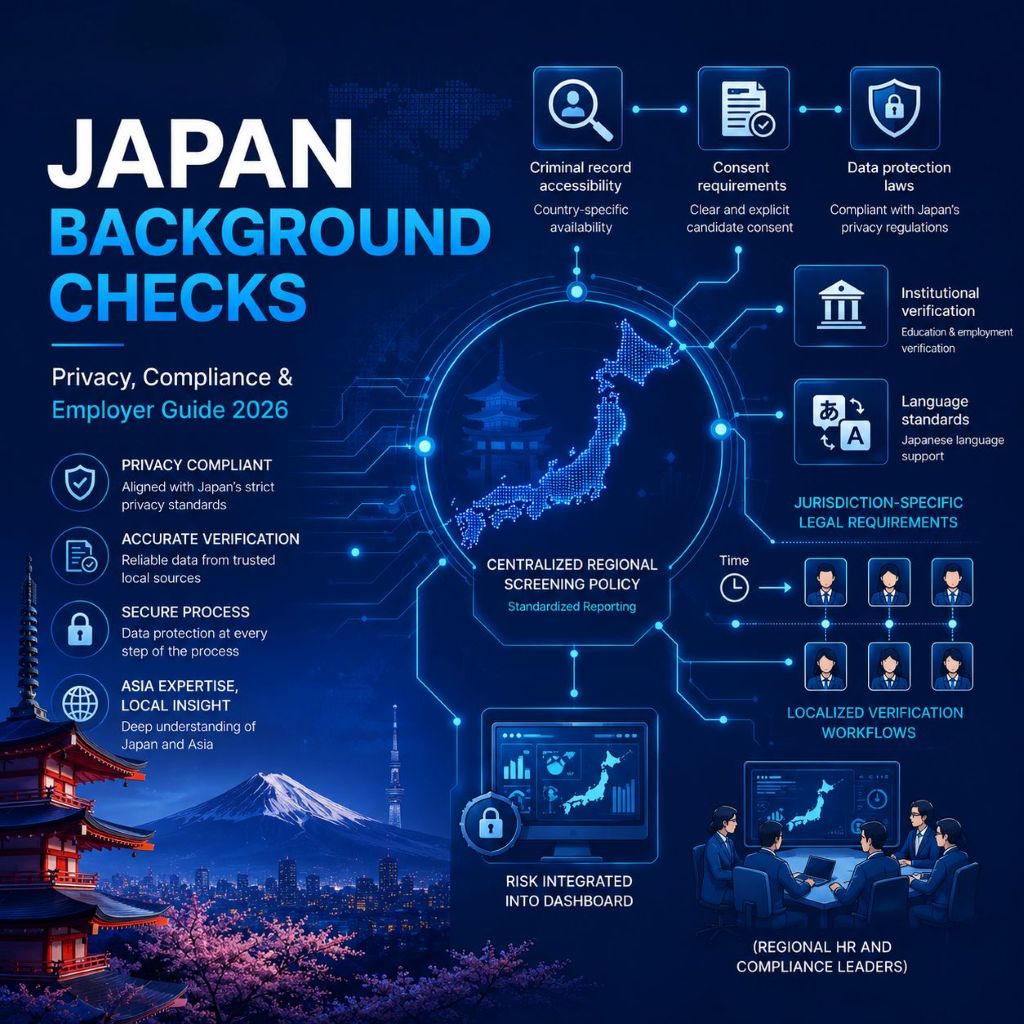
Japan Background Checks: Privacy, Compliance & Employer Guide 2026
Legal Framework, Privacy Considerations & Employer Screening Practices
Japan is one of Asia’s most privacy-conscious and relationship-driven employment markets. Background screening is widely used by multinational corporations, financial institutions, regulated industries, technology companies, and employers seeking to reduce hiring risk. However, Japan background checks must be conducted carefully, with attention to privacy, consent, proportionality, and cultural expectations.
Executive Summary
Background screening in Japan is generally possible when supported by clear candidate consent, a legitimate hiring purpose, and proportionate screening scope. Employers should take a careful approach because Japan’s privacy environment is strict, criminal record access is highly restricted, and many employers provide only limited information during employment verification.
For regional screening program design, employers should align Japan screening practices with a broader compliant background screening policy in Asia, use a clear background screening policy template for Asia-Pacific, and follow practical guidance from eeCheck’s Asia background check compliance guide.
Japan background checks work best when employers apply a role-based, risk-based, and documentation-led approach. This helps reduce legal exposure while supporting fair, consistent, and defensible hiring decisions.
Download Executive BriefingIntroduction: Why Japan Background Checks Require Careful Handling
Japan has a distinct employment culture and privacy framework. Employers conducting background checks should respect the candidate’s privacy, clearly explain the purpose of screening, avoid excessive data collection, and ensure all checks are relevant to the role.
Common considerations include:
- The Act on the Protection of Personal Information (APPI)
- Clear and specific candidate consent
- Restrictions surrounding sensitive personal information
- Purpose limitation and data minimization
- Local employer verification practices
- Cross-border data transfer safeguards
For employers building regional screening programs, Japan should be considered alongside broader APAC compliance planning. See eeCheck’s Asia Background Check Guide and Asia Background Screening Report for wider regional context.
Japan Background Check – At a Glance
| Category | Japan Position |
|---|---|
| Legal Framework | Act on the Protection of Personal Information (APPI) |
| Consent Required | Yes – explicit and specific consent is recommended |
| Criminal Record Access | Highly restricted and generally not available to employers |
| Employment Verification | Possible, but often limited by employer disclosure practices |
| Education Verification | Common and generally reliable |
| Credit Check | Generally not utilized for employment purposes |
| Data Localization | Not mandatory |
| Cross-Border Data Transfer | Permitted with safeguards and appropriate disclosure |
| Standard Coverage | 3–5 years typical, depending on role risk |
| Typical Turnaround | 5–12 business days |
1. Legal Framework Governing Background Checks in Japan
Background screening activities in Japan are primarily governed by the Act on the Protection of Personal Information (APPI). Employers should ensure that personal information is collected and processed transparently, securely, and only for legitimate hiring purposes.
| Compliance Principle | Employer Consideration |
|---|---|
| Purpose Disclosure | Clearly explain why the information is being collected and how it will be used. |
| Consent | Obtain clear candidate consent before initiating screening checks. |
| Data Minimization | Collect only information necessary for the role and hiring purpose. |
| Secure Handling | Apply controlled access, secure storage, and appropriate retention practices. |
| Transparency | Keep candidates informed about the screening scope and third-party providers where applicable. |
Employers operating across multiple Asian jurisdictions may benefit from aligning Japan procedures with a risk-based background screening framework in Asia.
2. Consent Requirements in Japan
Consent is one of the most important components of lawful and defensible background screening in Japan. Consent language should be specific, transparent, and proportionate to the screening scope.
Recommended Consent Elements
| Consent Element | Why It Matters |
|---|---|
| Types of Checks | Clarifies whether the screening includes identity, employment, education, litigation, reference, or other checks. |
| Purpose of Screening | Links the screening activity to legitimate hiring, compliance, or risk management purposes. |
| Scope of Information | Helps avoid overly broad or excessive data collection. |
| Retention and Handling | Explains how information will be stored, accessed, and retained. |
| Cross-Border Transfers | Important for multinational employers using regional or global screening providers. |
| Third-Party Providers | Informs candidates when an external screening provider is involved. |
For regional policy design, employers can refer to eeCheck’s background screening policy template for Asia-Pacific.
3. Japan Background Check Process Flow
A structured screening workflow helps employers improve consistency, audit readiness, and candidate experience.
| Step | Action | Responsible Party |
|---|---|---|
| 1 | Role risk classification | Employer |
| 2 | Consent collection | Candidate |
| 3 | Information submission | Candidate |
| 4 | Verification initiation | Screening Provider |
| 5 | Institutional or employer outreach | Screening Provider |
| 6 | Discrepancy review | HR / Compliance |
| 7 | Report issuance | Screening Provider |
| 8 | Hiring decision documentation | Employer |
Role classification is especially important in Japan. Employers should avoid applying unnecessary checks to low-risk roles. For more guidance, see role-based background screening in Asia.
4. Core Japan Background Check Services
4.1 Identity Verification
Identity verification may involve reviewing candidate-provided identity documentation and other lawful verification methods where appropriate. Because personal identifiers can be sensitive, employers should ensure identity checks remain proportionate, transparent, and aligned with APPI requirements.
4.2 Employment Verification
Employment verification in Japan may confirm employment dates, job title, and employer name. However, many employers are cautious when responding to verification requests.
| Employment Verification Area | Japan Practical Consideration |
|---|---|
| Employment Dates | May be confirmed where employer policy allows disclosure. |
| Job Title | Often available, but may depend on HR responsiveness. |
| Employer Name | Usually confirmable if documentation and consent are sufficient. |
| Reason for Leaving | Often limited or unavailable due to privacy and employer policy. |
| Performance Information | Usually handled through candidate-provided references, where appropriate. |
For deeper regional context, see eeCheck’s guide on employment verification in Asia.
4.3 Professional Reference Checks
Reference checks are typically conducted using candidate-provided referees. They are most commonly used for senior management positions, regulated roles, specialist hires, and leadership appointments.
4.4 Education Verification
Education verification is one of the more established and reliable screening components in Japan. It may confirm degree authenticity, educational institution, graduation details, and academic credentials.
4.5 Criminal Record Checks
Criminal record access in Japan is highly restricted. Official criminal records are generally not available to employers for employment screening purposes. Employers should avoid assuming that criminal record checks available in other jurisdictions can be replicated in Japan.
For comparison with other Asian markets, see eeCheck’s Hong Kong criminal record check guide and China background check process guide.
4.6 Credit Checks
Credit information is considered highly sensitive. Due to privacy considerations and data sensitivity, credit checks are generally not utilized for employment screening purposes in Japan.
4.7 Litigation & Public Record Searches
Public record searches may include civil litigation records, bankruptcy filings, and other publicly available legal information. Any use of public information should remain relevant to the role and proportionate to the hiring purpose.
4.8 Directorship & Corporate Registry Searches
Corporate registry searches may identify directorships, shareholding interests, corporate affiliations, and potential conflicts of interest. These searches may be relevant for regulated industries, executive hiring, financial services, and governance-related roles.
5. Sensitivity of Screening Checks
Japan generally requires a cautious approach to screening activities, especially when sensitive personal information may be involved.
| Check Type | Sensitivity | Additional Review Recommended |
|---|---|---|
| Identity | High | Yes |
| Employment | Moderate | No |
| Education | Low | No |
| Criminal | Very High | Yes |
| Credit | Very High | Yes |
| Litigation | Moderate | Role-dependent |
| Social Media | High | Yes |
Employers should consider whether a check is necessary for the role before initiating it. This is especially important for sensitive roles and regulated positions. For related guidance, see financial background screening in Asia.
6. Turnaround Time Summary
| Check Type | Estimated Time | Practical Notes |
|---|---|---|
| Identity | 2–5 business days | Depends on documentation quality and verification method. |
| Employment | 5–10 business days | Depends on employer responsiveness and candidate cooperation. |
| Reference | 3–7 business days | Depends on referee availability. |
| Education | 3–7 business days | Depends on institutional process and authorization requirements. |
| Litigation | 5–10 business days | Depends on the scope and available public records. |
Employers should avoid judging screening quality by speed alone. For more on turnaround expectations across Asia, see why fast turnaround time in Asia does not always mean accurate background checks.
7. Data Protection & Governance Considerations
Strong governance controls help reduce both regulatory and reputational risks in Japan. Employers should ensure that background screening programs include clear policies, limited access controls, appropriate retention standards, and secure handling procedures.
| Governance Area | Recommended Approach |
|---|---|
| Data Minimization | Collect only the information necessary for the role and stated purpose. |
| Purpose Limitation | Use screening data only for disclosed hiring or compliance purposes. |
| Controlled Access | Limit access to HR, compliance, and authorized decision-makers. |
| Retention Policy | Retain information only as long as necessary and in accordance with policy. |
| Secure Storage | Use appropriate technical and organizational security controls. |
| Cross-Border Transfers | Disclose cross-border processing and apply safeguards where applicable. |
For multinational employers, Japan screening should be integrated into broader regional governance. See MNC background screening in Asia and Asia background screening executive briefing.
8. Common Compliance Risks
| Risk | Potential Impact | Recommended Control |
|---|---|---|
| Over-collection of personal information | Regulatory and reputational exposure | Apply data minimization and role-based screening. |
| Improper consent structures | Compliance risk | Use clear, specific, and localized consent language. |
| Unauthorized use of sensitive information | Legal and reputational risk | Require additional review for sensitive checks. |
| Insufficient documentation | Audit exposure | Maintain screening records, consent evidence, and decision rationale. |
| Over-screening | Proportionality concerns | Match checks to role risk and business necessity. |
Many screening failures come from poor scope design, weak documentation, or applying global templates without local adaptation. See eeCheck’s guide on why background checks fail in Asia.
9. eeCheck Perspective: Screening in Japan
Japan remains one of Asia’s most privacy-conscious employment markets. While background screening is generally permissible when conducted appropriately, employers should recognize that practices commonly used in other jurisdictions may not translate directly into Japan.
Successful screening programs in Japan typically emphasize:
- Clear and specific candidate consent
- Purpose-driven and proportionate data collection
- Respect for privacy and reputation considerations
- Appropriate handling of sensitive information
- Strong governance and documentation controls
For employers selecting a screening partner, see eeCheck’s background screening vendor questions for Asia, in-house vs outsourced screening in Asia, and top background check firm in Asia.
Executive Oversight Checklist
Before Implementing a Screening Program in Japan
- Is consent compliant with APPI and clearly documented?
- Is the screening scope proportionate to the role?
- Are controls in place for handling sensitive information?
- Is documentation sufficient for audit and governance purposes?
- Are cross-border data transfers appropriately disclosed?
Frequently Asked Questions
Is background screening legal in Japan?
Yes. Background screening is generally permissible in Japan when conducted in compliance with APPI, supported by appropriate candidate consent, and limited to a legitimate and proportionate hiring purpose.
Can employers access criminal records in Japan?
Official criminal records are generally not available to employers for employment screening purposes. Employers should be careful not to assume that Japan offers the same criminal record access available in other jurisdictions.
Are credit checks commonly processed in Japan?
No. Due to data sensitivity and privacy considerations, credit checks are generally not utilized for employment screening purposes in Japan.
Is Japan considered a strict privacy market?
Yes. Japan is widely regarded as one of Asia’s more privacy-conscious jurisdictions. Employers should take a careful, transparent, and proportionate approach to screening activities.
Final Strategic Takeaway
Background screening in Japan is privacy-driven, legally sensitive, culturally nuanced, and governance-focused. Employers should balance compliance, proportionality, and practical verification objectives when designing screening programs.
Recommended practices include limiting screening scope to what is necessary, structuring consent clearly, avoiding over-collection of information, applying risk-based screening frameworks, and maintaining strong governance controls.
In Japan’s privacy-conscious environment, disciplined and proportionate screening practices are essential to achieving compliant and defensible hiring outcomes. For future-ready screening program design, employers may also review eeCheck’s guidance on AI background check automation risks and the future of background checks in Asia.
About eeCheck
eeCheck is an Asia-focused employment screening and verification provider supporting 5,000+ organizations across Asia, including financial institutions, government agencies, technology companies, multinational corporations, and regulated industries.
With operations across 10+ countries and local verification teams throughout Asia, eeCheck assists employers in navigating country-specific screening requirements, privacy regulations, and cross-border verification challenges.
As hiring becomes increasingly global, organizations face growing complexity in verifying employment history, academic qualifications, professional credentials, litigation records, and other risk indicators across multiple jurisdictions. eeCheck helps employers implement consistent, risk-based screening programs while adapting to local legal, regulatory, and cultural requirements.
Drawing on extensive experience across Asia’s diverse regulatory environments, eeCheck provides practical guidance on background screening governance, verification methodologies, privacy compliance, and emerging employment screening trends. Our focus is to help organizations make informed hiring decisions while maintaining compliance, fairness, and candidate trust.
For additional regional resources, see eeCheck’s common mistakes global background check firms make in Asia, Singapore background checks guide, Hong Kong background check guide, and Vietnam background checks guide.

