

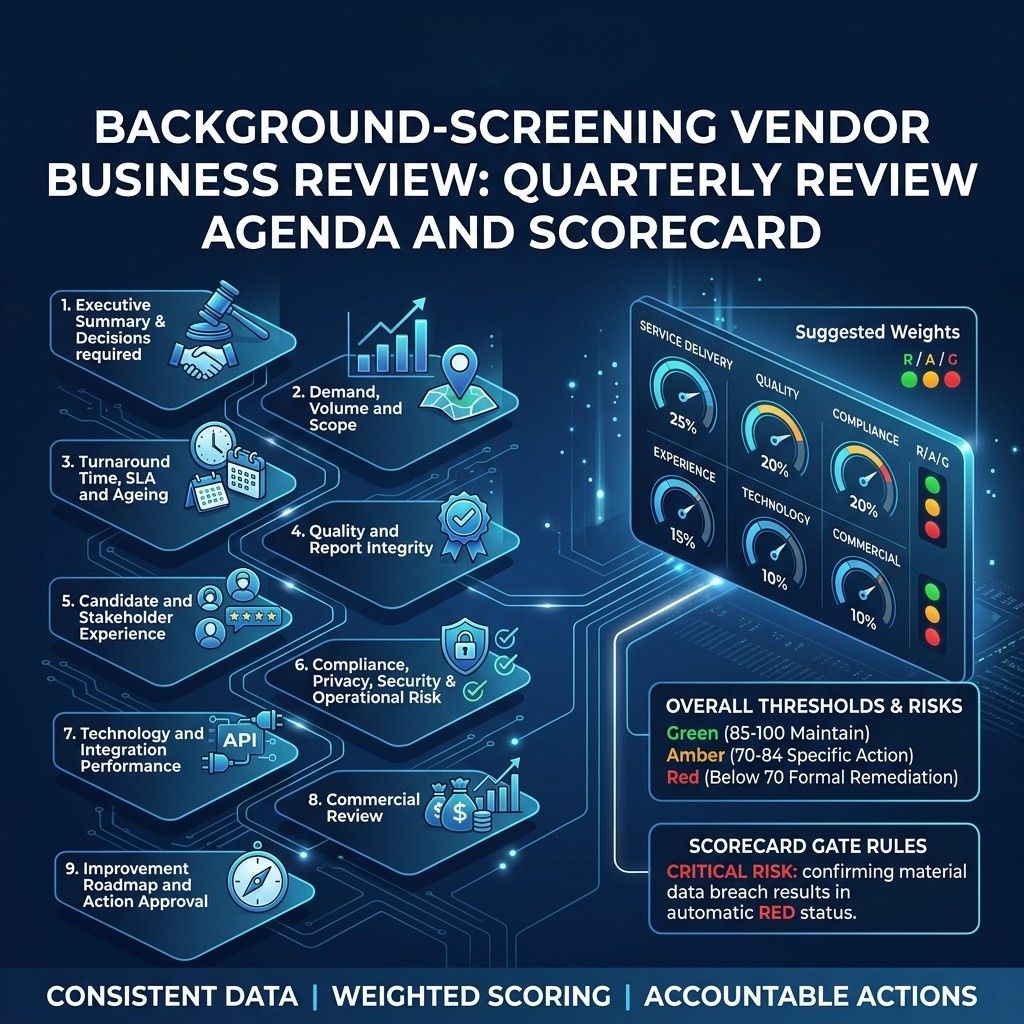
Background-Screening Vendor Business Review: Quarterly Review Agenda and Scorecard
Published: 15 September 2026 | Last updated: 15 September 2026
Hiring teams often review a background-screening provider only when a case is delayed or a serious issue has occurred. That is too late — and too narrow.
A structured quarterly business review (QBR) gives HR, talent acquisition, procurement, compliance and the screening provider a regular forum to evaluate whether the programme is delivering the right combination of speed, accuracy, candidate experience, compliance and operational resilience.
The purpose is not to spend an hour reading performance statistics aloud. A useful QBR explains what happened, why it happened, what risks or opportunities are emerging, and what each party will do next.
Executive Summary
A background-screening vendor QBR is a periodic governance meeting between an employer and its screening provider. It should go beyond SLA reporting to review programme outcomes, root causes, risks, quality, candidate experience, technology, compliance, commercial performance and improvement actions.
For established programmes, quarterly reviews are usually frequent enough to identify meaningful trends without allowing recurring problems to remain unaddressed for too long. New launches, high-volume programmes or materially underperforming services may require monthly reviews until performance stabilises.
A strong QBR should combine three things: consistent data, weighted scoring and accountable actions. The scorecard creates discipline, but the discussion should focus on causes, trade-offs and decisions — not simply whether one headline SLA was met.
For related governance tools, see eeCheck’s Background Check SLA Template for Asia, Background Screening Vendor Questions in Asia, In-House vs Outsourced Screening in Asia and Compliant Background Screening Policy in Asia.
What Is a Background-Screening Vendor QBR?
A background-screening vendor QBR is a periodic governance meeting between an employer and its screening provider. It typically reviews service demand and completion volumes; turnaround time and SLA performance; quality, discrepancies and rework; candidate and stakeholder experience; compliance, privacy and security matters; operational risks and country-specific developments; technology and integration performance; commercial performance; and agreed improvements for the next quarter.
QBR, SLA Review and Procurement Review: What Is the Difference?
| Review Mechanism | Primary Purpose | Typical Frequency | Core Question |
|---|---|---|---|
| Operational review | Resolve current cases, queues and immediate delivery issues | Weekly or monthly | What needs attention now? |
| SLA review | Measure performance against contracted service commitments | Monthly or quarterly | Did the provider meet the agreed service levels? |
| Quarterly business review | Evaluate programme outcomes, trends, risks and improvements | Quarterly | Is the overall programme working well, and what should change? |
| Procurement / contract review | Assess commercial value, contract performance and renewal options | Annually or before renewal | Should the organisation renew, renegotiate or retender? |
An SLA report is an input to the QBR, not the whole QBR. A provider could technically meet its headline SLA while creating unnecessary candidate follow-ups, producing inconsistent reports or failing to anticipate country-level risks. Conversely, a temporary fall in turnaround performance may be explainable by an institution closure, public holiday or government-source outage.
For a broader view of turnaround governance, see eeCheck’s Background Check Turnaround in Asia and Turnaround Time in Asia: Why “Fast” Is Not Always Accurate.
Who Should Attend?
- the employer’s programme owner in HR, talent acquisition or people operations;
- procurement or vendor management;
- compliance, legal, privacy or information security representatives where relevant;
- regional or business-unit stakeholders;
- the provider’s account lead;
- the provider’s operations or service-delivery lead; and
- technical or product representatives when integrations or workflow changes are on the agenda.
Not everyone needs to attend every meeting. A better model is to maintain a small accountable core group and invite subject-matter experts for specific agenda items.
What Should Be Sent Before the Meeting?
The QBR pack should normally be circulated three to five business days in advance. This allows participants to investigate exceptions before the meeting and reserve meeting time for decisions.
| QBR Pack Component | What It Should Show |
|---|---|
| Executive summary and overall score | Programme status, trend, key risks and decisions required |
| Volumes and scope | Cases and checks by country, business unit and check type |
| Turnaround performance | Median, percentile performance, SLA attainment and material misses |
| Ageing and WIP | Open-case ageing and long-running cases |
| Quality and rework | Errors, amendments, rework, complaints and QA findings |
| Candidate / stakeholder experience | Response time, follow-ups, complaints and recurring confusion points |
| Risk and compliance | Incidents, regulatory updates, audit findings and privacy/security matters |
| Technology | Integration availability, failed transactions and workflow issues |
| Commercial | Spend, pricing, pass-through fees, credits and invoice accuracy |
| Action tracking | Status of previous-quarter commitments |
Recommended 60–90 Minute QBR Agenda
1. Executive Summary and Decisions Required — 5–10 Minutes
Begin with the overall programme position, not a page-by-page reading of the report. Cover overall red, amber or green status, material improvements or deterioration, the three most important risks or opportunities, decisions required and overdue actions from the previous QBR.
2. Demand, Volume and Scope — 5–10 Minutes
Review total cases and checks ordered, volume changes, distribution by country/entity/business unit/package, cancellations, urgent requests and expected recruitment campaigns or market entries. Volume gives essential context when performance changes.
3. Turnaround Time, SLA and Ageing — 15 Minutes
- percentage completed within the agreed SLA;
- median turnaround time;
- 80th or 90th percentile turnaround time for high-volume services;
- ageing of open cases;
- performance by check type and country;
- provider-controlled versus third-party or candidate-dependent delay; and
- recurring delay reasons.
Where exclusions or paused-clock rules apply, report both the contractual result and the real candidate elapsed time.
4. Quality and Report Integrity — 10–15 Minutes
Quality should be assessed independently of speed. Measures may include report amendment rate, substantiated error rate, internal QA findings, rework, inconsistent classifications, dispute outcomes and repeated errors by check type, country or workflow.
One material misidentification or improper disclosure may be more significant than several minor formatting corrections. High-severity issues should receive greater weight than minor errors.
5. Candidate and Stakeholder Experience — 10 Minutes
Review candidate contact rate, response time, follow-up volume, portal completion, complaints, client enquiry response, escalation handling, accessibility or language issues, and recurring points of confusion.
6. Compliance, Privacy, Security and Operational Risk — 10–15 Minutes
Consider changes to screening requirements or source availability, consent and data-minimisation controls, retention and deletion, data-subject requests, access-control reviews, security incidents, audit findings, subcontractor oversight, business continuity and material processing changes.
Related guidance includes eeCheck’s Asia Background Check Compliance Guide, Risk-Based Background Screening in Asia and Role-Based Background Screening in Asia.
7. Technology and Integration Performance — 5–10 Minutes
For integrated programmes, review API, ATS or HRIS availability, failed transactions, duplicate orders, status-sync errors, manual workarounds, release-related incidents, user access issues and planned enhancements.
An integration should be measured by business outcomes, not only technical uptime. See eeCheck’s ATS Background Check Integration Workbook.
8. Commercial Review — 5–10 Minutes
Review spend against budget, price and volume-band performance, unused packages, pass-through fees, credits, invoice accuracy and opportunities to rationalise packages.
9. Improvement Roadmap and Action Approval — 10 Minutes
Conclude with a short, prioritised action plan. For each action, record the issue, agreed action, accountable owner, due date, intended outcome and dependencies.
Quarterly Background-Screening Vendor Scorecard
| Category | Suggested Weight | Example Measures |
|---|---|---|
| Service delivery and turnaround | 25% | SLA attainment, median and percentile TAT, open-case ageing, escalation frequency |
| Quality and report integrity | 20% | Substantiated errors, amendments, rework, QA findings, dispute outcomes |
| Compliance, privacy and security | 20% | Control performance, incidents, audit actions, retention, change notification |
| Candidate and client experience | 15% | Response time, complaints, satisfaction, clarity of communications, escalation handling |
| Technology and reporting | 10% | Integration reliability, data accuracy, report timeliness, workflow effectiveness |
| Commercial management and value | 10% | Invoice accuracy, budget performance, price compliance, cost optimisation, innovation delivered |
| Total | 100% |
These weights deliberately prevent turnaround time from becoming the only measure of performance. For regulated or high-risk programmes, compliance and quality may deserve greater weight. Highly automated, high-volume programmes may give more weight to technology performance.
How to Score Each Category
| Rating | Meaning | General Interpretation |
|---|---|---|
| 5 | Excellent | Materially exceeds requirements and demonstrates proactive improvement |
| 4 | Good | Meets requirements consistently, with only minor exceptions |
| 3 | Acceptable | Generally meets requirements but improvement is needed in identifiable areas |
| 2 | Weak | Repeated or material underperformance requiring a corrective plan |
| 1 | Critical | Serious control or service failure requiring immediate intervention |
Weighted points = category rating ÷ 5 × category weight
If service delivery is rated 4 out of 5 and carries a 25% weight, it contributes 20 points to the total score.
Suggested Overall Thresholds
| Overall Score | Status | Expected Response |
|---|---|---|
| 85–100 | Green | Maintain performance and pursue targeted improvements |
| 70–84 | Amber | Agree specific improvement actions and monitor affected metrics |
| Below 70 | Red | Formal remediation plan, increased review frequency and potential commercial or contractual action |
An overall score should never override a critical-risk rule. A provider should not receive a green status merely because strong scores in low-risk categories offset a serious compliance, privacy, security or report-integrity failure.
Example Scorecard Gates
- any confirmed material data breach results in an automatic red status pending assessment;
- any critical report-integrity incident requires executive review;
- two consecutive quarters below the quality threshold trigger a formal corrective-action plan; and
- overdue high-risk audit actions prevent an overall green rating.
Example Detailed Scorecard
| Category | KPI | Target / Assessment Basis | Result | Rating (1–5) | Commentary / Action |
|---|---|---|---|---|---|
| Service delivery | Cases completed within SLA | Contracted target | |||
| Service delivery | Open cases beyond agreed ageing point | Agreed threshold | |||
| Quality | Substantiated material error rate | Agreed threshold | |||
| Quality | Report amendment and rework trend | Quarter-on-quarter trend | |||
| Compliance and security | Material incidents | Zero, subject to defined severity | |||
| Compliance and security | Audit actions closed on time | 100% or agreed target | |||
| Experience | Candidate complaints | Volume-adjusted threshold and themes | |||
| Experience | Client enquiry response | Agreed target | |||
| Technology | Successful integration transactions | Agreed target | |||
| Reporting | QBR and operational reports delivered on time | 100% | |||
| Commercial | Invoice accuracy | Agreed target | |||
| Improvement | Previous-quarter actions completed | Agreed target |
Questions the Employer Should Ask
- Which three metrics changed most this quarter, and why?
- Which delay reasons are within the provider’s control?
- Are a small number of countries, institutions or checks driving most late cases?
- What does the 90th-percentile experience look like, not just the average?
- Which errors or complaints were preventable?
- What recurring candidate requests could be eliminated through better instructions?
- Have any data sources, subcontractors, processing locations or controls changed?
- What risks could affect the next quarter?
- Which manual steps could be removed or automated?
- Are we ordering checks that no longer match role or regulatory risk?
- What action from the employer would improve performance?
- What did the provider improve proactively, rather than only after escalation?
Common QBR Mistakes
| Common Mistake | Better Approach |
|---|---|
| Focusing only on averages | Use medians, percentiles, ageing bands and country-level analysis where volumes permit. |
| Treating every delay as the provider’s failure | Separate provider-controlled delay from external dependencies while still requiring effective communication and escalation. |
| Allowing exclusions to obscure elapsed time | Review both contractual SLA results and actual candidate elapsed time. |
| Measuring quantity instead of severity | Apply severity definitions and escalation triggers. |
| Scoring without evidence | Make every rating traceable to agreed data, incidents or documented feedback. |
| Changing KPIs every quarter | Maintain a stable core scorecard and add temporary diagnostic measures where needed. |
| Carrying actions forward indefinitely | Give every action an owner, deadline and closure evidence. |
| Turning the meeting into a sales presentation | Address operational, quality and risk matters before roadmap or sales updates. |
How to Make the QBR Drive Continuous Improvement
- Maintain a clear baseline. Use consistent definitions for turnaround time, completed cases, errors, complaints, escalations and exclusions.
- Segment the data. Country, check type, business unit, job level and ordering channel can expose patterns hidden in the global total.
- Prioritise root causes. Identify the small number of institutions, workflows or document issues driving most exceptions.
- Verify whether corrective actions worked. Test whether the relevant error, delay or complaint actually declined.
- Connect the QBR to annual vendor governance. Quarterly results should inform contract renewal, pricing, scope changes, risk assessments and retender decisions.
A Practical QBR Action Log
| ID | Finding / Opportunity | Agreed Action | Owner | Due Date | Success Measure | Status |
|---|---|---|---|---|---|---|
| 01 | ||||||
| 02 | ||||||
| 03 |
Use clear closure criteria. “Review process” is not a complete action. A measurable action would be: “revise the candidate document guide, deploy it to three business units and reduce document-related follow-ups by 15% next quarter.”
How eeCheck Supports Vendor Governance
eeCheck supports regional and multinational background-screening programmes across Asia and other markets. Depending on the agreed service model, programme governance can include operational reporting, turnaround and ageing analysis, escalation review, quality trends, compliance updates and structured improvement actions.
Organisations designing a new screening programme — or reviewing an existing provider — should tailor the QBR agenda and scorecard to their countries, check types, hiring volumes, regulatory environment and internal risk appetite.
For additional programme-governance resources, see eeCheck’s Asia Background Screening Report, Asia Background Screening Executive Briefing, Top Background Check Firm in Asia and Asia Background Check Guide.
Frequently Asked Questions
How often should a background-screening vendor QBR be held?
Quarterly is a practical frequency for an established programme because it provides enough data to identify meaningful trends without allowing recurring problems to persist for too long. New, high-volume or underperforming programmes may need monthly reviews until performance stabilises.
Is an SLA review the same as a QBR?
No. An SLA review measures performance against contracted service commitments. A QBR uses SLA results as one input but also reviews quality, candidate experience, compliance, technology, commercial value, emerging risks and improvement actions.
What should a background-screening vendor scorecard measure?
A balanced scorecard should typically include service delivery, quality, compliance/privacy/security, candidate and client experience, technology/reporting and commercial management. The exact weighting should reflect the organisation’s risk profile.
Should turnaround time be the most important QBR metric?
Not necessarily. Turnaround matters, but quality and compliance should be evaluated independently. In regulated or sensitive programmes, a serious report-integrity or privacy failure may be more significant than a temporary SLA miss.
What is a good overall vendor score?
One practical model is 85–100 for green, 70–84 for amber and below 70 for red. However, organisations should also use critical-risk gates so a serious privacy, security or report-integrity failure cannot be offset by strong scores elsewhere.
Who should own QBR actions?
Every action should have one accountable owner, a due date and a measurable success criterion. Actions without ownership or closure evidence are unlikely to produce sustained improvement.
Final Strategic Takeaway
A background-screening vendor QBR should answer four questions:
- Did the programme deliver the required service and quality?
- Were candidate data and screening processes managed responsibly?
- What caused the most important exceptions or inefficiencies?
- What will the employer and provider do differently next quarter?
The scorecard creates consistency, but the conversation creates value. Used properly, a QBR helps employers identify risks earlier, improve candidate experience, reduce avoidable work and build a more accountable relationship with their screening provider.
This article provides general operational guidance and does not constitute legal, regulatory or procurement advice. Requirements vary by jurisdiction, sector, check type and organisation.

