

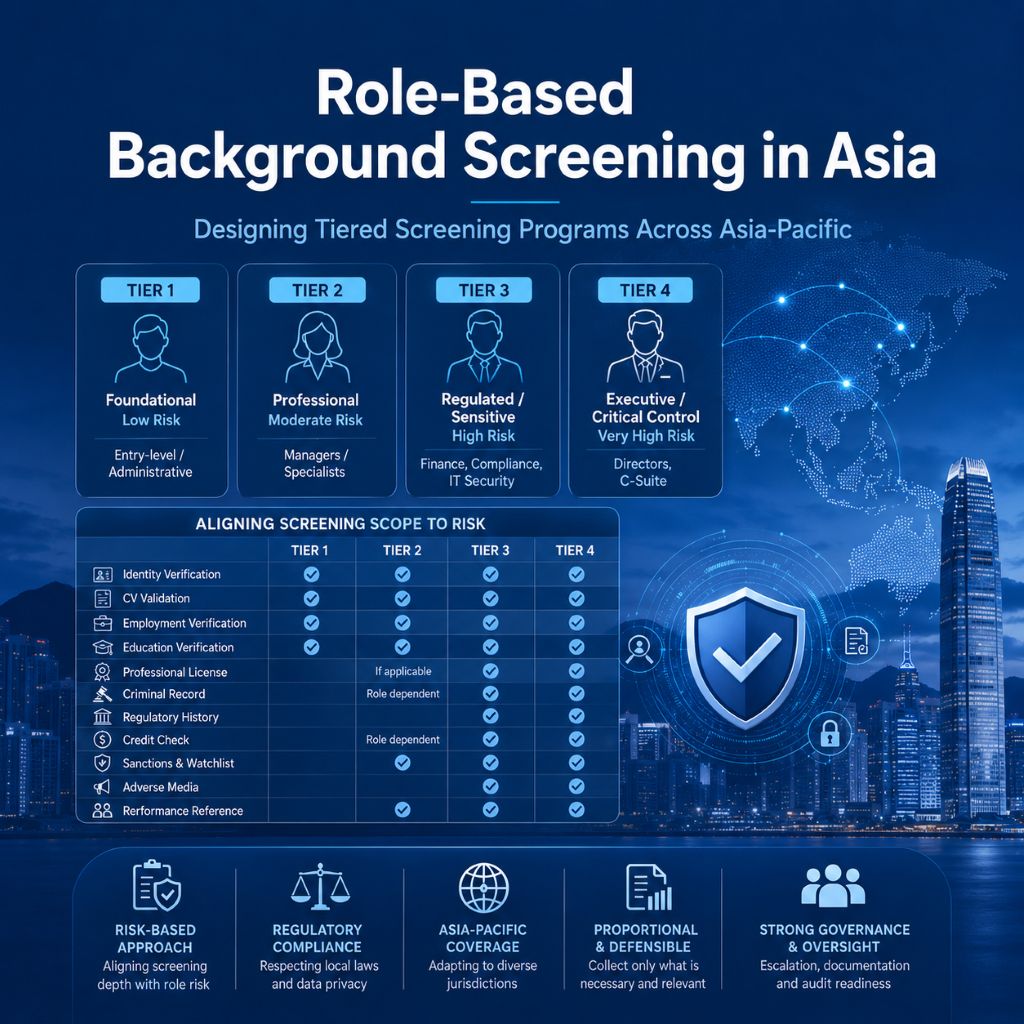
Role-Based Background Screening in Asia
Designing Tiered Screening Programs Across Asia-Pacific
Background screening in Asia cannot follow a single uniform template. Different roles carry different levels of financial authority, regulatory exposure, decision-making power, access to sensitive data, and reputational impact.
At the same time, legal permissibility of certain checks varies significantly across Asian jurisdictions. The most defensible approach is a role-based, tiered screening framework that aligns screening depth, regulatory compliance, risk exposure, and jurisdictional constraints.
Executive Summary
Role-based background screening in Asia aligns the scope and intensity of checks with the risk profile of each position. Organizations increasingly adopt risk-based background screening frameworks to ensure verification depth reflects role sensitivity and jurisdictional regulatory requirements.
They must also account for Asia background check compliance requirements to keep screening programs legally defensible across jurisdictions.
For broader regional context, see our Asia Background Check Guide.
By categorizing roles into structured tiers and adapting screening scope according to regulatory and jurisdictional constraints, organizations reduce compliance exposure, prevent over-screening, and improve defensibility.
1. Why Role-Based Screening Is Necessary in Asia
- Legal permissibility differs by jurisdiction
- Risk exposure differs by role
Applying identical checks to all employees may violate proportionality principles, trigger privacy concerns, increase compliance risk, and create operational inefficiency.
2. Defining Risk Dimensions
| Risk Dimension | Description | Example |
|---|---|---|
| Decision Authority | Ability to approve financial or strategic decisions | Executive sign-off authority |
| Financial Control | Access to funds or financial systems | Finance or treasury roles |
| Regulatory Exposure | Subject to regulator oversight | Licensed roles |
| Access to Sensitive Data | Access to confidential data | IT security roles |
| Reputational Impact | Public-facing leadership roles | Board member |
3. Designing Role Risk Tiers
| Tier | Role Type | Risk Profile |
|---|---|---|
| Tier 1 – Foundational | Entry-level / Administrative | Low authority, limited exposure |
| Tier 2 – Professional | Managers / Specialists | Moderate operational responsibility |
| Tier 3 – Regulated / Sensitive | Finance, Compliance, IT Security | High operational & regulatory exposure |
| Tier 4 – Executive / Critical Control | Directors, C-Suite | Strategic & reputational exposure |
4. Aligning Screening Scope to Tier
| Check Type | Tier 1 | Tier 2 | Tier 3 | Tier 4 |
|---|---|---|---|---|
| Identity Verification | ✓ | ✓ | ✓ | ✓ |
| CV Validation | ✓ | ✓ | ✓ | ✓ |
| Employment Verification | ✓ | ✓ | ✓ | ✓ |
| Education Verification | ✓ | ✓ | ✓ | ✓ |
| Professional License | – | If applicable | ✓ | ✓ |
| Criminal Record | – | Role dependent | ✓ | ✓ |
| Regulatory History | – | – | ✓ | ✓ |
| Credit Check | – | Role dependent | ✓ | ✓ |
| Sanctions & Watchlist | – | ✓ | ✓ | ✓ |
| Adverse Media | – | – | ✓ | ✓ |
| Performance Reference | – | ✓ | ✓ | ✓ |
5. Jurisdictional Overlay
| Compliance Factor | Why It Matters |
|---|---|
| Criminal record access restrictions | Not universally available |
| Credit check legality | Often restricted |
| Social media sensitivity | High privacy risk |
| Data localization | Affects storage & reporting |
| Consent language | Must reflect local law |
6. Proportionality & Legal Defensibility
7. Governance & Escalation Controls
| Finding Severity | Example | Escalation Level |
|---|---|---|
| Minor | Minor date inconsistency | HR Review |
| Material | Undisclosed employment | HR + Hiring Manager Review |
| Regulatory | Prior enforcement action | Compliance Review |
| Critical | Confirmed disqualification | Executive Escalation |
8. Scaling Tiered Screening Across Asia
| Centralized | Localized |
|---|---|
| Tier definitions | Legal permissibility checks |
| Reporting format | Institutional verification |
| Escalation thresholds | Consent language adaptation |
| Governance oversight | Data localization compliance |
9. Integrating AI Within Tiered Frameworks
- Workflow automation
- Tier classification
- Discrepancy flagging
- SLA monitoring
However, final hiring decisions and regulatory interpretation must remain human-led.
10. Common Mistakes in Tiered Screening Design
- Defining tiers without documented criteria
- Applying identical screening scope across jurisdictions
- Overlooking sector-specific regulatory expectations
- Failing to document escalation decisions
- Allowing ad hoc exceptions without policy control
Frequently Asked Questions
Final Strategic Takeaway
Role-based background screening introduces discipline into hiring governance.
- Reduce regulatory exposure
- Strengthen audit defensibility
- Improve operational consistency
- Prevent over-collection of sensitive data
In Asia-Pacific’s diverse regulatory environment, tiered screening programs are foundational to compliant hiring.

