

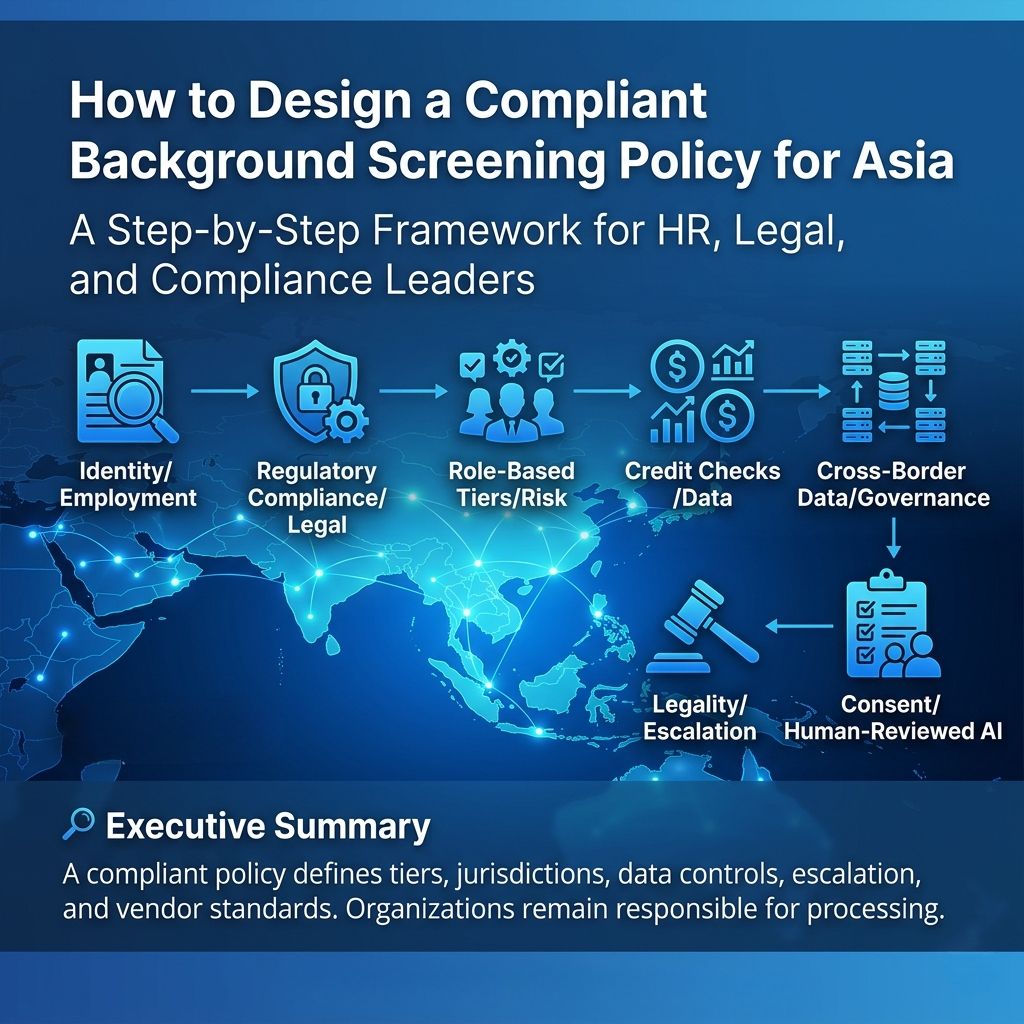
How to Design a Compliant Background Screening Policy for Asia
A Step-by-Step Framework for HR, Legal, and Compliance Leaders
Designing a compliant background screening policy in Asia is not about copying a global template.
Asia-Pacific comprises diverse legal systems, privacy regimes, regulatory environments, and institutional practices. A screening approach that is lawful in one jurisdiction may be restricted or impermissible in another. For broader regional context, see The Ultimate Guide to Background Checks in Asia (2026 Edition).
A defensible Asia screening policy must be:
- Role-based
- Jurisdiction-aware
- Proportionate
- Documented
- Governed
This guide outlines a structured approach to designing a compliant background screening policy across Asia-Pacific.
🔎 Executive Summary
A compliant background screening policy in Asia must define role-based screening tiers, jurisdiction-specific legal considerations, consent requirements, data governance controls, discrepancy escalation procedures, and vendor oversight standards.
Employers remain legally responsible for lawful data processing, even when using third-party screening providers.
Organizations designing regional screening frameworks should also review our guidance on Background Check Compliance in Asia: What Employers Must Know and Risk-Based Background Screening in Asia: A Structured Framework to ensure policies remain proportionate and defensible.
1. Define the Policy Objective
Before drafting procedures, define the policy purpose.
A compliant screening policy should aim to:
- Protect the organization from fraud and misconduct
- Align hiring decisions with regulatory requirements
- Ensure lawful data processing
- Maintain defensible documentation
- Standardize screening across jurisdictions
Policy design must align with enterprise risk strategy.
2. Conduct a Jurisdictional Compliance Mapping
Asia is not legally uniform.
Before defining screening scope, conduct a jurisdiction-by-jurisdiction review of:
- Criminal record permissibility
- Credit check legality
- Social media screening sensitivity
- Data localization requirements
- Cross-border transfer restrictions
- Retention limitations
Jurisdictional Compliance Mapping Table
| Jurisdiction | Criminal Check Permissibility | Credit Check Sensitivity | Data Localization | Cross-Border Risk Level |
|---|---|---|---|---|
| Country A | Restricted / Certificate-based | Role-specific | Moderate | Moderate |
| Country B | Sector-limited | Highly restricted | High | High |
| Country C | Permissible with consent | Moderate | Low | Low |
Mapping must be documented and periodically updated.
3. Implement a Risk-Based Role Tier Framework
A compliant screening policy must avoid uniform screening.
Instead, implement tier classification. This structured approach supports proportionality and aligns with Risk-Based Background Screening in Asia: A Structured Framework.
Role-Based Screening Tier Model
| Tier | Role Category | Risk Exposure |
|---|---|---|
| Tier 1 | Entry-level / Administrative | Low |
| Tier 2 | Professionals / Managers | Moderate |
| Tier 3 | Regulated / Finance / Compliance | High |
| Tier 4 | Executive / Key Control Roles | Critical |
Screening scope should escalate with risk exposure. This ensures proportionality.
4. Align Screening Scope to Risk Tier
Define which checks apply to which tier. For further guidance, see Role-Based Background Screening in Asia: Designing Tiered Screening Programs.
Tier-Scope Alignment Example
| Check Type | Tier 1 | Tier 2 | Tier 3 | Tier 4 |
|---|---|---|---|---|
| Identity Verification | ✓ | ✓ | ✓ | ✓ |
| Employment Verification | ✓ | ✓ | ✓ | ✓ |
| Education Verification | ✓ | ✓ | ✓ | ✓ |
| Professional License | – | If applicable | ✓ | ✓ |
| Criminal Record | – | Role-dependent | ✓ | ✓ |
| Regulatory History | – | – | ✓ | ✓ |
| Credit Check | – | Role-dependent | ✓ | ✓ |
| Conflict of Interest | – | – | ✓ | ✓ |
Checks must remain subject to jurisdictional permissibility.
5. Structure Consent Mechanisms
Consent must be:
- Explicit
- Specific
- Informed
- Documented
Consent forms should include:
- Scope of checks
- Purpose limitation
- Data retention period
- Cross-border disclosure
- Sensitive data acknowledgment
Consent language may require localization by country.
6. Establish Data Protection & Governance Controls
Screening involves sensitive personal data.
Core Data Governance Controls
| Control Area | Policy Requirement |
|---|---|
| Access Control | Role-based restriction |
| Encryption | Data in transit & at rest |
| Retention Schedule | Jurisdiction-aligned limits |
| Secure Deletion | Formal destruction protocol |
| Incident Response | Breach notification framework |
| Vendor Due Diligence | Third-party oversight |
Data protection compliance must be embedded into workflow.
7. Define Discrepancy Classification & Escalation
Policy must clearly define how findings are handled.
Discrepancy Classification Model
| Classification | Example | Action |
|---|---|---|
| Minor | Date mismatch (non-material) | Clarification |
| Material | Undisclosed employment gap | Secondary review |
| Critical | Confirmed regulatory ban | Escalation to Compliance |
Escalation authority should be documented. Decisions must be defensible.
8. Integrate Vendor Governance (If Outsourced)
If screening is outsourced:
- Conduct vendor due diligence
- Review data protection certifications
- Define SLA expectations
- Establish audit rights
- Document escalation pathways
Ultimate legal responsibility remains with the employer.
9. Address Cross-Border Data Transfers
Multinational organizations must evaluate:
- Where data is stored
- Whether processing crosses borders
- Transfer safeguards in place
- Localization requirements
Cross-border mapping should be maintained.
10. Incorporate AI Governance Boundaries
If AI tools are used:
- Human review must remain mandatory
- Regulatory interpretation must not be automated
- Adverse hiring decisions must not be automated
- Discrepancy materiality must be human-assessed
AI usage must be documented.
11. Establish Policy Review Mechanism
A compliant screening policy should be:
- Reviewed annually
- Updated upon regulatory changes
- Audited periodically
- Approved by HR and Compliance leadership
Policy governance must be active, not static. For a practical companion resource, see Background Screening Policy Template for Asia-Pacific.
Common Policy Design Mistakes
- Copying US templates into Asia
- Applying identical scope across all jurisdictions
- Ignoring cross-border data restrictions
- Failing to define escalation authority
- Over-screening lower-risk roles
- Under-documenting discrepancy decisions
Policy defensibility depends on structured design.
Executive Oversight Checklist
HR and Compliance leaders should confirm:
- Risk tiers are defined
- Jurisdictional mapping is documented
- Consent forms are localized
- Data governance controls are embedded
- Escalation protocols are defined
- Vendor oversight is documented
- Policy review schedule is formalized
If any of these elements are missing, the policy may be incomplete.
Frequently Asked Questions
What is the purpose of a compliant background screening policy in Asia?
The purpose is to create a structured, defensible framework that aligns screening practices with legal requirements, organizational risk, and data protection obligations across multiple Asian jurisdictions.
Why can’t employers apply one uniform screening policy across Asia?
Because Asia-Pacific is not legally uniform. The permissibility of criminal checks, credit checks, social media screening, retention, and cross-border transfers varies significantly by jurisdiction.
Why should screening be role-based instead of identical for every employee?
Role-based screening supports proportionality. Higher-risk roles may justify broader checks, while lower-risk roles should generally be screened more narrowly to reduce legal and compliance risk.
Does outsourcing screening reduce the employer’s legal responsibility?
No. Even if a third-party vendor conducts the checks, the employer remains responsible for lawful processing, vendor oversight, and defensible hiring decisions.
How often should a background screening policy be reviewed?
At least annually, and sooner when laws change, new jurisdictions are added, vendors change, or the organization materially updates its hiring or screening processes.
Final Strategic Takeaway
A written, structured background screening policy transforms screening from an operational process into a governed compliance framework.
Organizations that formalize:
- Risk-based tier classification
- Jurisdiction-specific adaptation
- Documented escalation protocols
- Data protection safeguards
are better positioned to ensure defensible hiring across Asia-Pacific.

