

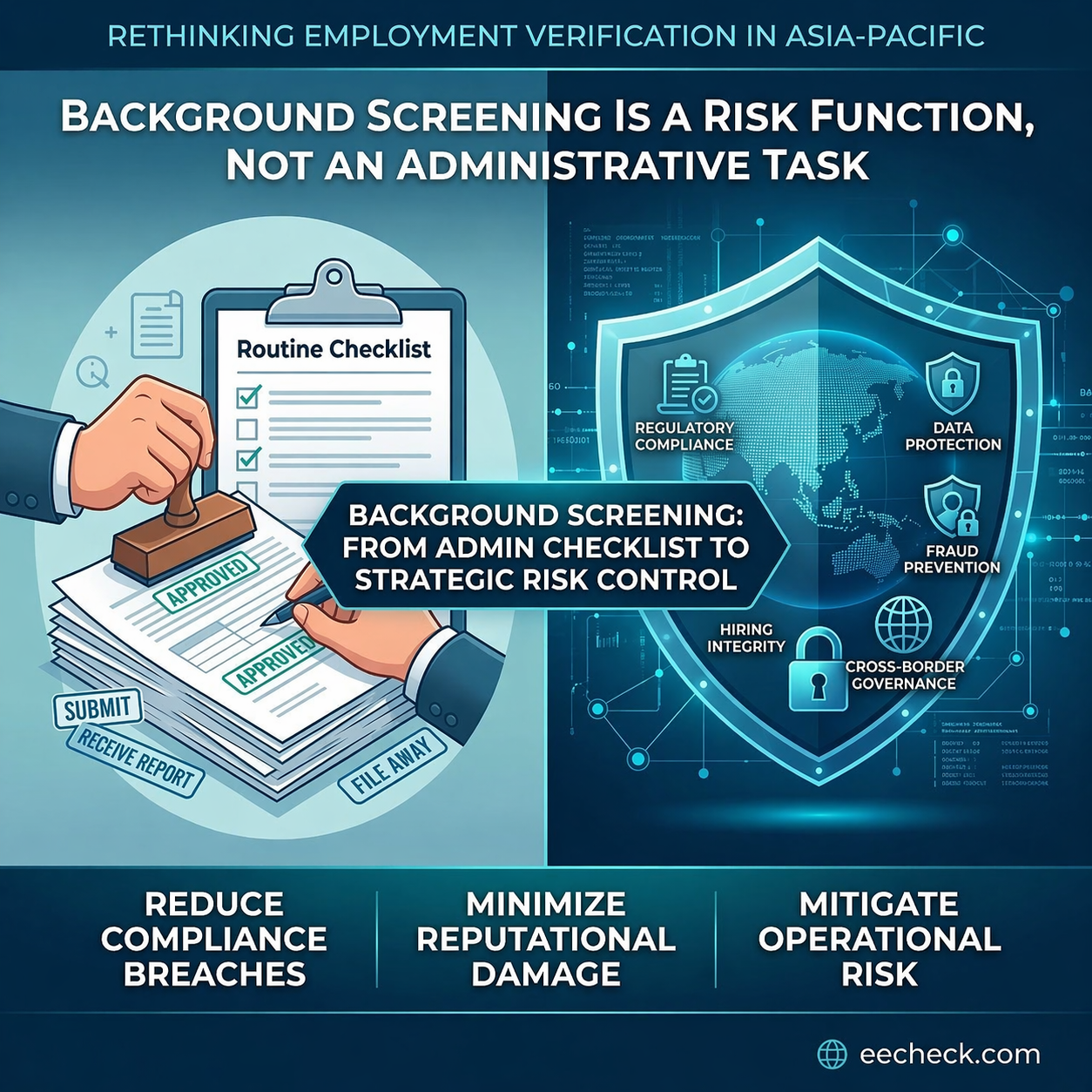
Background Screening Is a Risk Function, Not an Administrative Task
Rethinking Employment Verification in Asia-Pacific
Many organizations still treat background screening as a routine HR checklist item.
Submit request.
Receive report.
File it away.
But in reality, background screening is not an administrative formality.
It is a risk management function.
In Asia-Pacific — where regulatory diversity, data protection laws, and verification limitations vary by country — treating screening as a simple administrative task can expose organizations to compliance breaches, reputational damage, and operational risk.
Executive Summary
Background screening should be treated as a risk management function because it directly impacts regulatory compliance, hiring integrity, data protection exposure, and organizational reputation.
In Asia-Pacific, jurisdictional differences and privacy regulations increase complexity. A structured, compliance-led screening framework reduces legal and operational risk. Organizations that treat screening as strategic risk control make stronger, defensible hiring decisions.
Related reading: Risk-Based Background Screening in Asia, Asia Background Check Compliance, Asia Background Check Guide
Direct Answer: Background screening is not just an HR processing task. It is a control mechanism that supports compliance, protects organizational reputation, strengthens hiring integrity, and reduces cross-border operational risk. In Asia-Pacific, where legal and practical conditions differ by jurisdiction, a risk-based model is more defensible than a purely administrative one.
Why Screening Is More Than Administrative Processing
An administrative task is procedural and repeatable. Risk functions require judgment, compliance interpretation, escalation handling, documentation defensibility, and governance oversight.
Background screening involves all of the above.
1. Regulatory Risk
Across Asia, screening laws vary significantly:
- Criminal record access differs by country
- Consent requirements vary
- Cross-border data transfers may be restricted
- Certain checks are legally impermissible
Improper screening can lead to regulatory penalties or privacy violations. This makes screening a compliance issue — not just an HR workflow.
2. Hiring Risk
Background screening directly impacts:
- Fraud prevention
- Credential misrepresentation detection
- Conflict-of-interest identification
- Regulatory hiring obligations
In regulated industries such as finance, banking, fintech, healthcare, and government-linked entities, inadequate screening may lead to supervisory action or reputational damage. Hiring decisions must be defensible.
3. Data Protection Risk
Background screening processes highly sensitive personal data:
- Identity information
- Education records
- Employment history
- Criminal data (where permitted)
- Financial or sanctions data
Data breaches in screening can result in legal liability and reputational harm. Data governance, access control, and retention policies must be structured and auditable.
4. Cross-Border Operational Risk
Many Asia-Pacific employers hire across multiple jurisdictions. Each country introduces:
- Different turnaround expectations
- Different verification limitations
- Different document formats
- Different regulatory frameworks
Without structured oversight, inconsistencies emerge. A risk-led approach standardizes governance while respecting local variation.
Administrative Mindset vs Risk Management Mindset
| Administrative Approach | Risk Management Approach |
|---|---|
| Focus on speed | Focus on speed, accuracy, and defensibility |
| Database-heavy checks | Primary-source verification |
| Minimal discrepancy review | Structured escalation protocols |
| Basic consent handling | Jurisdiction-specific compliance control |
| Simple report delivery | Audit-ready documentation |
The difference lies in how screening is positioned internally.
Signs Your Organization Treats Screening as Admin
- Screening is handled solely by junior HR staff
- No formal compliance review process exists
- No documented quality control checkpoints
- No structured discrepancy categorization
- No audit trail retention framework
These gaps may not be visible until a regulatory inquiry or hiring dispute occurs.
What a Risk-Based Screening Framework Looks Like
A risk-oriented background screening framework includes:
- Jurisdiction-specific compliance mapping
- Defined escalation and discrepancy protocols
- Structured quality control checkpoints
- Role-based access controls
- Documented audit trails
- Data minimization and retention policies
Screening becomes part of enterprise governance.
For policy and implementation support, see Compliant Background Screening Policy in Asia, Background Screening Policy Template: Asia-Pacific, and Role-Based Background Screening in Asia.
Why This Matters More in Asia-Pacific
Asia-Pacific does not operate under a unified screening model. Legal systems differ across:
- Greater China
- Southeast Asia
- South Asia
- North Asia
- Oceania
Privacy regulations, institutional practices, and data access norms vary widely. A “one-size-fits-all” administrative process cannot adequately address this diversity. Risk-based screening frameworks are necessary.
Further Reading
Frequently Asked Questions
Because it directly affects regulatory compliance, hiring integrity, and data protection exposure. Poor screening decisions can result in legal penalties, governance failures, or reputational damage.
No. Screening intersects with compliance, legal, risk management, and information security functions. It should be aligned with broader enterprise governance frameworks.
Yes, but not at the expense of accuracy and compliance. Risk-based screening prioritizes defensibility and reliability, not just turnaround time.
Organizations should formalize screening policies, document compliance controls, implement structured quality review, conduct vendor due diligence, and align screening with enterprise risk frameworks.
Final Takeaway
When background screening is treated as a simple administrative checkbox, organizations underestimate its impact.
When it is treated as a structured risk function, it becomes a protective layer — safeguarding compliance, protecting reputation, and strengthening hiring integrity.
In Asia-Pacific’s complex regulatory environment, that distinction is critical.

