

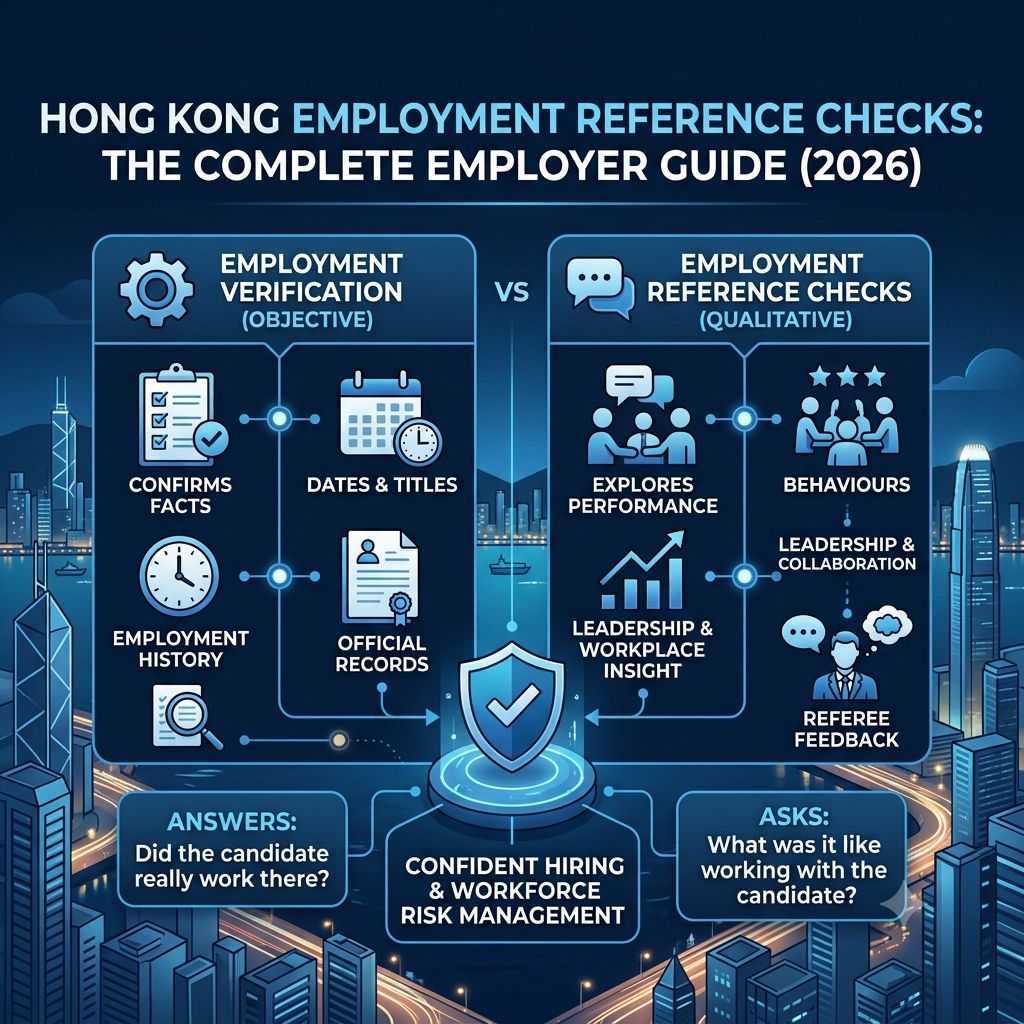
Hong Kong Employment Reference Checks: The Complete Employer Guide (2026)
Understanding the Difference Between Employment Verification and Reference Checks
Executive Summary
Employment verification and employment reference checks are related but different. Verification confirms factual employment history and, where legally permissible, relevant information disclosed by the employer. Reference checks explore how the candidate performed, behaved and worked with others.
In Hong Kong, reference checks are generally voluntary and consent-driven, and the information available may depend on privacy considerations, employer policy and the referee’s willingness to participate. A structured approach helps organisations combine factual verification with meaningful performance insight.
This guide explains the legal framework, practical methodology and role-based considerations for integrating both processes into a risk-based employment screening programme.
Employment Verification vs Employment Reference Checks
Employment verification and employment reference checks answer different questions. Verification establishes whether the candidate’s stated employment history is accurate. Reference checks assess professional performance, behaviours and workplace effectiveness.
| Employment Verification | Employment Reference Checks |
|---|---|
| Confirms objective employment information such as employer, dates, title and employment status. | Explores work quality, leadership, communication, collaboration and professional conduct. |
| Asks: “Did the candidate really work there, and is there any potential problem?” | Asks: “What was it like working with the candidate?” |
| Primarily factual and objective. | Qualitative and requires professional interpretation. |
Neither replaces the other. The strongest hiring decisions combine factual verification with qualitative assessment.
The eeCheck Verification & Reference Framework
eeCheck separates the two processes so that each contributes a distinct layer of evidence.
| Employment Verification | Employment Reference Check |
|---|---|
| Objective verification | Qualitative assessment |
| Confirms factual information | Evaluates workplace performance |
| Conducted using official employment records | Conducted through structured discussions with referees |
| Confirms employment dates | Assesses work quality |
| Confirms job title | Assesses leadership and collaboration |
| Confirms employer information | Explores communication style and professional conduct |
| High degree of objectivity | Requires professional interpretation |
| Answers the question: “Did the candidate work there, and is there any material adverse information on record?” | Answers: “How did the candidate perform?” |
Together, the two methods provide greater hiring confidence than either process alone.
Verification Confirms the Past. Reference Checks Help Predict the Future.
Employment verification confirms historical facts. Reference checks add context by examining how the candidate demonstrated knowledge, judgement, professionalism and interpersonal skills in previous employment.
| Employment Verification May Confirm | A Professionally Conducted Reference Check May Reveal |
|---|---|
| Employment dates | Strong operational leadership |
| Job title | Excellent stakeholder management |
| Department | Calm under pressure |
| Employment status | Highly trusted by clients |
| Reason for leaving | Successful organisational transformation |
| Workplace issues where disclosed | Readiness for senior leadership |
Reference feedback may also identify areas requiring further assessment, such as communication, delegation, adaptability or leadership maturity.
Why Both Are Essential
Using only one method leaves gaps. Verification may confirm that employment information is accurate but says little about performance, while referee feedback can provide useful context without proving that the underlying employment history is accurate.
A comprehensive process therefore combines both approaches.
The Four Questions Every Employer Should Answer Before Hiring
eeCheck believes every hiring decision should address four core areas of employment risk.
| Hiring Question | Primary Screening Method |
|---|---|
| Is this the individual they claim to be? | Identity Verification |
| Did they actually perform the employment they claim? | Employment Verification |
| How effectively did they perform in those roles? | Employment Reference Checks |
| Are there integrity, regulatory or reputational risks? | Role-appropriate Background Screening |
Together, these questions create a layered assessment rather than a collection of isolated checks.
Employment Screening as Workforce Risk Management
Forward-looking organisations increasingly treat employment screening as workforce risk management rather than a purely administrative recruitment exercise.
- Employment verification helps reduce resume fraud.
- Reference checks provide insight into behavioural and leadership risks.
- Role-appropriate background screening can identify integrity, regulatory or compliance concerns.
The depth of screening should remain consistent, proportionate and appropriate to the responsibilities and risk profile of the role.
Related eeCheck resources: Compliant Background Screening Policy in Asia, Role-Based Background Screening in Asia, Risk-Based Background Screening in Asia, Asia Background Check Compliance and Hong Kong Background Check Guide.
Part II — Conducting Effective Employment Reference Checks in Hong Kong
The Legal Framework Governing Employment Reference Checks in Hong Kong
Hong Kong does not generally require employers to provide employment references. The information an employer is willing to disclose may depend on internal policy, legal risk appetite and the circumstances of departure.
For organisations conducting reference checks, the Personal Data (Privacy) Ordinance (PDPO) is a key consideration.
| Principle | Good Practice |
|---|---|
| Fair and lawful collection | Collect personal information fairly and lawfully. |
| Relevance | Limit information to the recruitment purpose. |
| Proportionality | Collect only what is reasonably necessary. |
| Security | Protect information against unauthorised access or disclosure. |
| Retention | Retain information only as long as necessary. |
| Consent | Obtain clear candidate consent before contacting referees or former employers. |
Checks should also be conducted professionally, objectively and consistently to support fair hiring decisions.
Why Many Hong Kong Employers Provide Limited References
Many Hong Kong employers, particularly multinational corporations, financial institutions and listed companies, restrict references to factual employment confirmation.
| Typical Information Provided | Why Performance Information May Be Restricted |
|---|---|
| Employment dates | Confidentiality |
| Job title | Defamation concerns |
| Department | Privacy obligations |
| Employment status | Internal policy or legal risk |
A limited reference should not automatically be treated as negative feedback; it may simply reflect organisational policy.
Employment Verification Is Not a Reference Check
Speaking with HR to confirm dates and job title is employment verification, not a professional reference check.
Employer: “Can you confirm John worked for your organisation?”
HR: “Yes. John worked here from 2020 to 2025 as Assistant Manager.”
This confirms employment but does not assess leadership, technical competence, communication, judgement, teamwork, integrity, adaptability or overall workplace performance.
Who Should Be a Referee?
The value of a reference depends heavily on whether the referee had meaningful visibility of the candidate’s work.
| Referee Type | Typical Insight |
|---|---|
| Former Direct Managers | Performance, accountability, decision-making, leadership potential and development areas. |
| Skip-Level Managers | Strategic thinking, executive presence, organisational impact and stakeholder management. |
| Colleagues | Collaboration, teamwork, communication and workplace relationships. |
| Direct Reports | Coaching, leadership style, delegation, conflict resolution and engagement. |
| Clients or Business Partners | Professionalism, customer service, relationship management and commercial judgement. |
Direct managers are usually preferred. Other referee types can add useful perspective depending on the seniority and nature of the role.
Candidate-Nominated Referees
Where possible, the referee’s identity and employment relationship should be confirmed through the employment verification process. If independent confirmation is unavailable, the reference can still provide insight but should be treated as one source of information rather than conclusive evidence.
Because candidate-nominated referees may be expected to be favourable, their comments should be considered alongside verification findings, qualifications, interviews and other screening results.
Structured Reference Checks Produce Better Hiring Decisions
A professional reference check should follow a consistent methodology rather than an informal conversation.
| Stage | What It Covers |
|---|---|
| Stage 1 – Preparation | Review the resume, job description, verification findings, interview observations and areas requiring clarification. |
| Stage 2 – Referee Validation | Confirm identity, position, organisation, relationship and period of interaction. |
| Stage 3 – Structured Competency Discussion | Explore role-relevant areas such as competence, leadership, communication, integrity, adaptability and teamwork. |
| Stage 4 – Cross-Validation | Compare feedback with employment verification, interviews, resume information and other referees. |
The objective is not perfect consistency, but to identify meaningful patterns and areas requiring clarification.
Reference Checks Are About Evidence, Not Opinions
Professional reference checks seek observable evidence rather than general praise or personal opinions.
More useful: “She successfully led a cross-functional transformation project involving five departments, consistently met deadlines, and was promoted twice within three years.”
Specific workplace examples provide stronger and more defensible hiring information while reducing the influence of personal bias.
Part III — Integrating Employment Verification and Reference Checks into a Modern Employment Screening Programme
Reference Checks Should Never Operate in Isolation
No single screening method provides a complete picture. References are qualitative and may be influenced by policy, limited disclosure or personal experience; employment verification is objective but provides little insight into performance.
A layered approach allows different verification methods to complement one another.
The eeCheck Three-Dimensional Employment Assessment
eeCheck views employment screening through three complementary dimensions.
| Dimension | Core Question | Typical Focus |
|---|---|---|
| 1. Employment Verification | Can the employment history be objectively verified? | Employer, dates, title, department, status, reporting line and reason for leaving where available. |
| 2. Employment Reference Checks | How did the candidate perform? | Leadership, communication, competence, teamwork, judgement, conduct and adaptability. |
| 3. Integrity and Workforce Risk Screening | Are there broader integrity or organisational risks? | Role-appropriate criminal/court, bankruptcy, directorship, licence, sanctions, adverse media, identity and education checks. |
Combined, these dimensions provide a balanced view of employment history, past performance and broader integrity or compliance risk.
Different Roles Require Different Levels of Reference Checking
Screening depth should be risk-based and proportionate to the responsibilities of the position.
| Role Type | Typical Approach |
|---|---|
| Administrative and Junior Positions | Identity, employment and education verification where applicable; references depending on policy and role. |
| Professional and Technical Roles | Employment verification plus one or two professional references, qualification and identity verification. |
| Management Positions | More detailed references covering leadership, decision-making, team management, stakeholder communication and performance under pressure. |
| Executive and Board Appointments | Multiple executive references plus enhanced qualification, regulatory, litigation, bankruptcy, directorship, adverse media and sanctions screening where appropriate. |
Common Mistakes Employers Make
Even established programmes can lose value when the methodology is inconsistent.
| Common Mistake | Better Practice |
|---|---|
| Mistake 1 – Confusing Employment Verification with Reference Checks | Treat factual verification and performance assessment as separate but complementary processes. |
| Mistake 2 – Asking Only Closed Questions | Use behavioural and competency-based questions that encourage examples. |
| Mistake 3 – Accepting General Praise Without Evidence | Ask referees to describe observable workplace situations. |
| Mistake 4 – Ignoring Inconsistencies | Compare references with interviews, verification, resume and qualifications and seek clarification. |
| Mistake 5 – Applying Different Standards to Different Candidates | Use a consistent methodology for comparable candidates. |
Employment Verification and Reference Checks: Better Together
The better question is not which method is more valuable, but how the two can be used together.
Verification may confirm that a Regional Sales Director worked for five years with no material adverse information disclosed. Reference checks can then add context, such as whether the individual expanded markets, built effective teams, developed client relationships or demonstrated ethical leadership.
Combining objective verification with structured qualitative assessment supports more informed hiring decisions.
Employment Screening as Good Corporate Governance
Employment screening increasingly forms part of corporate governance, workforce integrity and enterprise risk management.
Verification helps address resume fraud, reference checks provide behavioural and leadership insight, and integrity screening can identify relevant regulatory or reputational concerns. Together, they support stronger hiring decisions and organisational resilience.
Part IV — Best Practices, Frequently Asked Questions and the Future of Employment Reference Checks
Should Employers Conduct Reference Checks Internally or Outsource Them?
Internal reference checking may be suitable for some roles, but hiring managers can be affected by confirmation bias and HR teams may have limited time or specialist interview training.
| Third-Party Advantage | Value |
|---|---|
| Objectivity | Separates the reference assessment from the hiring decision. |
| Consistency | Uses structured questions and comparable competency areas. |
| Experience | Skilled interviewers can probe examples, identify inconsistencies and distinguish observations from opinions. |
| Documentation | Creates a consistent and auditable record supporting governance. |
Independent reference checking can be particularly useful for executive, regulated or higher-risk positions.
Common Questions Employers Should Ask During Reference Checks
Effective reference checks focus on questions that generate evidence about workplace performance.
| Discussion Area | Examples |
|---|---|
| Understanding the Working Relationship | Length of relationship, reporting line, frequency and capacity of interaction. |
| Performance and Responsibilities | Primary responsibilities, strengths, achievements and contribution. |
| Leadership and Management | Leadership style, team development, conflict, pressure and difficult decisions. |
| Communication and Collaboration | Communication, stakeholders, teamwork, cross-functional work, clients and professionalism. |
| Areas for Development | Development opportunities, preferred management environment and useful coaching. |
| Rehire Question | “Would you hire this individual again?” followed by “Why?” |
Frequently Asked Questions
Are employment reference checks legal in Hong Kong?
Yes. They are generally lawful when conducted in accordance with applicable privacy obligations and with appropriate candidate consent.
Can previous employers refuse to provide references?
Yes. Many organisations limit references to factual employment confirmation. This should not automatically be interpreted negatively.
How many references should be obtained?
There is no universal number. Two may be suitable for lower-risk roles; experienced professionals and managers may warrant two to four, while senior or regulated roles may justify additional references depending on risk and budget.
Can a positive reference guarantee future performance?
No. Reference findings should be considered alongside interviews, verification and other screening because future performance also depends on culture, leadership and role expectations.
The Future of Employment Reference Checks
Reference checking continues to evolve with cross-border hiring, regulatory expectations and technology.
| Trend | What It Means |
|---|---|
| Increasing Cross-Border Hiring | Organisations need consistent methods that can accommodate different languages, employment practices and cultures. |
| Greater Regulatory Expectations | Reference checks increasingly sit within broader governance and workforce risk programmes. |
| AI-Assisted Reference Checking | AI can support scheduling, workflow, transcription, summarisation and quality assurance, while professional judgement remains important. |
Why Organisations Choose eeCheck
eeCheck approaches reference checks as one component of a broader workforce integrity programme rather than a recruitment checklist.
| eeCheck Methodology | Approach |
|---|---|
| Independent third-party assessment | Provides separation from the hiring decision. |
| Structured competency-based interviews | Promotes consistent and meaningful discussions. |
| Experienced reference interviewers | Supports professional probing and interpretation. |
| Consistent documentation | Provides clear and auditable reporting. |
| Integration with employment verification | Combines factual confirmation with qualitative insight. |
| Regional expertise | Supports Hong Kong and wider Asia screening requirements. |
| AI-assisted workflow and quality assurance | Improves efficiency and consistency while retaining professional review. |
Conclusion
Effective reference checking requires more than informal questions. It depends on understanding the distinction between verification and references, using structured interviews, evaluating evidence objectively and integrating findings with a broader risk-based screening programme.
For Hong Kong and regional hiring, combining employment verification with professionally managed reference checks can strengthen hiring confidence, workforce integrity and corporate governance.
Need Support with Employment Reference Checks in Hong Kong?
eeCheck supports organisations with consistent, compliant and risk-based employment screening across Hong Kong and the Asia-Pacific region.
| Service | Coverage |
|---|---|
| Employment Reference Checks | Structured professional reference checking. |
| Employment Verification | Verification of employment history. |
| Education Verification | Verification of academic qualifications. |
| Identity Verification | Identity and document checks. |
| Criminal and Court Record Screening | Where legally appropriate. |
| Bankruptcy and Financial Integrity Checks | Role-relevant financial integrity screening. |
| Professional Licence Verification | Verification of licences and credentials. |
| Global Employment Background Screening | Asia and international screening support. |
Whether hiring a graduate, senior executive or regional workforce, eeCheck helps organisations make informed hiring decisions through professionally managed screening solutions.
Final Strategic Takeaway
Employment verification confirms the factual past; reference checks add context about performance and workplace behaviour. Neither should be treated as a substitute for the other.
A stronger programme combines both with identity, qualification and role-appropriate integrity screening to support proportionate, defensible and risk-informed hiring decisions.

