

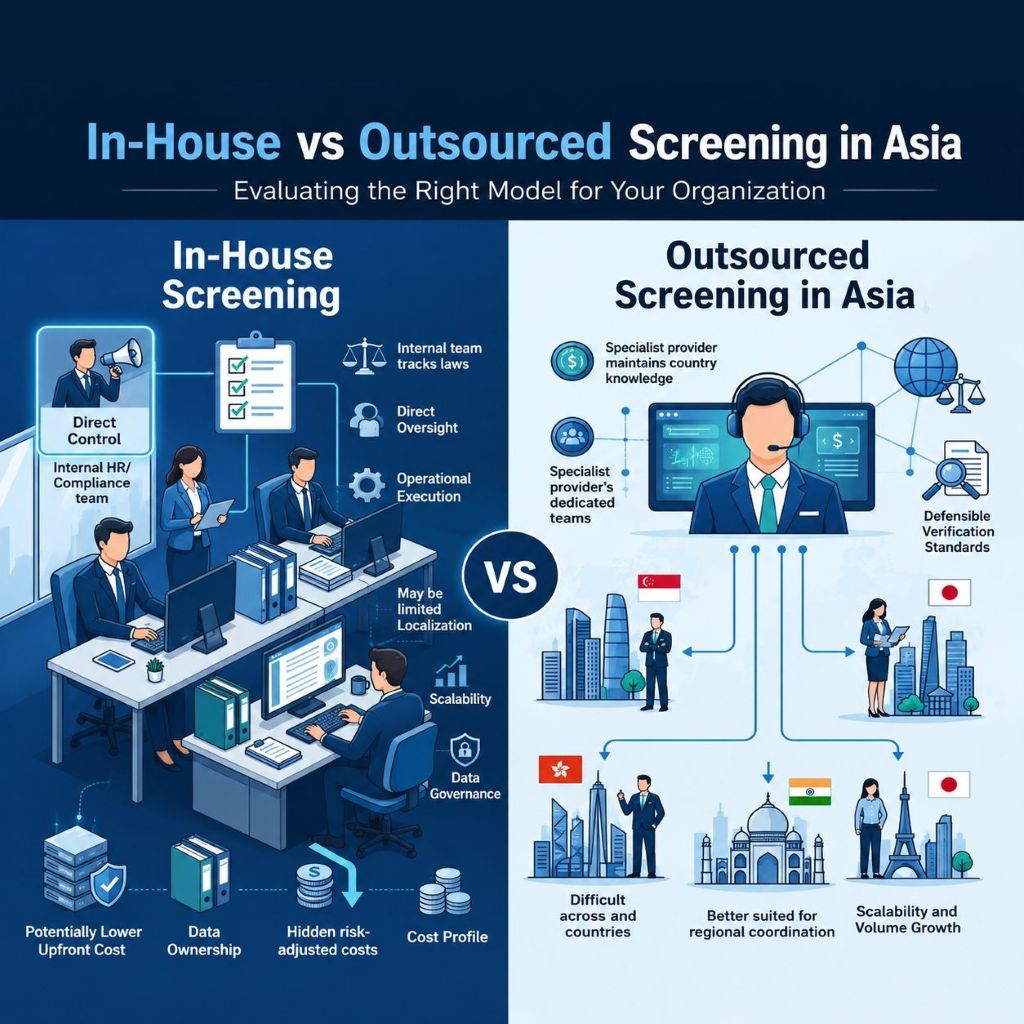
In-House Screening vs Outsourcing in Asia
Which Model Is Right for Your Organization?
When hiring across Asia-Pacific, organizations face a critical decision: should background screening be handled internally, or outsourced to a specialist provider?
The answer depends on scale, regulatory exposure, jurisdictional complexity, and risk tolerance.
In Asia — where laws, access to records, and verification practices differ by country — this decision carries significant operational and compliance implications.
🔎 Executive Summary
In-house screening may work for small, single-country hiring programs with limited regulatory complexity. However, for multi-country hiring across Asia, outsourcing to a specialized background screening firm typically offers stronger compliance control, localized expertise, scalability, and defensible verification standards.
Asia’s jurisdictional diversity makes standardized internal screening difficult to manage effectively. For broader regional context, see the Asia Background Check Guide and Background Check Compliance in Asia.
Direct Answer
In-house screening may be suitable for smaller hiring programs in a single jurisdiction with limited regulatory complexity. For multi-country hiring across Asia, outsourcing to a specialist provider is often the more defensible model because it offers stronger compliance capability, local execution, and governance support.
Comparison Overview
The table below summarizes how in-house and outsourced screening models typically differ in Asia-Pacific hiring environments.
| Evaluation Area | In-House Screening | Outsourced Screening |
|---|---|---|
| Compliance Management | Internal team must track legal and privacy requirements across jurisdictions | Specialist provider typically maintains country-specific compliance knowledge |
| Operational Execution | Managed by HR, compliance, or operations teams | Managed through structured verification workflows and dedicated teams |
| Localization | May be limited by language and local institutional knowledge | Typically supported through in-language and jurisdiction-specific processes |
| Scalability | Can become difficult across multiple countries | Better suited for regional coordination and volume growth |
| Quality Control | Depends on internal resources and documented controls | Often supported by formal review, escalation, and audit processes |
| Data Governance | Internal ownership of security, retention, and access controls | Provider may offer structured governance and documentation frameworks |
| Cost Profile | May appear lower upfront but can create hidden compliance and operational costs | May appear higher per check but often lowers risk-adjusted cost over time |
| Best Fit | Small, low-complexity, single-country programs | Multi-country, regulated, or high-volume hiring environments |
Understanding In-House Background Screening
In-house screening means your HR, compliance, or operations team conducts verification directly. This may include contacting previous employers, verifying educational institutions, conducting ID or document checks, managing candidate consent, and reviewing discrepancies.
Advantages of in-house screening may include:
- Full internal control
- Direct oversight of processes
- Potentially lower apparent upfront cost
- Immediate communication with hiring managers
For small organizations hiring within a single country, this model may be manageable. To support internal governance, many employers begin with a documented Compliant Background Screening Policy in Asia and a clear Background Screening Policy Template: Asia-Pacific.
Risks of In-House Screening in Asia
1. Regulatory Complexity
Screening laws differ significantly across jurisdictions. Criminal record access, consent structures, data protection obligations, cross-border transfer restrictions, and legal permissibility of certain checks vary by country. Maintaining current compliance knowledge across multiple Asian jurisdictions requires dedicated expertise. For deeper legal context, see Background Check Compliance in Asia.
2. Lack of Local Operational Knowledge
Effective verification often requires local language communication, understanding of institutional practices, familiarity with documentation norms, and the ability to handle adverse findings and follow-up actions. Internal teams may not have the operational depth needed across diverse markets.
3. Scalability Challenges
As hiring expands across five to fifteen jurisdictions, complexity multiplies. Turnaround times, document formats, escalation procedures, and reporting standards can all differ. Managing this internally can place strain on HR and compliance teams.
4. Data Security and Governance Exposure
Background screening involves sensitive personal data. Internal teams must manage encryption, access controls, retention schedules, audit documentation, and cross-border transfer compliance. Without structured governance frameworks, risk increases. Employers operating in regulated sectors may also need stronger controls similar to those discussed in Financial Background Screening in Asia.
Understanding Outsourced Background Screening in Asia
Outsourcing means partnering with a specialized screening provider that manages verification processes, compliance handling, and reporting. A mature Asia-focused provider typically offers jurisdiction-specific workflows, primary-source verification, human-reviewed quality control, data protection governance, and regional scalability.
Organizations evaluating third-party providers should also review What Questions to Ask Before Hiring a Background Screening Vendor before finalizing their model.
Advantages of Outsourcing in Asia
1. Regulatory Alignment
A specialized provider maintains current knowledge of country-specific legal limitations, privacy regulations, consent requirements, and sector-specific compliance expectations. This helps reduce regulatory exposure.
2. Localized Execution
Effective outsourcing partners conduct in-language verification, direct institutional communication, structured discrepancy analysis, and documentation-supported findings. This improves both accuracy and defensibility.
3. Scalable Multi-Country Programs
Outsourcing can support centralized coordination, standardized reporting formats, consistent service levels, and a single point of contact for regional hiring. This makes multi-country expansion easier to manage. Related reading: Asia Background Screening Executive Briefing.
4. Governance and Security Frameworks
Professional screening firms typically maintain structured information security and quality governance frameworks, role-based access controls, data encryption standards, audit-ready documentation, and vendor risk management processes. This shifts operational burden away from internal HR teams.
When In-House Screening May Be Appropriate
- Hiring is limited to one jurisdiction
- Screening scope is basic
- Regulatory exposure is low
- Internal compliance expertise is strong
- Headcount volume is manageable
For more complex regional hiring programs, however, this model becomes increasingly difficult to sustain.
When Outsourcing Is Strategically Advantageous
- Hiring spans multiple Asian jurisdictions
- Regulatory exposure is high, such as finance, banking, fintech, healthcare, education, or government-linked sectors
- Large-scale recruitment is planned
- Audit defensibility is required
- Internal resources are limited
In these scenarios, screening becomes less of an administrative task and more of a compliance-led risk management function. Organizations often benefit from aligning provider selection with a Risk-Based Background Screening in Asia framework and a Role-Based Background Screening in Asia approach.
Cost vs Risk: The Real Consideration
Some organizations choose in-house screening to reduce cost. However, the real comparison should include compliance exposure, data breach risk, inaccurate hiring consequences, reputational impact, and operational inefficiency.
The real question is not simply which model is cheaper. It is which model better protects the organization.
Strategic Consideration for Asia-Pacific Employers
For organizations hiring across multiple Asian markets, outsourcing to a compliance-driven regional specialist can provide:
- Jurisdiction-specific regulatory awareness
- Primary-source verification standards
- Human-reviewed quality control
- Enterprise-grade governance frameworks
- Scalable multi-country coordination
As an Asia-focused screening specialist, eeCheck supports employers in building compliant, defensible, and scalable screening programs across the region. For broader planning, employers may also refer to the Asia Background Check Guide.
Frequently Asked Questions
Is outsourcing background screening more expensive than in-house?
Outsourcing may appear more expensive on a per-check basis. However, when compliance management, governance controls, localization, and scalability are factored in, outsourcing may reduce overall risk-adjusted cost.
Can organizations combine in-house and outsourced screening?
Yes. Some organizations handle basic identity or document checks internally while outsourcing employment, education, and multi-country verifications to a specialist provider.
Why is Asia more complex than other regions for screening?
Asia comprises multiple legal systems, languages, data protection regimes, and verification infrastructures. There is no unified screening model, so programs must adapt by jurisdiction.
How do specialized providers manage quality control?
Mature providers typically apply structured workflows, escalation protocols, human-reviewed validation processes, and documented reporting standards to improve defensibility.
When is in-house screening still appropriate?
In-house screening may be workable for smaller, single-country hiring programs with basic screening scope, low regulatory exposure, and strong internal compliance capability.
Final Takeaway
In Asia-Pacific hiring environments, in-house screening may offer control, but it can also create regulatory, operational, and scalability challenges.
Outsourcing to a specialized regional provider typically offers stronger localization, compliance alignment, governance maturity, and multi-country consistency.
For multi-country hiring across Asia, the more defensible model is often the one that combines regulatory precision, operational depth, and scalable governance.
For further reading, see Compliant Background Screening Policy in Asia, Background Screening Policy Template: Asia-Pacific, and Asia Background Screening Executive Briefing.

