

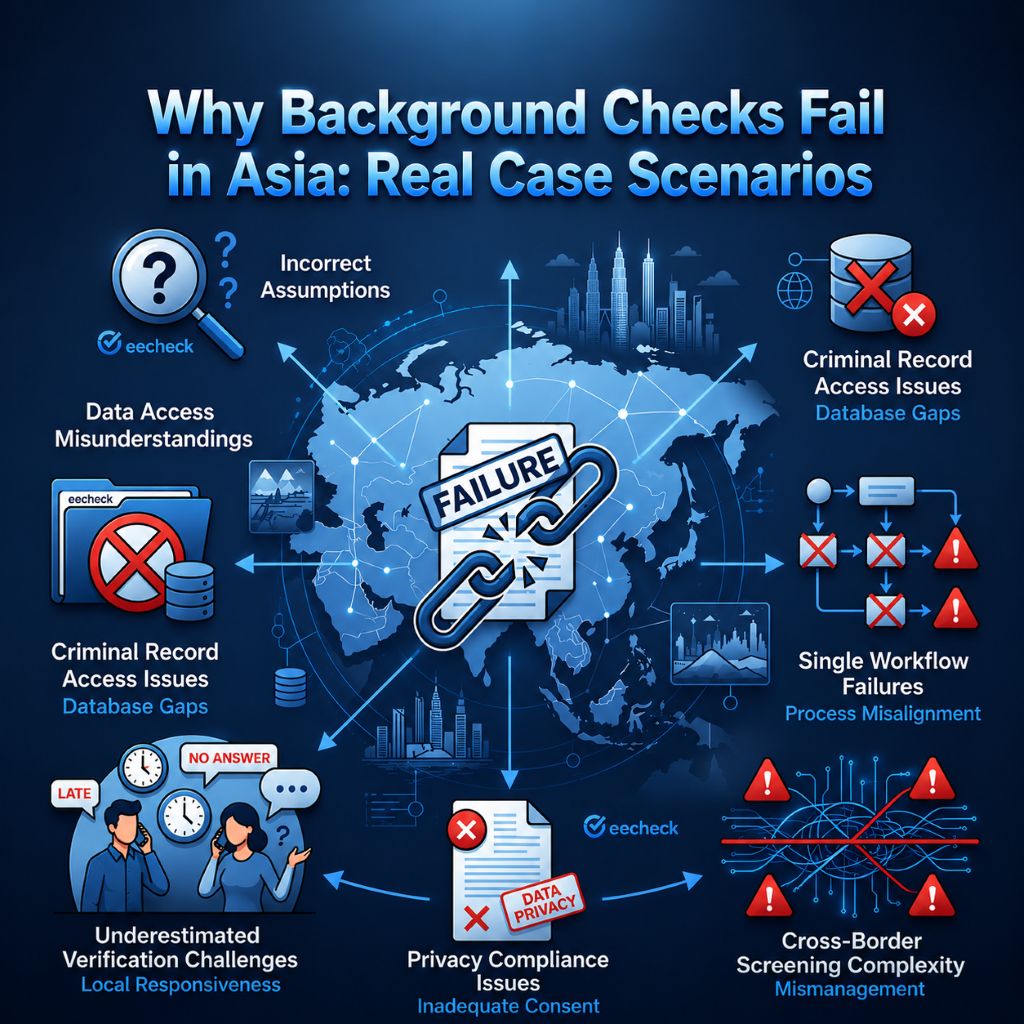
Why Background Checks Fail in Asia: Real Case Scenarios
Common Breakdown Points in Multi-Jurisdiction Screening and What They Reveal
Executive Summary
Background check failures in Asia are often caused by process misalignment, not lack of effort. Many failures arise from incorrect assumptions about data access, verification practices, and jurisdiction-specific compliance requirements.
Employers can reduce these risks by building a compliant background screening policy for Asia supported by structured workflows, localized consent, and country-specific verification processes.
Key Takeaways
- Background check failures in Asia are often caused by process misalignment, not lack of effort.
- Many failures arise from incorrect assumptions about data access and verification practices.
- Cross-border hiring introduces hidden complexity that is often underestimated.
- Most issues can be traced to lack of structured, jurisdiction-specific execution.
Introduction
Background screening failures in Asia are rarely due to a lack of intent or capability. More often, they result from:
- Misaligned expectations
- Incorrect assumptions
- Inadequate process design
In complex, multi-jurisdiction environments, small misunderstandings can lead to significant verification gaps. For broader regional planning, employers may refer to this Asia background check guide and this Asia background check compliance guide.
Common Background Check Failure Points in Asia
| Scenario | Common Breakdown Point | What It Reveals |
|---|---|---|
| Assuming Criminal Records Are Universally Accessible | Criminal record access is treated as uniform across jurisdictions | Access models differ significantly by country and may require candidate-controlled processes |
| Over-Reliance on Database Screening | Centralized databases are used where coverage may be incomplete | Database checks must often be supplemented by direct verification |
| Applying a Single Workflow Across Multiple Countries | A global workflow is applied without local adaptation | Consistency requires jurisdiction-specific execution, not one-size-fits-all standardization |
| Underestimating Employment Verification Challenges | Employer responsiveness, language, and escalation needs are underestimated | Verification depends heavily on local institutional behavior |
| Ignoring Data Privacy Constraints | Global consent forms and data collection practices are reused | Privacy compliance must be localized by jurisdiction |
| Mismanaging Cross-Border Screening | Regional screening is handled without structured coordination | Cross-border screening requires governance, consistency, and clear reporting |
| Prioritizing Speed Over Verification Depth | Verification steps are reduced to accelerate turnaround time | Speed without depth can weaken screening defensibility |
Scenario 1: Assuming Criminal Records Are Universally Accessible
Situation
An employer requests a criminal background check across multiple Asian jurisdictions using a standardized process.
What Went Wrong
- Assumed criminal records could be accessed directly
- Did not account for Data Subject-controlled access (e.g. Hong Kong, Singapore)
- No alternative verification strategy
Outcome
- Delayed hiring process
- Incomplete screening results
- Misinterpretation of “no record found”
In many Asian markets, absence of data does not equal absence of risk.
Related guidance: Hong Kong criminal record check guide and Singapore background checks guide.
Scenario 2: Over-Reliance on Database Screening
Situation
A company relies on database checks for employment and criminal history verification.
What Went Wrong
- Used centralized databases in markets where they are incomplete
- Did not conduct direct institutional verification
- Failed to validate discrepancies
Outcome
- Inaccurate candidate profile
- Missed inconsistencies
- Increased compliance exposure
Database coverage in Asia is often fragmented and must be supplemented by direct verification.
Related guidance: Risk-based background screening in Asia.
Scenario 3: Applying a Single Workflow Across Multiple Countries
Situation
A global company applies the same screening workflow across Asia.
What Went Wrong
- Did not adapt to country-specific requirements
- Ignored regulatory differences
- Used uniform turnaround expectations
Outcome
- Delays in certain jurisdictions
- Inconsistent results across regions
- Frustration from hiring teams
Consistency in Asia requires adaptation, not standardization.
Related guidance: Background screening policy template for Asia Pacific.
Scenario 4: Underestimating Employment Verification Challenges
Situation
An employer expects quick employment verification across Asia.
What Went Wrong
- Assumed employer responsiveness
- Did not account for language barriers
- Lacked escalation process
Outcome
- Prolonged verification timelines
- Incomplete confirmations
- Reliance on unverified information
Employment verification outcomes often depend on local practices and institutional behavior.
Related guidance: Role-based background screening in Asia.
Scenario 5: Ignoring Data Privacy Constraints
Situation
Screening conducted using global templates and consent forms.
What Went Wrong
- Consent not localized
- Data usage not clearly disclosed
- Over-collection of information
Outcome
- Potential regulatory non-compliance
- Audit risk
- Need for re-screening
Privacy compliance in Asia is jurisdiction-specific and must be carefully structured.
Related guidance: Asia background check compliance.
Scenario 6: Mismanaging Cross-Border Screening
Situation
A regional hiring program spans multiple countries.
What Went Wrong
- No coordination across jurisdictions
- Inconsistent reporting formats
- Data transfer not clearly structured
Outcome
- Disjointed screening results
- Compliance uncertainty
- Delayed hiring decisions
Cross-border screening requires structured coordination, not parallel local execution.
Related guidance: In-house vs outsourced screening in Asia.
Scenario 7: Prioritizing Speed Over Verification Depth
Situation
A hiring team prioritizes fast turnaround.
What Went Wrong
- Reduced verification steps
- Skipped follow-ups
- Relied on partial data
Outcome
- Incomplete screening
- Increased risk exposure
- Lack of defensibility
Faster screening does not always mean better screening.
Related guidance: Financial background screening in Asia.
Common Pattern Across Failures
Across these scenarios, failures are rarely random. They typically result from:
- Misaligned expectations
- Lack of local adaptation
- Weak process design
- Inadequate governance
Most failures are structural, not operational. Vendor selection and governance also matter. Employers may find this guide on background screening vendor questions in Asia useful.
What These Failures Reveal
These cases highlight that:
- Asia screening requires country-specific understanding
- Processes must be designed, not assumed
- Verification requires active engagement, not passive data retrieval
For senior decision-makers, this Asia background screening executive briefing provides a useful regional overview.
FAQ
Why do background checks fail in Asia?
They fail due to incorrect assumptions about data availability, regulatory requirements, and verification processes across different countries.
Is database screening reliable in Asia?
No. Many markets require direct verification, making database-only approaches insufficient.
What is the biggest risk in cross-border screening?
Lack of coordination and inconsistent processes across jurisdictions.
How can companies avoid screening failures?
By adopting structured, localized, and compliance-driven screening frameworks.
Final Takeaway
Background check failures in Asia are not caused by lack of tools or effort. They are caused by applying the wrong assumptions to the wrong environment.
Effective screening in Asia depends on structured processes, local understanding, and consistent execution across jurisdictions.
Related resource: Common mistakes global background check firms make in Asia.

