

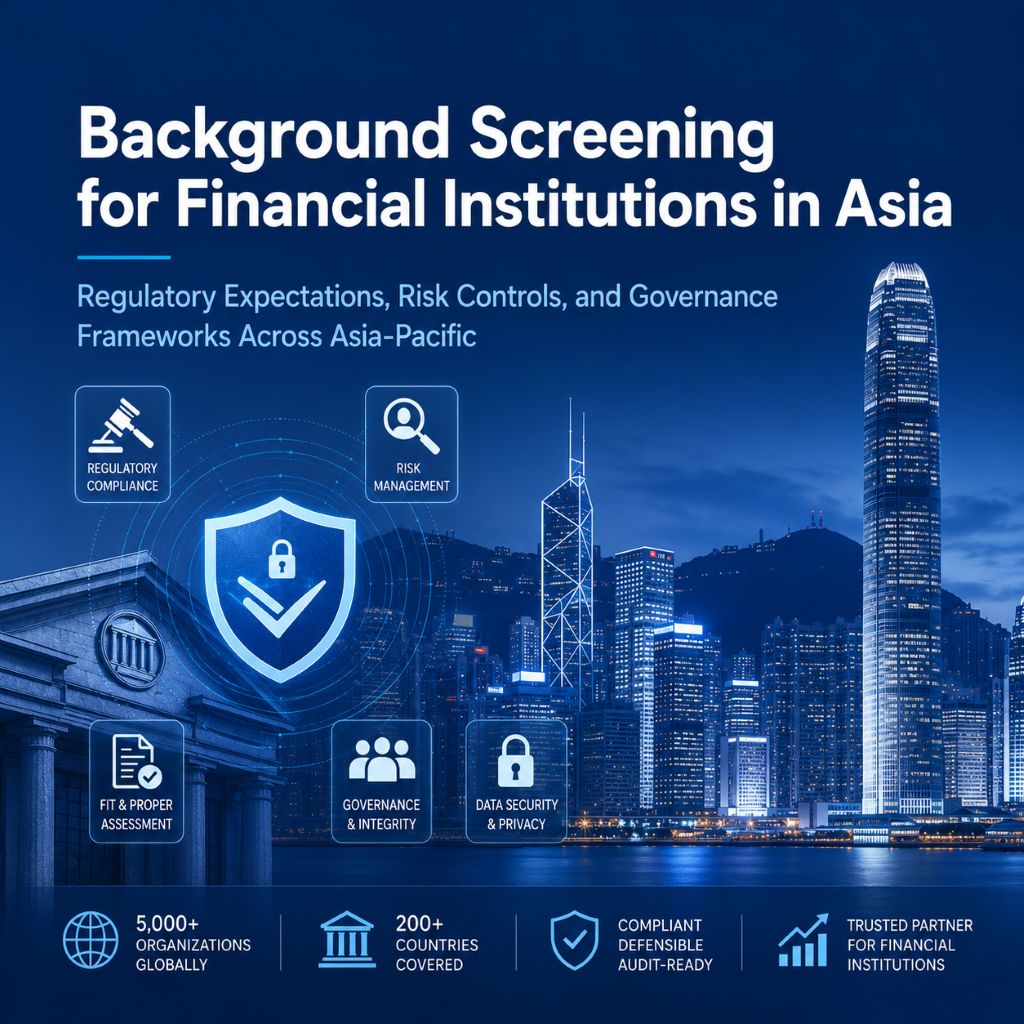
Background Screening for Financial Institutions in Asia
Regulatory Expectations, Risk Controls, and Governance Frameworks Across Asia-Pacific
Background screening for financial institutions in Asia is fundamentally different from standard employment verification.
Banks, fintech firms, insurers, asset managers, and other regulated financial entities operate under heightened supervisory scrutiny. Hiring decisions must withstand regulatory review, audit inspection, and reputational risk.
In Asia-Pacific — where regulatory regimes differ by jurisdiction — screening programs must be structured, proportionate, and defensible.
This article outlines what financial institutions must consider when designing compliant background screening frameworks across Asia.
Financial institutions in Asia must implement structured, risk-based background screening programs aligned with regulatory expectations, data protection laws, and fit and proper requirements for regulated personnel.
Screening frameworks should include enhanced verification for regulated roles, formal escalation procedures, centralized governance oversight, and audit-ready documentation.
Uniform global screening templates are insufficient without jurisdiction-specific adaptation. Organizations building regional frameworks should also review Background Check Compliance in Asia, Background Screening Policy Template: Asia-Pacific, and Risk-Based Background Screening in Asia to ensure screening policies remain proportionate and defensible.
1. Why Financial Institutions Face Higher Screening Standards
Financial institutions are subject to:
- Licensing requirements
- Fit and proper assessments
- Ongoing supervisory oversight
- Internal audit scrutiny
- Reputational risk exposure
Hiring individuals with undisclosed misconduct or regulatory sanctions may result in:
- Regulatory sanctions
- Supervisory remediation
- Reputational damage
- Governance failures
Screening must therefore operate as part of the institution’s broader risk management and control framework, not as a standalone HR verification exercise.
2. Regulatory Expectations Across Asia
Although Asia does not operate under a single financial regulatory regime, common supervisory expectations across the region include:
- Fit and proper standards for key personnel
- Integrity and conduct expectations
- Financial soundness requirements
- Disclosure obligations
- Internal control expectations
Financial institutions must align screening scope with regulator expectations in each jurisdiction. A defensible regional program should reflect both local legal limits and local supervisory expectations. This is especially important for institutions standardizing processes across multiple markets in Asia-Pacific.
3. Role-Based Risk Categorization in Financial Institutions
Financial institutions typically categorize roles by regulatory exposure rather than using uniform screening scope for all employees.
Instead, role-based tiering creates proportionality and supports governance consistency across jurisdictions. Institutions reviewing tiered models may also find useful context in Role-Based Background Screening in Asia.
| Tier | Role Category | Regulatory Exposure |
|---|---|---|
| Tier 1 | Administrative / Back Office | Low |
| Tier 2 | Client-Facing Staff / Relationship Managers | Moderate |
| Tier 3 | Compliance / Risk / Finance | High |
| Tier 4 | Directors / Senior Management / Key Control Functions | Critical |
Screening depth should align with regulatory sensitivity, role influence, access to funds or confidential information, and the institution’s governance model.
4. Enhanced Screening Components for Financial Institutions
Compared to general corporate screening, financial institutions may require additional checks for regulated or higher-risk roles.
| Check Type | Typical Applicability |
|---|---|
| Employment & Education Verification | All tiers |
| Professional License Verification | Regulated roles |
| Regulatory Enforcement History | Tier 3 & 4 |
| Sanctions & Watchlist Screening | Tier 2–4 |
| Criminal Record Check | Permissible jurisdictions |
| Bankruptcy / Insolvency Record | Tier 3–4 |
| Credit Check (where permissible) | Finance-sensitive roles |
| Conflict of Interest Check | Senior and key control roles |
| Adverse Media Review | Tier 3–4 |
All checks must remain legally permissible in each jurisdiction and should be connected to role relevance and documented policy rationale.
5. Fit and Proper Considerations
Financial regulators often require institutions to assess whether individuals are:
- Honest and of good integrity
- Financially sound
- Competent and qualified
- Free from serious misconduct
Background screening contributes to this assessment but does not replace structured internal evaluation, hiring committee review, or regulated appointment governance.
Escalation frameworks should exist for material findings, especially where disclosure issues, sanctions history, prior enforcement actions, or integrity concerns are identified.
6. Cross-Border Financial Institutions
Regional banks, insurers, and fintech firms operating across multiple Asian jurisdictions face additional complexity when standardizing screening practices.
Key considerations include:
- Regulatory differences between jurisdictions
- Centralized versus localized screening governance
- Cross-border data transfer compliance
- Harmonized reporting across entities
| Centralized | Localized |
|---|---|
| Policy design | Jurisdiction-specific legal adaptation |
| Risk tier definition | Local regulatory alignment |
| Reporting standards | Institutional verification |
| Escalation thresholds | Consent localization |
Hybrid governance models are common. Institutions often centralize policy architecture while localizing consent language, screening permissibility, and escalation triggers.
7. Data Protection in Financial Sector Screening
Financial institutions process sensitive personal data during screening, including:
- Criminal data
- Financial records
- Regulatory findings
- Identity documentation
Strong governance controls should include:
- Encryption standards
- Access limitation
- Audit logs
- Data retention controls
- Third-party oversight
Data breaches in regulated industries carry elevated consequences. Institutions should also align regional screening operations with broader legal and operational principles discussed in Asia Background Check Guide.
8. Escalation & Discrepancy Handling
Financial institutions should formalize discrepancy management and case escalation protocols.
| Finding Type | Example | Action |
|---|---|---|
| Minor | Date discrepancy | Clarification |
| Material | Undisclosed employment gap | Secondary verification |
| Regulatory | Prior enforcement action | Compliance review |
| Critical | Confirmed ban or disqualification | Executive escalation |
Decision rationale should be documented, reviewed by appropriate control functions, and retained for audit purposes.
9. Audit Readiness & Documentation
Regulators may review hiring practices, control design, and vendor governance during inspections or internal audits.
Institutions should maintain:
- Screening policy documentation
- Risk-tier classification records
- Consent forms
- Escalation decisions
- Vendor oversight evidence
- Periodic review documentation
Screening programs should be audit-ready, consistently applied, and supported by documented governance ownership.
10. Common Mistakes in Financial Sector Screening
- Applying generic corporate screening scope to regulated roles
- Ignoring regulator-specific expectations
- Over-relying on database checks
- Failing to document escalation decisions
- Neglecting cross-border data risk
Financial institutions require structured defensibility rather than informal or overly generic hiring controls.
Are criminal checks mandatory for financial institutions?
Should credit checks be conducted for all financial roles?
Is a global screening template sufficient for financial institutions in Asia?
Who should oversee screening governance in financial institutions?
How often should a financial sector screening framework be reviewed?
Final Strategic Takeaway
Background screening for financial institutions in Asia is not a standard HR process. It is a regulated risk control mechanism embedded within governance frameworks.
Institutions that formalize:
- Risk-tier classification
- Jurisdiction-specific regulatory alignment
- Documented escalation decisions
- Data governance safeguards
- Role-relevant screening standards
are better positioned to withstand regulatory scrutiny across Asia-Pacific.
For related frameworks, review Compliant Background Screening Policy in Asia, Background Screening Policy Template: Asia-Pacific, Role-Based Background Screening in Asia, Risk-Based Background Screening in Asia, Asia Background Check Compliance, and Asia Background Check Guide.

