

Asia Background Screening Intelligence Report (2026)
Market Structure, Regulatory Landscape, and Execution Models Across Asia
🔎 Executive Summary
Asia presents one of the most complex background screening environments globally. Employers must manage fragmented regulations, restricted data access, variable institutional response times, and different consent requirements across markets.
For organizations hiring across multiple Asian jurisdictions, screening quality depends less on database access and more on local verification capability, compliance design, and centralized governance.
For broader regional context, see the Asia Background Check Guide and Background Check Compliance in Asia.
Download Executive BriefingKey Takeaways
- Background screening in Asia is defined by fragmentation, regulatory diversity, and execution complexity.
- No single standardized model works across jurisdictions.
- Organizations are shifting from administrative checks to structured risk management frameworks.
- Effective screening requires local execution combined with centralized governance.
- Cross-border hiring is driving demand for regionally integrated screening models.
Introduction
Background screening across Asia operates in a fundamentally different environment compared to Western markets. Organizations must navigate multiple legal systems, diverse privacy regulations, non-standardized verification practices, and limited centralized data access.
In Asia, background screening is best understood as a compliance-driven risk management function rather than a standardized administrative process. Organizations building regional screening policies should also review this compliant background screening policy for Asia and this Asia-Pacific background screening policy template.
1. Market Overview: A Fragmented Operating Environment
Asia is not a unified screening market. Each jurisdiction operates independently, with its own regulatory framework, verification infrastructure, and institutional responsiveness.
| Market | Regulatory Complexity | Data Access | Verification Difficulty |
|---|---|---|---|
| Hong Kong | High | Restricted | Moderate |
| Singapore | High | Controlled | Moderate |
| China | Very High | Highly Restricted | High |
| Japan | High | Restricted | High |
| South Korea | Very High | Highly Restricted | High |
| India | Moderate–High | Fragmented | High |
| Vietnam | Moderate | Limited | Moderate–High |
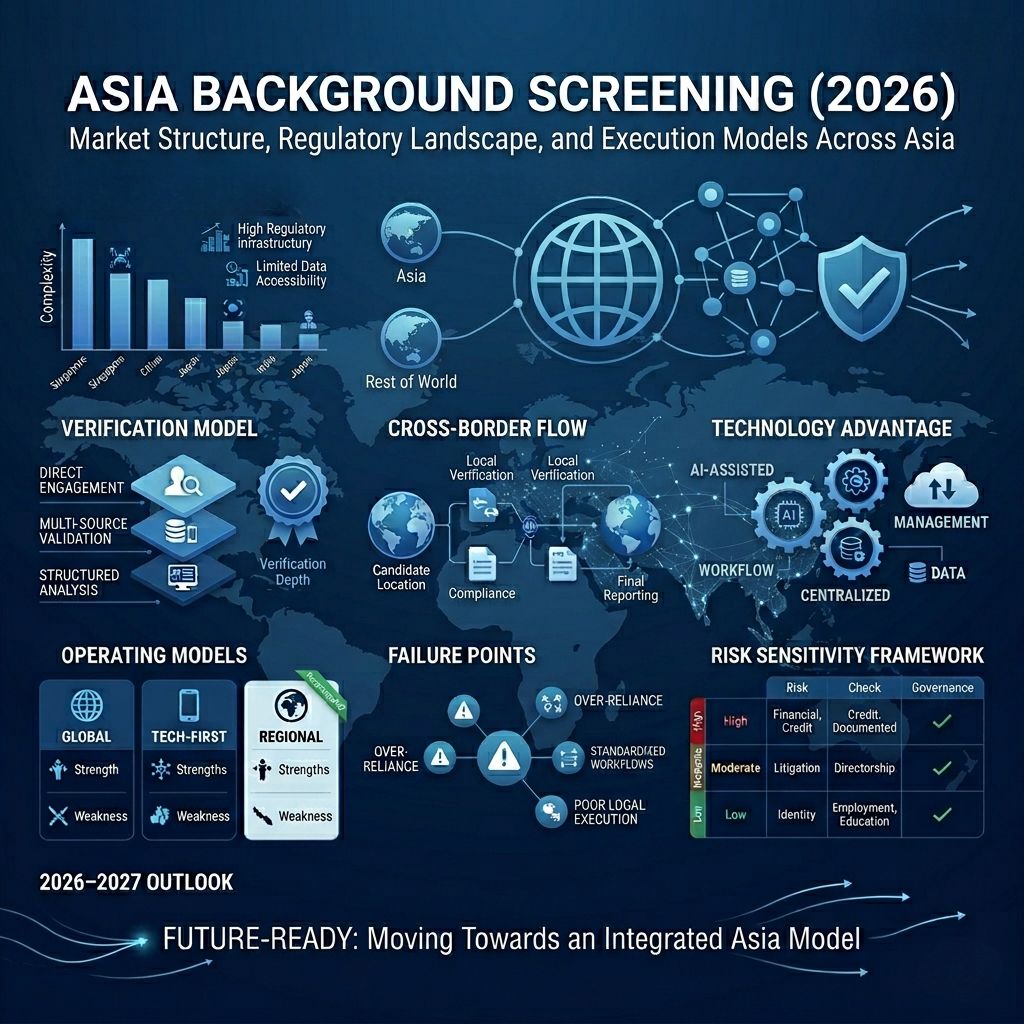
Complexity in Asia is driven by regulatory diversity and limited data accessibility.
2. Regulatory Landscape Across Asia
Regulatory requirements vary significantly across key markets.
| Market | Key Regulation |
|---|---|
| Hong Kong | PDPO |
| Singapore | PDPA |
| China | PIPL / DSL / CSL |
| South Korea | PIPA |
| Japan | APPI |
| India | DPDP Act |
| Vietnam | PDPD |
Regulation is increasingly shaping how screening processes must be designed and executed. For market-specific guidance, see the Hong Kong Background Check Guide, Singapore Background Checks Guide, and China Background Check Process.
3. Data Access vs Verification Reality
A defining characteristic of Asia is limited centralized data access.
| Market | Data Availability | Verification Effort |
|---|---|---|
| Singapore | Moderate | Moderate |
| Hong Kong | Moderate | Moderate |
| India | Low | High |
| China | Very Low | Very High |
| Japan | Low | High |
| South Korea | Very Low | Very High |
Lower data availability increases reliance on direct verification and institutional engagement.
4. Verification Model in Asia
Effective background screening in Asia typically requires:
- Direct institutional engagement
- Multi-source validation
- Structured discrepancy analysis
Verification depth — not data access — is the defining factor of screening quality. Employers should consider risk-based background screening in Asia and role-based background screening frameworks.
5. Cross-Border Hiring Complexity
Hiring across Asia introduces additional layers of complexity, including data transfer compliance, local verification, institutional response time, and centralized review.
| Screening Stage | Key Consideration |
|---|---|
| Candidate Country | Where the candidate is located and what consent is required |
| Data Transfer Compliance | Whether information can be transferred across borders |
| Verification Country | Where education, employment, criminal, or financial records must be verified |
| Institutional Response | Whether institutions respond directly, slowly, or only through local processes |
| Central Review | How discrepancies are reviewed and documented consistently |
| Final Report | How findings are presented for defensible hiring decisions |
6. Technology Landscape
Technology is transforming background screening through workflow automation, AI-assisted verification, and centralized case management. However, technology enables scale; it does not replace local execution or regulatory understanding.
7. Operating Models in the Market
| Model | Strength | Limitation | Suitability |
|---|---|---|---|
| Global Standardized | Scale | Low adaptability | Global programs |
| Technology-First | Speed | Limited verification depth | High-volume hiring |
| Regionally Integrated | Execution + compliance | Requires coordination | Multi-country Asia hiring |
The regionally integrated model is increasingly the most effective approach in Asia. Organizations comparing operating models may also review in-house vs outsourced screening in Asia and background screening vendor questions for Asia.
8. Common Failure Points
| Root Cause | Impact |
|---|---|
| Over-reliance on databases | Incomplete verification |
| Standardized workflows | Inconsistency |
| Weak local execution | Delays |
| Poor compliance design | Regulatory risk |
| Lack of coordination | Fragmentation |
Most failures are structural rather than operational. See also: common mistakes global background check firms make in Asia and why background checks fail in Asia.
9. Risk Sensitivity Framework
| Risk Level | Typical Checks | Governance Requirement |
|---|---|---|
| High Risk | Criminal, credit, social media | Stronger justification, consent, and documentation |
| Moderate Risk | Litigation, directorship | Role-based assessment and review process |
| Low Risk | Identity, employment, education | Standard verification and recordkeeping |
Higher-risk checks require stronger governance, documentation, and justification. For finance-related roles, see financial background screening in Asia.
10. Strategic Implications for Employers
Organizations hiring across Asia should:
- Apply role-based screening frameworks
- Ensure compliance alignment across jurisdictions
- Prioritize verification depth over speed
- Maintain audit-ready documentation
- Integrate screening into risk and governance systems
Screening should be treated as a core component of risk management, not a standalone process.
2026–2027 Outlook
| Past | Present | Future |
|---|---|---|
| Basic Checks | Structured Screening | Risk-Based Governance |
| Manual | Semi-Automated | AI + Human Hybrid |
| Local | Regional | Integrated Asia Model |
The industry is moving toward integrated, compliance-driven, and regionally coordinated screening models.
FAQ
What makes background screening in Asia different?
Asia is fragmented, with varying regulations, data access limitations, and verification practices across countries.
Is background screening standardized across Asia?
No. Each country requires a different approach based on local laws, available records, consent requirements, and verification practices.
What is the biggest challenge in Asia screening?
The biggest challenge is maintaining consistency and compliance across multiple jurisdictions while still achieving reliable verification outcomes.
What model works best in Asia?
A regionally integrated model combining local execution with centralized governance is often the most effective approach for multi-country hiring across Asia.
Final Takeaway
Background screening in Asia is not a standardized administrative process. It is a structured, compliance-driven risk management function. Success depends on the ability to deliver consistent, compliant, and verifiable outcomes across jurisdictions.
For further reading, explore eeCheck’s background check firm guidance for Asia and regional compliance resources.

