

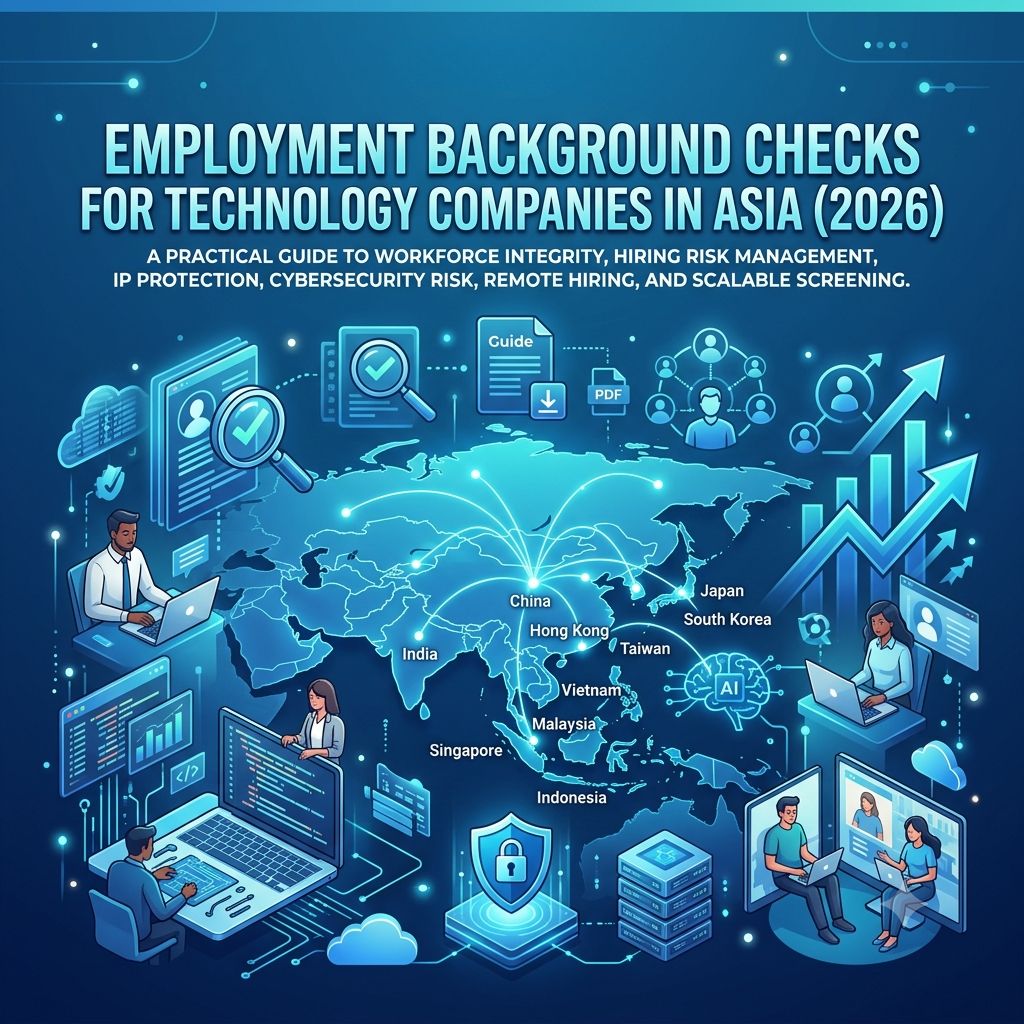
Employment Background Checks for Technology Companies in Asia (2026)
A practical guide to workforce integrity, hiring risk management, intellectual property protection, cybersecurity risk, remote hiring, and scalable employment screening for technology companies across Asia.Executive Summary
Technology companies are among the fastest-growing employers across Asia. From startups and unicorns to software companies, artificial intelligence firms, SaaS providers, fintech platforms, e-commerce marketplaces, cloud infrastructure providers, and technology-enabled businesses, organizations within the sector face hiring challenges that differ significantly from traditional industries. Rapid expansion, remote hiring, cross-border workforce mobility, intellectual property protection, cybersecurity risks, and competition for talent have fundamentally changed how technology companies approach workforce risk management. As organizations continue scaling across multiple countries and hiring increasingly distributed teams, employment background checks have become an important component of workforce integrity, trust, and risk management.For broader program design, employers may also refer to eeCheck’s compliant background screening policy guide, Asia-Pacific background screening policy template, role-based background screening in Asia, and risk-based background screening in Asia.
About This Guide
This guide was prepared by eeCheck, an Asia-focused background screening and workforce integrity specialist supporting more than 5,000 organizations across Asia. eeCheck supports employment background screening programs for technology companies, SaaS providers, fintech platforms, AI companies, cloud infrastructure businesses, e-commerce platforms, digital services providers, multinational corporations, and high-growth organizations across Asia-Pacific.The guidance in this article is based on practical experience supporting technology hiring, cross-border employment verification, technical credential verification, and workforce integrity programs across Hong Kong, Singapore, China, India, Taiwan, Japan, South Korea, Indonesia, Malaysia, Vietnam and other Asian markets.
Why Employment Background Checks Matter for Technology Companies
Technology companies often operate in highly dynamic environments where employees may have access to source code, proprietary technology, artificial intelligence models, customer data, financial information, product roadmaps, intellectual property, and sensitive business information. Unlike traditional industries where risk may be tied primarily to physical assets, technology companies often rely heavily on digital assets and knowledge-based workforces. A hiring mistake can therefore create risks involving data security, intellectual property protection, fraud, insider threats, regulatory compliance, and reputational damage.| Technology Asset / Risk Area | Why Background Screening Matters |
|---|---|
| Source Code | Helps assess candidates before granting access to critical development environments. |
| Customer Data | Supports trust and data protection for roles handling personal, commercial, or sensitive customer information. |
| Artificial Intelligence Models | Supports workforce integrity for teams working with AI systems, training data, models, and proprietary algorithms. |
| Financial Information | Helps reduce financial integrity risk for finance, operations, payments, and regulated technology roles. |
| Product Roadmaps | Protects strategic business information and confidential product plans. |
| Intellectual Property | Supports hiring diligence before employees access proprietary systems, designs, or research. |
| Sensitive Business Information | Supports informed hiring decisions before employees gain access to confidential commercial information, strategic plans, and other sensitive business assets. |
Workforce Integrity Challenges in the Technology Sector
Technology companies frequently face workforce challenges that differ from many traditional industries, including rapid workforce growth, aggressive hiring targets, cross-border recruitment, remote hiring programs, hybrid workforce models, highly mobile talent pools, and intense competition for skilled professionals.| Workforce Challenge | Screening Program Consideration |
|---|---|
| Rapid Workforce Growth | Screening programs must scale without losing consistency or quality control. |
| Aggressive Hiring Targets | Process efficiency matters, but verification quality should not be sacrificed for speed. |
| Cross-Border Recruitment | Programs must account for different laws, languages, institutions, and verification practices. |
| Remote and Hybrid Work | Identity, employment history, and credential validation become especially important for distributed teams. |
| Highly Mobile Talent Pools | Employment histories may span multiple jurisdictions, employers, contract models, or project-based roles. |
Why Background Screening Is Different in Technology Companies
Technology organizations often operate differently from traditional industries. They may hire across borders, operate remote-first teams, scale rapidly, and grant employees access to intellectual property, cloud systems, and sensitive data early in the onboarding process.| Traditional Corporate Hiring | Technology Sector Hiring |
|---|---|
| Primarily local hiring | Regional and global hiring |
| Office-based workforce | Remote and hybrid workforce models |
| Stable hiring volumes | Rapid and fluctuating hiring demands |
| Lower digital asset exposure | Significant access to intellectual property and sensitive systems |
| Traditional career pathways | Highly mobile and competitive talent markets |
| Lower cybersecurity exposure | Elevated cybersecurity and insider risk considerations |
| Fixed operational environments | Fast-changing business and workforce structures |
What Makes Technology Companies Different
Speed of Decision-Making
Technology companies often operate in highly competitive talent markets where strong candidates may receive multiple offers simultaneously. Hiring teams are frequently under pressure to make decisions quickly, resulting in greater emphasis on fast turnaround times, responsive communication, efficient onboarding, and real-time visibility into screening progress.Strong Focus on Operational Efficiency
Technology organizations are typically early adopters of automation and process optimization. Many seek to reduce manual administrative work through online candidate portals, automated workflows, API integrations, ATS integrations, and centralized reporting dashboards. For broader discussion of automation risks and opportunities, see eeCheck’s AI background checks and automation risks guide and future of background checks in Asia.Agile Workforce Expansion
Many technology companies experience periods of rapid growth. A screening program supporting a team of 50 employees may be significantly different from one supporting 500 or 5,000 employees across multiple countries.| Growth Requirement | What Technology Companies Need From Screening Partners |
|---|---|
| Rapid Implementation | Ability to support urgent hiring programs and fast onboarding requirements. |
| Flexible Workflows | Ability to adjust screening scope by role, market, and hiring volume. |
| Regional Coverage | Support across multiple Asia-Pacific jurisdictions. |
| Consistent Service Delivery | Maintains quality, reporting, and governance standards across locations. |
| Operational Scalability | Supports growth from pilot programs to large-scale workforce screening. |
| Nimble Response to Changing Hiring Demands | Enables screening programmes to adapt quickly to changing business priorities, workforce expansion, and evolving hiring requirements. |
Verification of Technical and Professional Credentials
Technology hiring frequently involves candidates with diverse educational and professional backgrounds. Beyond traditional university qualifications, organizations may encounter coding bootcamps, professional certifications, cloud certifications, cybersecurity certifications, data analytics programs, artificial intelligence and machine learning courses, and vendor-issued technical certifications. The ability to verify both traditional academic qualifications and industry-recognized technical credentials can therefore be an important component of technology-sector screening programs.Technology-Aligned Communication
Technology companies often expect the same responsiveness from service providers that they expect internally. This may include fast response times, digital-first communication, workflow transparency, efficient escalation channels, and real-time project visibility.Risk-Based Screening by Workforce Category
Different roles within technology organizations often present different levels of risk. A risk-based approach is typically more effective than applying identical screening requirements to every employee.| Workforce Category | Primary Risks | Typical Screening Focus |
|---|---|---|
| Software Engineers | Intellectual property access, source code access | Employment verification, education verification where relevant |
| Product and Engineering Leaders | Strategic decision-making, confidential information | Enhanced employment verification, references, and integrity-related reviews |
| Cybersecurity Personnel | Access to critical systems and security infrastructure | Comprehensive verification and workforce integrity assessment |
| Data and AI Teams | Access to sensitive data and AI systems | Employment verification, education verification, and risk-based integrity reviews |
| Customer Support Personnel | Access to customer information | Employment verification and reference checks |
| Finance and Operations Teams | Access to financial and operational information | Employment verification and financial integrity screening where appropriate |
| Senior Executives | Governance, reputation, and strategic risk | Comprehensive background screening and leadership-level due diligence |
Remote Hiring and Cross-Border Workforce Challenges
One of the defining characteristics of the technology sector is the increasing use of remote and cross-border hiring. Technology companies regularly recruit talent across multiple countries, creating challenges involving identity verification across jurisdictions, different verification standards, varying privacy regulations, cross-border document validation, multiple educational systems, and international employment histories.| Cross-Border Challenge | Employer Consideration |
|---|---|
| Identity Verification Across Jurisdictions | Identity documents, verification methods, and data handling requirements may vary by country. |
| Different Verification Standards | Employers should adapt methodology while maintaining consistent screening objectives. |
| Varying Privacy Regulations | Consent, retention, cross-border transfer, and data minimization requirements should be reviewed locally. |
| Cross-Border Document Validation | Educational, employment, and identity documents may require local-language or jurisdiction-specific review. |
| Multiple Educational Systems | Qualifications may originate from different education systems, requiring local knowledge and appropriate verification methods. |
| International Employment Histories | Employment verification may involve multiple countries, time zones, languages, and employer practices. |
Intellectual Property and Insider Risk Considerations
For many technology companies, intellectual property is among their most valuable assets. This may include source code, proprietary software, algorithms, artificial intelligence models, product designs, business processes, and research and development information. While employment background checks alone cannot eliminate insider threats, they can form an important component of broader workforce integrity and information security programs.Emerging Trends in Technology Sector Screening
Several trends continue shaping employment background screening programs across Asia.| Trend | Impact on Screening Programs |
|---|---|
| Remote-First Workforce Models | Organizations increasingly need screening programs that support distributed and cross-border hiring. |
| Artificial Intelligence and Data-Driven Roles | AI-related hiring increases focus on credential verification, sensitive data access, and workforce integrity. |
| Cross-Border Hiring Expansion | Technology companies need consistent standards adapted to local legal and operational requirements. |
| Cybersecurity and Insider Risk Awareness | Screening increasingly supports broader information security and access governance programs. |
| Workforce Integrity as a Governance Function | Background screening is increasingly integrated into compliance, governance, and risk management frameworks. |
Why Technology Companies Work With eeCheck
eeCheck has supported employment background screening programs for technology companies ranging from fast-growing startups and regional scale-ups to multinational technology organizations operating across Asia. Technology companies often require screening partners that understand rapid growth environments, cross-border hiring challenges, remote workforce models, technical credential verification, and workforce integrity requirements.| Technology Hiring Need | eeCheck Support |
|---|---|
| Rapid Growth Hiring | Scalable screening workflows for startups, scale-ups, and multinational technology teams. |
| Cross-Border Hiring | Regional verification capability across Asia-Pacific markets. |
| Remote Workforce Models | Screening support for distributed teams and remote hiring processes. |
| Technical Credential Verification | Support for education verification, professional credentials, and technical certification review where appropriate. |
| Workforce Integrity Requirements | Role-based and risk-based screening programs aligned with information security and governance needs. |
Frequently Asked Questions
Why are background checks important for technology companies?
Should technology companies screen every employee the same way?
How does remote hiring affect background screening?
Can background checks prevent insider threats?
What checks are common for technology roles?
Final Strategic Takeaway
For technology companies, employment background checks are no longer simply an administrative hiring process. They have become an important component of workforce integrity, information security, governance, and risk management. As organizations continue scaling across Asia and building increasingly distributed workforces, effective employment background screening programs can help strengthen trust, protect intellectual property, support compliance, and enable informed hiring decisions.The most successful technology organizations balance growth, agility, workforce integrity, and operational efficiency while maintaining the governance standards necessary to support long-term business success.

