

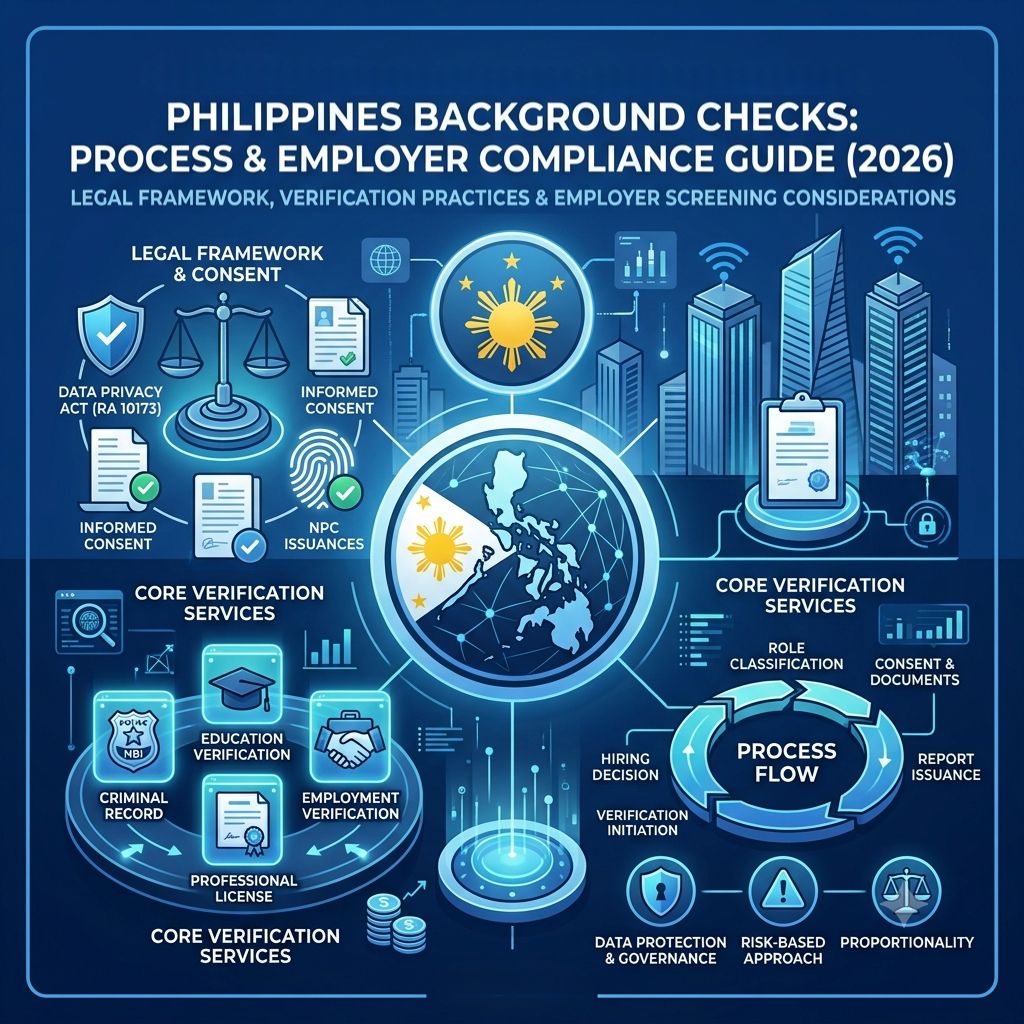
Philippines Background Checks: Process & Employer Compliance Guide (2026)
Legal Framework, Verification Practices & Employer Screening Considerations The Philippines is one of Asia’s most important hiring markets, especially for business process outsourcing, shared services, financial services, healthcare, technology and multinational regional operations. Employers recruiting in the country should understand how to structure employment background screening in a way that supports hiring integrity while respecting privacy, consent and proportionality requirements.Executive Summary
Employment background screening is widely practised in the Philippines, but employers should design programmes carefully around privacy, informed consent, role relevance, documentation and secure handling of personal information. The principal legal framework is the Data Privacy Act of 2012, administered by the National Privacy Commission. Screening is generally lawful when supported by proper consent, a clear hiring purpose, proportionate scope and appropriate governance controls. Employers should also distinguish between official candidate-obtained clearances, such as NBI Clearance, and alternative public-record methodologies, such as court record searches. These approaches may serve different purposes and should not be presented as equivalent.For wider regional planning, employers may also refer to eeCheck’s compliant background screening policy guide, background screening policy template for Asia-Pacific, role-based screening guide, risk-based screening guide and Asia background check compliance guide.
Philippines Background Check – At a Glance
The following summary provides employers with a high-level view of the legal and operational environment for employment background screening in the Philippines. Actual requirements may vary depending on the role, industry, candidate history and the type of check being performed.| Category | Philippines Position |
|---|---|
| Legal Framework | Data Privacy Act of 2012 |
| Consent Required | Yes – explicit and informed |
| Criminal Record Access | Candidate-applied NBI Clearance and other official clearances |
| Employment Verification | Widely practised |
| Education Verification | Common, institution-dependent |
| Professional Licence Check | Common for licensed professions |
| Credit Check | Role-dependent |
| Cross-Border Data Transfer | Permitted with safeguards |
| Standard Coverage | 5–7 years typical |
| Typical Turnaround | 3–10 business days, depending on the check |
1. Legal Framework Governing Background Checks in the Philippines
Understanding the legal framework is the first step in building a defensible screening programme. Employers should ensure that each screening activity is connected to a legitimate hiring purpose and supported by controls that protect candidate information throughout the screening lifecycle. Background screening in the Philippines is governed primarily by the Data Privacy Act of 2012 (Republic Act No. 10173) and related National Privacy Commission issuances. The law applies to personal information processed by both private and public-sector organisations. Employers should ensure that screening is:- Supported by valid consent
- Limited to legitimate hiring purposes
- Proportionate to the role
- Governed through appropriate data protection controls
eeCheck Insight: Employers should adopt a risk-based and proportionate screening approach that aligns with Philippine legal requirements while supporting consistent regional hiring standards.
2. Consent Requirements in the Philippines
Consent is the cornerstone of a compliant employment screening process in the Philippines. A clear and well-documented consent process helps candidates understand what information will be collected, why it is needed and how it will be used. Employers should obtain written or digital consent that clearly explains:| Consent Element | What Should Be Explained |
|---|---|
| Checks Conducted | The types of checks being performed |
| Purpose | Why the information is required for hiring |
| Data Collected | What personal information will be processed |
| Cross-Border Transfer | Whether data may be transferred outside the Philippines |
| Retention | How long the information will be retained |
3. Philippines Background Check Process Flow
A structured workflow helps employers manage candidate expectations, maintain consistency and create a clear audit trail. It also allows HR, Compliance and screening providers to understand their respective responsibilities at each stage.| Step | Action | Responsible Party |
|---|---|---|
| 1 | Role risk classification | Employer |
| 2 | Consent collection | Candidate |
| 3 | Document submission | Candidate |
| 4 | Verification initiation | Screening provider |
| 5 | Institutional outreach | Screening provider |
| 6 | Discrepancy review | HR / Compliance |
| 7 | Report issuance | Screening provider |
| 8 | Hiring decision documentation | Employer |
4. Core Philippines Background Check Services
Employers should select checks according to the role, level of responsibility and potential risk exposure. The objective is not to apply the widest possible screening package, but to use a proportionate combination of checks that supports informed and defensible hiring decisions.4.1 Identity Verification
Identity verification is usually the first stage of employment screening. It helps confirm that the candidate is who they claim to be before additional checks are performed and reduces the risk of verifying information against the wrong individual.- Government ID review
- Passport verification
- Address consistency checks
- Biographical consistency checks
4.2 Employment Verification
Employment verification helps employers confirm whether a candidate’s stated work history is accurate. It is commonly used for professional, managerial, regulated and trust-sensitive roles, particularly where previous responsibilities are relevant to the new position.- Employment dates
- Job title
- Nature of employment
- Status of separation, where available and appropriate
Typical Turnaround: 5–10 business days, depending on employer response.
Where employers provide limited information, screening teams should use supporting documents and defined escalation procedures to manage incomplete verification.
4.3 Performance Reference Check
Performance reference checks provide qualitative information that is not normally available through basic employment verification. They are especially useful for mid-senior, regulated, leadership and trust-based roles.- Conduct
- Integrity
- Professional performance
- Reason for departure
4.4 Education Verification
Education verification helps confirm whether a candidate’s academic qualifications are authentic and accurately represented. It is particularly important for graduate hiring, technical roles, professional occupations and positions where a qualification is a formal requirement.- Degree authenticity
- Institution confirmation
- Graduation details
- Accreditation or recognition validation, where relevant
4.5 Criminal Record & Court Record Search
Criminal screening in the Philippines requires employers to distinguish carefully between official criminal clearance and alternative public-record searches. The appropriate method should be selected according to role risk, legal availability, candidate involvement and the level of assurance required.Official Criminal Clearance – NBI Clearance
- The National Bureau of Investigation Clearance is the principal official criminal-clearance document used in employment screening.
- It generally requires the candidate to participate directly through authorised NBI procedures.
- It may be appropriate where the employer requires the highest level of official assurance.
Alternative Methodology – Court Record Search
- May be conducted using legally available public judicial records.
- Generally does not require the candidate to obtain an official clearance.
- Can often be initiated directly by the screening provider.
- Should not be represented as equivalent to an official NBI Clearance.
- Should be interpreted in light of the limitations of publicly available judicial information.
| Method | Candidate Involvement | Typical Use |
|---|---|---|
| Official NBI Clearance | Yes | Highest level of official assurance |
| Court Record Search | No | Faster pre-employment screening using publicly available judicial records |
| Combined Approach | Partial | Higher-risk and regulated positions |
4.6 Professional Licence Verification
Professional licence verification is important where a candidate must hold a current and valid licence to perform the role. It helps employers confirm professional standing and reduces the risk of relying on expired, suspended or misrepresented credentials.- Licence status
- Registration standing
- Eligibility to practise
4.7 Credit & Financial Checks
Credit and financial checks should be reserved for roles where financial integrity is genuinely relevant. They are commonly considered for finance-sensitive, treasury, accounting, fiduciary and senior positions involving significant financial authority.- Finance-sensitive roles
- Treasury and accounting positions
- Fiduciary responsibilities
- Senior positions with significant financial authority
4.8 Litigation & Public Records
Litigation and public-record searches may provide additional context for senior, regulated or risk-sensitive roles. Employers should ensure that any finding is relevant to the hiring purpose and is assessed fairly rather than treated as automatically adverse.- Civil litigation records
- Bankruptcy-related information
- Public adverse information, where lawfully available and relevant
5. Sensitivity of Screening Checks
Different screening checks involve different levels of privacy, legal and reputational sensitivity. Employers should apply stronger justification, more specific consent and tighter governance where a check involves highly sensitive personal information.| Check Type | Sensitivity | Legal Review Recommended |
|---|---|---|
| Identity | Moderate | No |
| Employment | Low–Moderate | No |
| Education | Low | No |
| Criminal / Official Clearance | High | Yes |
| Credit | High | Yes |
| Professional Licence | Moderate | Role-dependent |
| Public Adverse Records | Moderate–High | Role-dependent |
| Social Media | High | Yes |
6. Turnaround Time Summary
Turnaround time should be treated as a planning consideration rather than a fixed promise. Timelines may vary because of candidate participation, official processing requirements, employer responsiveness and institution-specific verification procedures.| Check Type | Estimated Time |
|---|---|
| Identity | 1–3 business days |
| Employment | 5–10 business days |
| Reference | 3–7 business days |
| Education | 3–10 business days |
| Criminal / Official Clearance | 3–10 business days |
| Professional Licence | 1–5 business days |
| Credit | 3–5 business days |
7. Data Protection & Governance Considerations
Screening data often includes sensitive personal information. A formal governance framework helps employers reduce privacy risk, protect candidate trust and demonstrate that screening decisions are supported by consistent processes.| Governance Area | Employer Expectation |
|---|---|
| Purpose Limitation | Collect data only for defined hiring purposes |
| Data Minimisation | Collect only information necessary for the role |
| Security | Use secure storage and restricted access |
| Retention | Define and document retention periods |
| Cross-Border Transfer | Apply lawful, transparent and safeguarded transfer controls |
| Privacy Governance | Maintain formal policies, controls and privacy documentation |
8. Common Compliance Risks
Most compliance issues arise from weak programme design rather than from the concept of background screening itself. Employers should therefore focus on consent, proportionality, documentation, retention and secure handling of sensitive information.| Risk | Impact |
|---|---|
| Generic or unclear consent | Data privacy non-compliance |
| Over-screening junior roles | Proportionality risk |
| Poor retention control | Privacy exposure |
| Weak documentation | Audit and defensibility risk |
| Improper handling of sensitive identifiers | Regulatory exposure |
9. Executive Oversight Checklist
Senior management and compliance teams should periodically review whether the screening programme remains aligned with organisational risk, privacy requirements and operational needs. The following questions provide a practical governance checklist.- Is consent explicit and well documented?
- Is the screening scope proportionate to the role?
- Are official verifications used where needed?
- Are data protection controls documented and implemented?
- Are cross-border transfers disclosed and governed?
- Are discrepancies reviewed and documented consistently?
Frequently Asked Questions
The following questions address common employer concerns about employment background screening in the Philippines.Is background screening legal in the Philippines?
Yes, provided it is conducted in line with the Data Privacy Act of 2012 and supported by proper consent, a legitimate hiring purpose and appropriate governance controls.
Can employers conduct criminal screening without candidate involvement?
Official NBI Clearance generally requires candidate participation. Employers may consider legally available court record searches where appropriate, but these are not equivalent to official NBI Clearance.
Are education checks common in the Philippines?
Yes. Higher education verification is common, although turnaround time and record availability may vary by institution.
Are licensed-profession checks important?
Yes, particularly for regulated roles. The Professional Regulation Commission is a key reference point for licence status and professional standing.
Final Strategic Takeaway
Employment background screening in the Philippines should be treated as part of enterprise risk management rather than simply a recruitment exercise. By combining local regulatory knowledge with internationally recognised screening practices, employers can make more informed hiring decisions while maintaining compliance with Philippine privacy and employment requirements.At eeCheck, we believe a balanced, risk-based and candidate-aware approach helps organisations build more resilient and trustworthy workforces across the Philippines and the wider Asia-Pacific region.

