

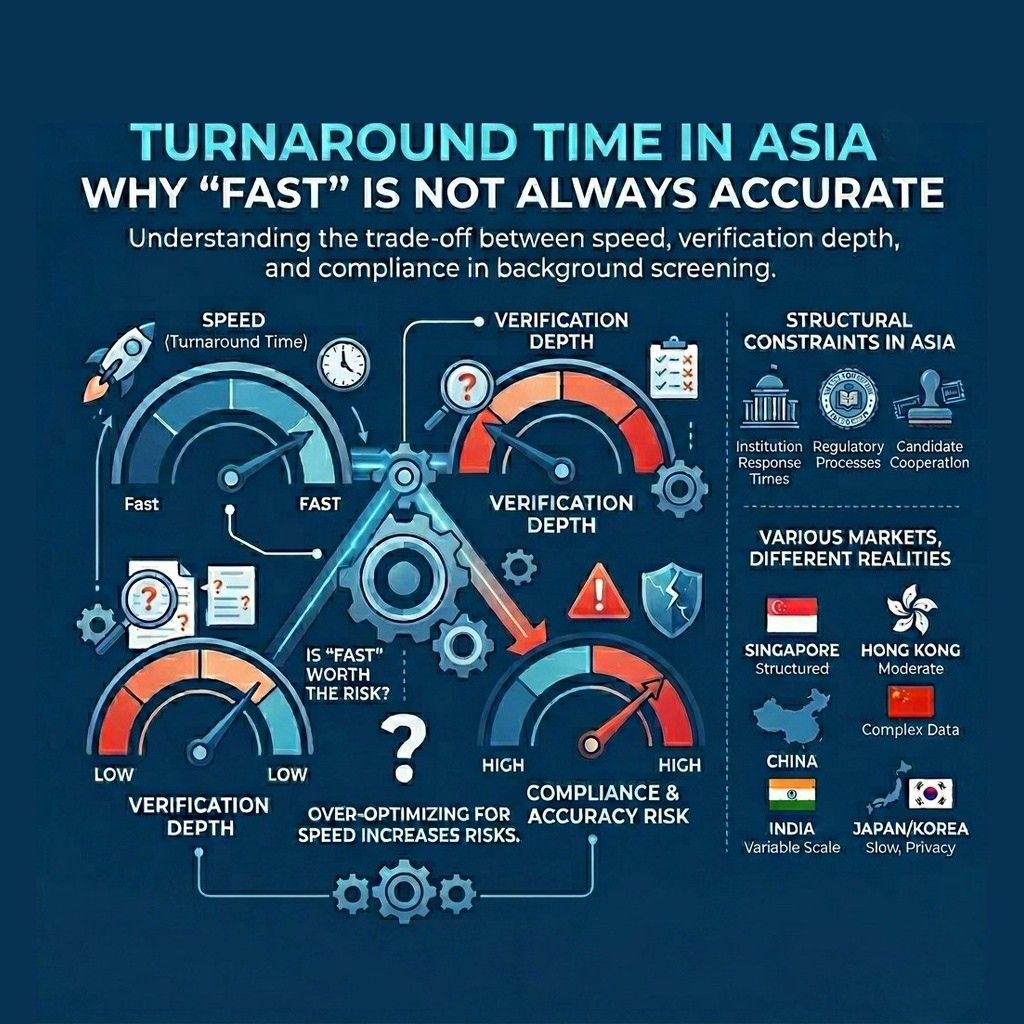
Turnaround Time in Asia: Why “Fast” Is Not Always Accurate
Understanding the trade-off between speed, verification depth, and compliance in background screening.Executive Summary
In Asia, background check turnaround time is not simply a measure of speed. It reflects institutional response times, regulatory requirements, candidate cooperation, and the level of verification depth required for the role.
Employers that focus only on the fastest possible result may increase accuracy, compliance, and audit risks. A better approach is to apply a structured risk-based background screening framework supported by role-based screening and clear regional compliance controls.
Download Full Guide (PDF)Key Takeaways
- Faster turnaround times in Asia often come with reduced verification depth.
- Many delays are caused by institutional response and regulatory processes, not provider inefficiency.
- Over-optimizing for speed can create hidden compliance and accuracy risks.
- Effective screening balances speed, verification rigor, and regulatory constraints.
Introduction
In many hiring environments, turnaround time is treated as a primary performance metric. Employers often ask: “How fast can background checks be completed?” or “Can we shorten the screening timeline?”
In Asia, speed is not simply a function of workflow efficiency. It is shaped by regulatory, institutional, and jurisdiction-specific verification realities. For employers operating across multiple markets, the right question is not only how fast screening can be completed, but whether the result is accurate, compliant, and defensible.
What Does “Turnaround Time” Actually Mean?
Turnaround time refers to the total time required to complete verification checks from initiation to final report delivery. In Asia, this timeline may be influenced by candidate responsiveness, institution cooperation, legal requirements, verification methodology, and cross-border processing rules.
For a broader regional overview, see this Asia background check compliance guide.
1. Why Faster Is Not Always Better
In many cases, “fast” screening may involve limited verification steps, reliance on readily available data, and reduced follow-up on discrepancies.
| Speed-Driven Shortcut | Potential Risk |
|---|---|
| Limited employment verification | Missed tenure, title, or departure inconsistencies |
| Database-only screening | Incomplete or outdated results |
| Reduced discrepancy follow-up | Lower audit defensibility |
| Generic consent handling | Privacy and compliance exposure |
2. Structural Constraints in Asia
Turnaround time in Asia is shaped by factors beyond provider control. Employers, universities, government agencies, and official bodies may all have different response timelines and verification procedures.
Criminal checks, work pass-related checks, education verification, and financial-sector screening may require additional consent, official processing, or candidate involvement. These constraints are structural, not merely operational.
3. Variability Across Asian Markets
| Market | Typical Turnaround Consideration |
|---|---|
| Singapore | Relatively structured, especially for employment and education checks. See the Singapore background checks guide. |
| Hong Kong | Moderate timelines, with controlled criminal record access. See the Hong Kong background check guide. |
| China | More complex due to data, privacy, and official-channel restrictions. See the China background check process. |
| India | Variable due to scale, institution diversity, and local responsiveness. |
| Japan / Korea | Often slower due to privacy expectations and controlled information access. |
4. The Hidden Cost of Accelerated Screening
When turnaround time is artificially shortened, verification steps may be skipped, follow-ups may be reduced, and data sources may be limited. This may produce faster reports, but not necessarily better hiring decisions.
Employers should also understand why screening failures occur across the region. Read more here: Why background checks fail in Asia.
5. Turnaround vs Verification Depth
| Approach | Speed | Verification Depth | Risk Level |
|---|---|---|---|
| Database-only | High | Low | High |
| Limited verification | Moderate–High | Moderate | Moderate |
| Full verification | Moderate | High | Low |
Higher verification depth typically results in more reliable and defensible outcomes, especially for regulated, executive, finance, or sensitive roles. For financial-sector roles, see this financial background screening guide for Asia.
6. The Role of Process Design
Turnaround is heavily influenced by workflow structure, document collection timing, escalation procedures, and coordination across jurisdictions. Well-designed screening processes can reduce unnecessary delays while maintaining quality.
Employers can strengthen consistency by using a background screening policy template for Asia Pacific and reviewing their approach against a compliant background screening policy.
7. Managing Expectations
Instead of asking only “How fast can we complete this?”, employers should ask:
- What level of verification is required for this role?
- What risks are acceptable?
- Which jurisdictions are involved?
- Are consent and privacy requirements properly documented?
8. Practical Approach for Employers
| Action | Why It Helps |
|---|---|
| Apply role-based screening | Matches screening depth to role risk. |
| Prepare documents early | Reduces candidate-side delay. |
| Plan by jurisdiction | Sets realistic turnaround expectations. |
| Use structured vendor oversight | Improves quality and accountability. See these vendor questions for Asia. |
| Review outsourcing model | Clarifies whether in-house or outsourced screening is more suitable. See in-house vs outsourced screening in Asia. |
FAQ
Why do background checks take longer in Asia?
Because verification depends on institutional responses, regulatory processes, candidate cooperation, and limited data access across different jurisdictions.
Is faster screening less reliable?
In many cases, yes. Faster screening may involve reduced verification depth, fewer follow-ups, or narrower data sources.
What affects turnaround time the most?
Institutional responsiveness, candidate cooperation, legal requirements, and the type of checks being performed.
How can companies reduce delays?
Companies can prepare documents early, obtain clear consent, apply role-based screening, and set realistic expectations by country.
Should employers use one SLA for all Asian markets?
Not usually. A single SLA may not reflect differences in regulation, official-channel access, and institutional responsiveness across Asia.
Final Takeaway
Turnaround time in Asia is not simply a measure of speed. It is a reflection of verification depth, compliance obligations, institutional engagement, and jurisdictional complexity.
The goal should not be the fastest possible report. The goal should be the most reliable, compliant, and defensible screening outcome.
For strategic planning, see the Asia background screening executive briefing and the Asia background check guide.

