

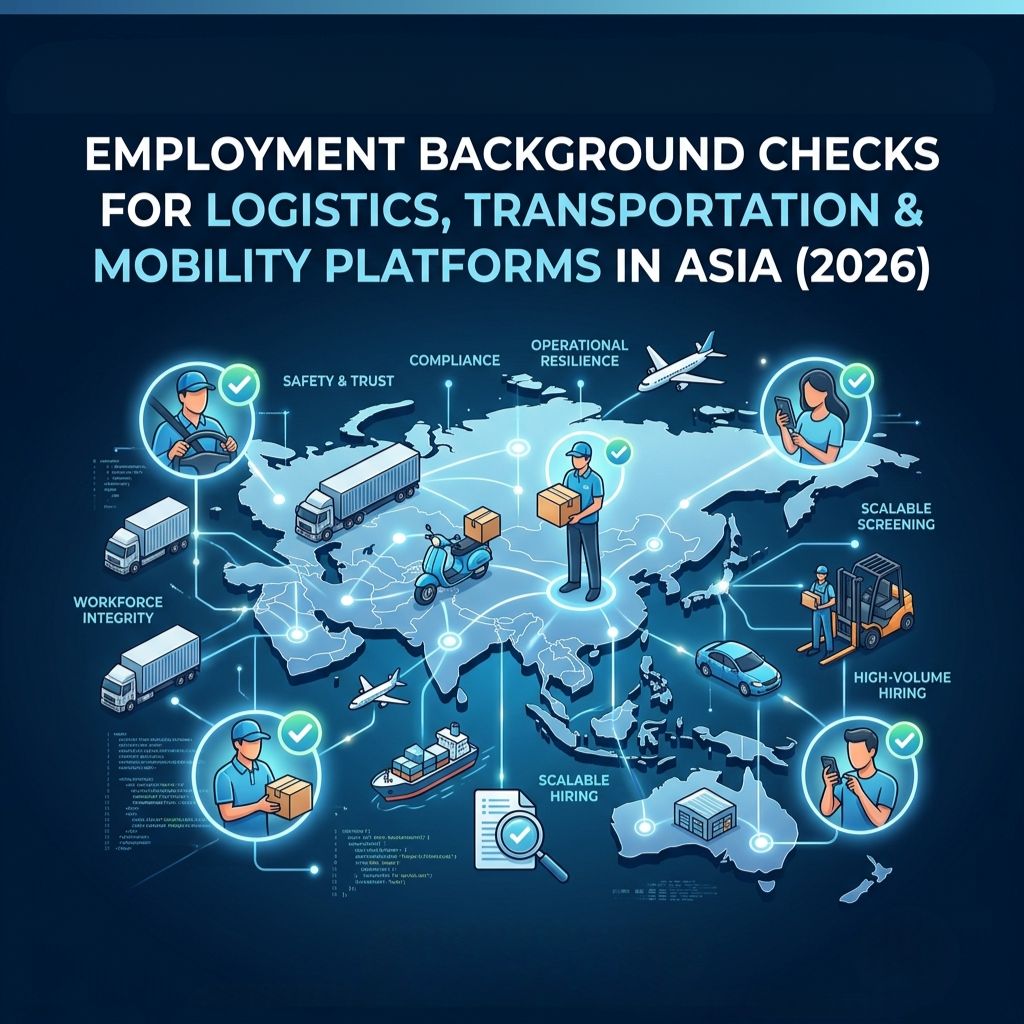
Employment Background Checks for Logistics, Transportation & Mobility Platforms in Asia (2026)
A practical guide to workforce integrity, safety, trust, compliance, operational resilience, and scalable background screening for logistics providers, transportation operators, delivery networks, ride-hailing platforms, and mobility businesses across Asia.Executive Summary
The logistics, transportation, and mobility sectors form a critical part of Asia’s economy, connecting businesses, consumers, and communities across borders. From logistics providers and freight operators to ride-hailing platforms, delivery networks, public transportation operators, and mobility technology companies, organizations within these sectors face unique workforce risks that differ significantly from traditional office-based environments. Unlike many industries where employees have limited interaction with customers or physical assets, personnel within transportation and mobility organizations often have direct access to customers, vehicles, cargo, facilities, sensitive information, and public infrastructure. As a result, employment background checks have become an increasingly important component of workforce risk management, helping organizations strengthen safety, trust, compliance, and operational integrity.For broader program design, employers may also refer to eeCheck’s compliant background screening policy guide, Asia-Pacific background screening policy template, role-based background screening guide, and risk-based background screening guide.
About This Guide
This guide was prepared by eeCheck, an Asia-focused background screening and workforce integrity specialist supporting more than 5,000 organizations across Asia. eeCheck supports background screening programs for logistics providers, delivery platforms, transportation operators, ride-hailing businesses, mobility technology companies, public transport operators, multinational corporations, government-linked organizations, and regulated industries across Asia-Pacific.The guidance in this article is based on practical experience supporting high-volume hiring, frontline workforce screening, cross-border verification, operational risk management, and trust and safety programs across Hong Kong, Singapore, China, India, Taiwan, Japan, South Korea, Indonesia, Malaysia, Vietnam and other Asian markets.
Why Employment Background Checks Matter in Logistics and Mobility
Transportation and mobility organizations operate in environments where workforce decisions can have direct consequences on public safety, customer trust, asset protection, service reliability, regulatory compliance, and brand reputation. A hiring mistake may result in safety incidents, theft or fraud, customer complaints, regulatory violations, data security breaches, and reputational damage.| Risk Area | Why Background Screening Matters |
|---|---|
| Public Safety | Supports informed hiring for roles involving passengers, vehicles, facilities, and public-facing operations. |
| Customer Trust | Helps organizations assess personnel before they interact directly with customers or handle customer information. |
| Asset Protection | Reduces risks involving cargo, vehicles, equipment, inventory, and facilities. |
| Service Reliability | Supports workforce continuity and reduces avoidable operational disruption. |
| Regulatory Compliance | Helps organizations align screening scope with local employment, privacy, transport, and safety requirements. |
| Brand Reputation | Helps protect public confidence in services that depend heavily on trust and reliability. |
Workforce Integrity Challenges in the Sector
The logistics and mobility sectors often face unique workforce challenges, including high-volume hiring requirements, rapid workforce expansion, large distributed workforces, contractor and gig worker engagement, cross-border hiring, high turnover in certain job categories, and operational pressure to onboard quickly.| Workforce Challenge | Screening Program Consideration |
|---|---|
| High-Volume Hiring Requirements | Requires scalable screening workflows that can manage large numbers of candidates consistently. |
| Rapid Workforce Expansion | Screening must support fast onboarding without compromising verification quality. |
| Large Distributed Workforces | Requires consistent screening standards across locations, hubs, branches, and markets. |
| Contractor and Gig Worker Engagement | Screening frameworks should be adapted to workforce category, legal status, and operational risk. |
| Cross-Border Hiring | Verification may involve multiple jurisdictions, languages, and documentation standards. |
| High Turnover in Certain Job Categories | Screening programs should remain cost-effective, efficient, and operationally sustainable. |
| Operational Pressure to Onboard Quickly | Requires screening processes that support fast onboarding while maintaining accuracy, compliance, and workforce integrity. |
Common Risks Addressed Through Employment Background Checks
Organizations commonly implement employment background screening programs to help mitigate risks such as identity fraud, qualification misrepresentation, employment history discrepancies, safety-related concerns, theft and asset misappropriation, customer trust incidents, conflicts of interest, regulatory non-compliance, insider threats, and reputational risk.| Risk | How Screening Helps |
|---|---|
| Identity Fraud | Confirms candidate identity and supports consistent onboarding controls. |
| Qualification Misrepresentation | Verifies claimed education, licences, professional credentials, and role-related qualifications where relevant. |
| Employment History Discrepancies | Validates past employment history, job titles, and work experience. |
| Safety-Related Concerns | Supports role-relevant review before assigning public-facing or vehicle-related duties. |
| Theft and Asset Misappropriation | Helps reduce risks involving cargo, inventory, fleet assets, or facilities. |
| Customer Trust Incidents | Supports safer customer-facing operations and helps reduce incidents that may undermine trust in the platform or service. |
| Conflicts of Interest | Helps identify potential external interests, affiliations, or role-related concerns where relevant to operational integrity. |
| Regulatory Non-Compliance | Supports documentation, auditability, and role-relevant checks for regulated activities. |
| Insider Threats | Adds one layer of workforce integrity control for roles with system, facility, customer, or operational access. |
| Reputational Risk | Helps protect public confidence and customer trust in safety-sensitive services. |
Common Risks Addressed Through Employment Background Checks
Organizations commonly implement employment background screening programs to help mitigate risks such as identity fraud, qualification misrepresentation, employment history discrepancies, safety-related concerns, theft and asset misappropriation, customer trust incidents, conflicts of interest, regulatory non-compliance, insider threats, and reputational risk.| Risk | How Screening Helps |
|---|---|
| Identity Fraud | Confirms candidate identity and supports consistent onboarding controls. |
| Qualification Misrepresentation | Verifies claimed education, licences, professional credentials, and role-related qualifications where relevant. |
| Employment History Discrepancies | Validates past employment history, job titles, and work experience. |
| Safety-Related Concerns | Supports role-relevant review before assigning public-facing or vehicle-related duties. |
| Theft and Asset Misappropriation | Helps reduce risks involving cargo, inventory, fleet assets, or facilities. |
| Regulatory Non-Compliance | Supports documentation, auditability, and role-relevant checks for regulated activities. |
| Insider Threats | Adds one layer of workforce integrity control for roles with system, facility, customer, or operational access. |
| Reputational Risk | Helps protect public confidence and customer trust in safety-sensitive services. |
Why Background Screening Is Different in Logistics and Mobility
Employment background screening in logistics and mobility organizations often differs significantly from traditional corporate environments. These organizations often manage large frontline teams, distributed workforces, high-volume hiring, and operational roles with direct customer or public safety exposure.| Traditional Corporate Hiring | Logistics & Mobility Workforce Hiring |
|---|---|
| Primarily office-based workforce | Large frontline and operational workforce |
| Lower public safety exposure | Direct impact on public safety and customer trust |
| Fixed workplace environments | Distributed and mobile workforce |
| Moderate hiring volumes | High-volume and continuous hiring needs |
| Lower turnover in many roles | Higher turnover in selected workforce segments |
| Primarily employee workforce | Employees, contractors, and gig workers |
| Operational delays have limited external impact | Workforce shortages can directly affect service delivery |
Risk-Based Screening by Workforce Category
Different workforce groups present different levels of risk and therefore often require different screening approaches. Screening requirements should be aligned with operational, legal, and business risks rather than applying identical checks across all positions.| Workforce Category | Primary Risks | Typical Screening Focus |
|---|---|---|
| Drivers and Vehicle Operators | Public safety, customer trust, regulatory compliance | Identity verification, licence verification, employment history validation |
| Delivery Personnel | Customer interaction, asset protection, operational integrity | Identity verification, employment history validation |
| Warehouse and Operations Staff | Inventory loss, operational integrity, facility access | Identity verification, employment history, references where appropriate |
| Fleet Management Personnel | Asset management, fraud risk, operational oversight | Employment verification, references, and integrity-focused screening where relevant |
| Customer Service Teams | Customer trust, access to sensitive information | Employment verification and reference checks |
| Technology and Platform Teams | Data access, cybersecurity, platform integrity | Employment verification, education verification, adverse dataset screening where relevant |
| Senior Management | Governance, reputation, strategic decision-making | Comprehensive background screening, reference checks, directorship and integrity-related reviews |
Why Safety and Trust Are Critical
Unlike many industries, transportation and mobility personnel often interact directly with passengers, customers, goods and cargo, vehicles and equipment, and critical infrastructure. As a result, trust and safety considerations often form a central part of workforce governance. Organizations increasingly view employment background checks as one component of broader trust and safety frameworks designed to protect customers, protect employees, reduce operational risks, strengthen brand reputation, and support regulatory expectations.| Trust and Safety Focus | Practical Value |
|---|---|
| Protect Customers | Supports safer and more reliable customer-facing operations. |
| Protect Employees | Helps maintain a safer workforce environment for frontline and operational teams. |
| Reduce Operational Risks | Supports service continuity and reduces avoidable incidents. |
| Strengthen Brand Reputation | Builds customer confidence in services that depend on safety and reliability. |
| Support Regulatory Expectations | Helps demonstrate structured workforce governance and compliance readiness. |
Candidate Experience Remains Important
Many logistics and mobility organizations hire at scale. Complex or inefficient screening processes may lead to candidate withdrawal, delayed onboarding, operational staffing shortages, and increased recruitment costs. Modern screening programs therefore increasingly focus on mobile-friendly candidate journeys, digital document collection, electronic consent processes, automated status updates, and clear communication throughout the process.| Candidate Experience Element | Why It Matters |
|---|---|
| Mobile-Friendly Candidate Journeys | Supports frontline, contractor, and distributed workforces that may rely heavily on mobile devices. |
| Digital Document Collection | Reduces administrative delays and improves submission completeness. |
| Electronic Consent Processes | Improves transparency and supports compliant screening workflows. |
| Automated Status Updates | Keeps candidates, recruiters, and operations teams informed. |
| Clear Communication Throughout the Process | Reduces candidate confusion, follow-up delays, and drop-off. |
Balancing Speed, Accuracy and Operational Needs
One of the most common challenges faced by transportation and mobility organizations is balancing hiring speed with screening quality. Organizations often require rapid onboarding, seasonal workforce expansion, large recruitment campaigns, and operational flexibility. At the same time, hiring decisions must remain defensible, consistent, compliant, and risk-based.| Evaluation Factor | Importance |
|---|---|
| Safety | Critical |
| Accuracy | Critical |
| Compliance | Critical |
| Candidate Experience | High |
| Turnaround Time | High |
| Operational Scalability | High |
| Cost Efficiency | High |
Emerging Trends in Logistics and Mobility Screening
| Trend | Impact on Screening Programs |
|---|---|
| Growth of Platform-Based Workforces | Mobility and delivery platforms increasingly rely on contractors and independent workers, creating new workforce verification challenges. |
| Increasing Regulatory Expectations | Many jurisdictions continue strengthening expectations around workforce integrity, public safety, and operational accountability. |
| Cross-Border Workforce Mobility | Regional expansion and labour mobility continue increasing the need for cross-border verification capabilities. |
| Trust and Safety Programs | Organizations are investing more heavily in workforce screening as part of broader trust and safety initiatives. |
| Digital Transformation | Technology-driven onboarding and screening workflows continue improving candidate experience and operational efficiency. |
Key Considerations When Selecting a Screening Partner
Organizations evaluating background screening providers should consider factors beyond simply the screening checks available.| Consideration | Why It Matters in Logistics & Mobility |
|---|---|
| High-Volume Processing Capability | Supports large-scale and continuous hiring needs. |
| Candidate Experience | Enables efficient onboarding of frontline workers. |
| Regional Coverage | Supports multi-country operations and workforce mobility. |
| Operational Scalability | Accommodates workforce growth and seasonal hiring. |
| Turnaround Time | Delays can directly impact service delivery and operations. |
| Workforce Category Flexibility | Different roles require different screening approaches. |
| Information Security | Protects candidate, customer, and operational information. |
| Regulatory Understanding | Supports compliance with local employment and privacy requirements. |
| Reporting Capability | Enables workforce governance and operational oversight. |
| Quality Assurance | Ensures consistency and reliability of screening outcomes. |
Why Logistics and Mobility Organizations Work With eeCheck
eeCheck has extensive experience supporting leading global and regional logistics, transportation, mobility, and platform organizations across Asia. With a strong understanding of high-volume hiring environments, workforce integrity requirements, and trust and safety considerations, eeCheck helps organizations implement scalable employment background screening programs that support both operational efficiency and risk management.Frequently Asked Questions
Why are background checks important for logistics and mobility companies?
Should all logistics roles receive the same screening package?
How can companies balance speed and accuracy?
Are background checks useful for gig workers and contractors?
What should employers consider when choosing a screening partner?
Final Strategic Takeaway
For logistics, transportation, and mobility organizations, employment background checks are no longer simply an administrative hiring activity. They have become an important component of workforce integrity, trust and safety, operational resilience, and risk management. As organizations across Asia continue expanding transportation networks, delivery platforms, and mobility services, effective employment background screening programs can help strengthen customer confidence, protect assets, support regulatory compliance, and enable informed hiring decisions.The most successful programs balance speed, scalability, candidate experience, safety, and compliance while maintaining the workforce integrity standards necessary to support long-term operational success.

