

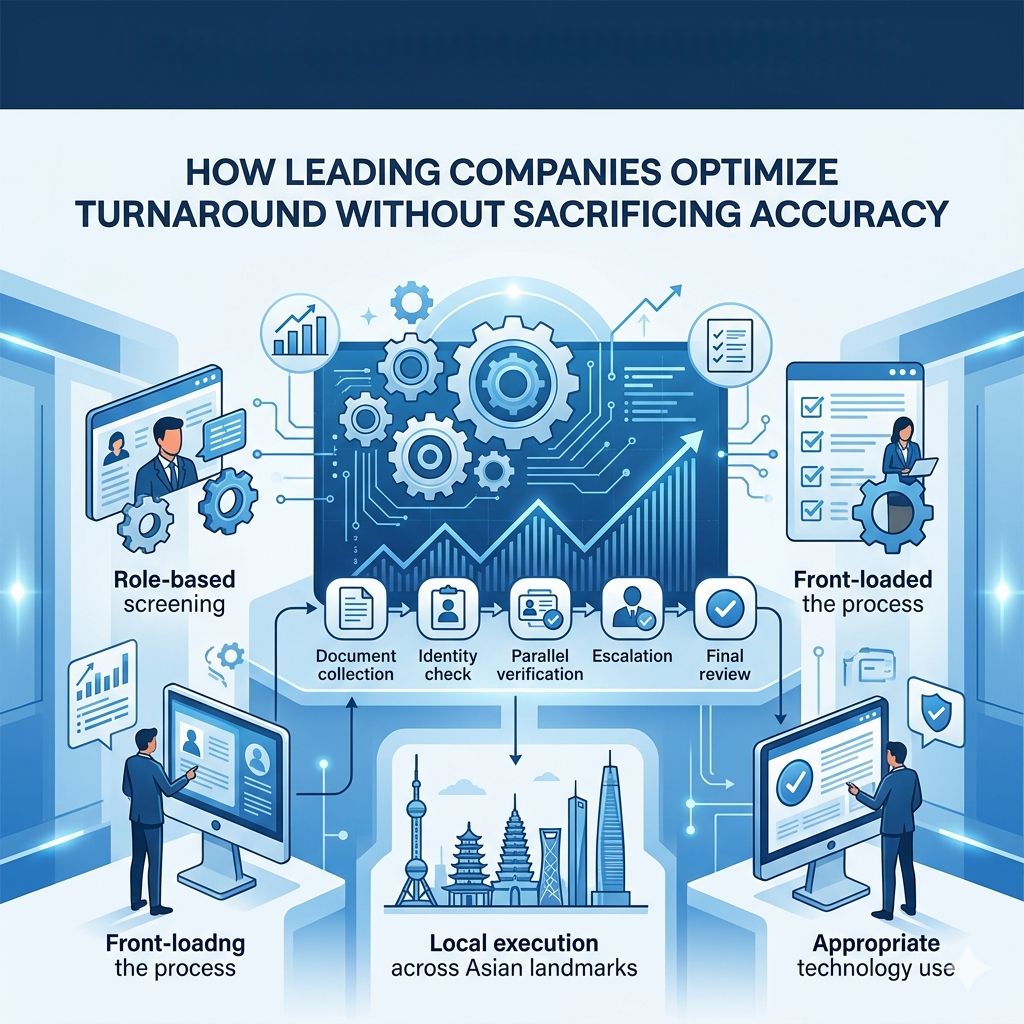
How Leading Companies Optimize Turnaround Without Sacrificing Accuracy
A Structured Approach to Balancing Speed, Verification Depth, and Compliance in Asia
Executive Summary
Leading organizations treat background screening turnaround as a process design outcome, not simply a speed target. Faster screening is achieved through structured workflows, early preparation, role-based screening, local execution, and strong governance.
In Asia-Pacific, where verification timelines vary by country, institution, language, and regulatory requirements, companies should balance speed with accuracy, compliance, and defensibility. For broader compliance planning, see our guides to building a compliant background screening policy in Asia, risk-based background screening in Asia, and role-based background screening in Asia.
Download the Turnaround Optimization GuideKey Takeaways
| Topic | Employer Consideration |
|---|---|
| Turnaround | Should be treated as a process outcome, not a standalone KPI. |
| Accuracy | Should not be compromised by reducing verification scope unnecessarily. |
| Role-based screening | Helps allocate verification depth according to role sensitivity and risk. |
| Preparation | Early document collection and consent reduce downstream delays. |
| Governance | Consistent controls help maintain compliance and audit readiness. |
Introduction
Organizations hiring across Asia often face the same question: how can background screening be completed faster without compromising accuracy or compliance?
While some organizations try to accelerate screening by reducing scope or relying heavily on automation, leading companies take a more structured approach. They optimize the screening process rather than simply compressing timelines.
This is especially important in Asia, where verification practices, institutional response times, data protection requirements, and documentation standards differ significantly by jurisdiction. For wider regional context, see the Asia Background Check Guide and Asia Background Check Compliance Guide.
1. Redefining Turnaround as a Process Outcome
Leading organizations do not begin by asking, “How fast can this be completed?”
Instead, they ask:
- What level of verification is appropriate for this role?
- What risks are associated with the position?
- Which checks must be prioritized?
- How can the workflow be structured efficiently?
Turnaround time should be the result of structured process design, not a promise made before jurisdictional and role-specific factors are assessed.
2. Applying Role-Based Screening Frameworks
One of the most effective ways to optimize turnaround is to apply a tiered screening framework. This ensures that verification effort is proportionate to the role.
| Role Type | Screening Depth | Expected Turnaround |
|---|---|---|
| Administrative | Basic checks | Fast |
| Professional | Standard checks | Moderate |
| Finance / Sensitive | Enhanced checks | Longer |
| Executive | Comprehensive checks | Longest |
A role-based model helps organizations avoid unnecessary delays while ensuring that higher-risk roles receive the appropriate level of scrutiny. For related guidance, read Financial Background Screening in Asia and the Background Screening Policy Template for Asia Pacific.
3. Front-Loading the Process
Many screening delays occur before verification begins. Missing documents, incomplete candidate details, unclear consent, or undefined scope can slow down the entire process.
Leading organizations reduce delays by focusing on:
- Early document collection
- Complete candidate submissions
- Proper consent structure
- Clear scope definition
- Country-specific preparation
A well-prepared case usually moves faster than one requiring repeated follow-up.
4. Structuring Verification Workflows
Efficient screening relies on structured workflows. The objective is not to skip steps, but to sequence and manage them properly.
| Workflow Element | Purpose |
|---|---|
| Document collection | Ensures required information is available before verification starts. |
| Identity check | Confirms the candidate identity before other checks proceed. |
| Parallel verification | Allows suitable checks to run at the same time where legally appropriate. |
| Escalation | Flags missing, delayed, or inconsistent information early. |
| Final review | Ensures report quality, consistency, and defensibility. |
5. Leveraging Local Execution
In Asia, verification often depends on institutional responsiveness, local language capability, jurisdiction-specific procedures, and direct source engagement.
Leading companies therefore rely on:
- Local execution teams or local verification capability
- Direct institutional engagement
- Country-specific process knowledge
- Reduced reliance on unnecessary intermediaries
Local execution can improve both turnaround reliability and verification accuracy. For jurisdiction-specific examples, see the Hong Kong Background Check Guide, Singapore Background Checks Guide, China Background Check Process, and Hong Kong Criminal Record Check Guide.
6. Managing Cross-Border Coordination
For multi-country hiring, turnaround must be managed across several timelines at the same time. Different checks may depend on different institutions, regulators, schools, employers, or government processes.
| Challenge | Recommended Approach |
|---|---|
| Different country timelines | Use jurisdiction-specific turnaround expectations. |
| Data transfer requirements | Apply privacy and compliance controls from the start. |
| Inconsistent documentation | Use standardized submission requirements. |
| Escalation delays | Define escalation paths before cases begin. |
Central coordination with local execution is often more effective than simply demanding faster completion.
7. Using Technology Appropriately
Technology can improve turnaround when it supports the verification process.
Effective uses of technology include:
- Case tracking dashboards
- Automated reminders
- Workflow routing
- Structured reporting templates
- Audit trail management
8. Setting Realistic Expectations
Leading organizations align stakeholders early instead of promising unrealistic timelines.
Rather than promising “three-day turnaround for all checks,” they communicate:
- Jurisdiction-specific timelines
- Role-based differences
- Institutional dependencies
- Possible escalation triggers
- Compliance-related limitations
This helps reduce pressure to compromise accuracy for speed. For more on this topic, read Turnaround Time in Asia: Why “Fast” Is Not Always Accurate.
9. Building Governance into the Process
Efficient screening must also be compliant screening. Governance ensures that faster workflows remain defensible.
| Governance Element | Why It Matters |
|---|---|
| Documented decisions | Supports auditability and consistency. |
| Defined escalation procedures | Ensures issues are handled consistently. |
| Audit trails | Provides evidence of process integrity. |
| Discrepancy classification | Helps avoid inconsistent or unfair treatment. |
| Role-based justification | Supports proportionality and compliance. |
Common Misconception
| Misconception | Reality |
|---|---|
| Faster screening means better efficiency. | Not always. Faster screening may reduce verification depth if the process is not properly designed. |
| Automation alone solves turnaround issues. | Automation helps, but local execution and human quality control remain important. |
| One timeline works across Asia. | Different jurisdictions have different verification processes and response times. |
How This Fits into a Wider Screening Programme
Turnaround optimization should form part of a broader screening strategy that includes policy design, vendor evaluation, compliance review, and jurisdiction-specific execution.
Recommended internal resources:
Background Screening Vendor Questions Asia
In-House vs Outsourced Screening in Asia
Top Background Check Firm in Asia
Global Background Check Firms Asia Mistakes
Why Background Checks Fail in Asia
Asia Background Screening Report
MNC Background Screening in Asia
Asia Background Screening Executive Briefing
FAQ
How do companies speed up background checks without reducing accuracy?
Companies can improve turnaround by structuring workflows, applying role-based screening, collecting documents early, and using local verification capability where needed.
What is the most effective way to reduce screening delays?
Front-loading the process with complete documentation, accurate candidate information, proper consent, and clear scope definition is one of the most effective ways to reduce delays.
Does automation reduce turnaround time?
Yes. Automation can reduce manual bottlenecks and improve tracking, but it should support verification rather than replace proper verification procedures.
What is the biggest factor affecting turnaround in Asia?
Institutional response time, local regulatory requirements, documentation standards, and jurisdiction-specific verification access are major factors affecting turnaround in Asia.
Final Takeaway
Leading organizations do not sacrifice accuracy for speed. They optimize background screening turnaround through structured frameworks, early preparation, local execution, workflow discipline, and governance controls.
In Asia-Pacific, the strongest screening programmes balance speed, accuracy, compliance, and defensibility. Turnaround should not be reduced by cutting corners; it should be improved through better process design.

