

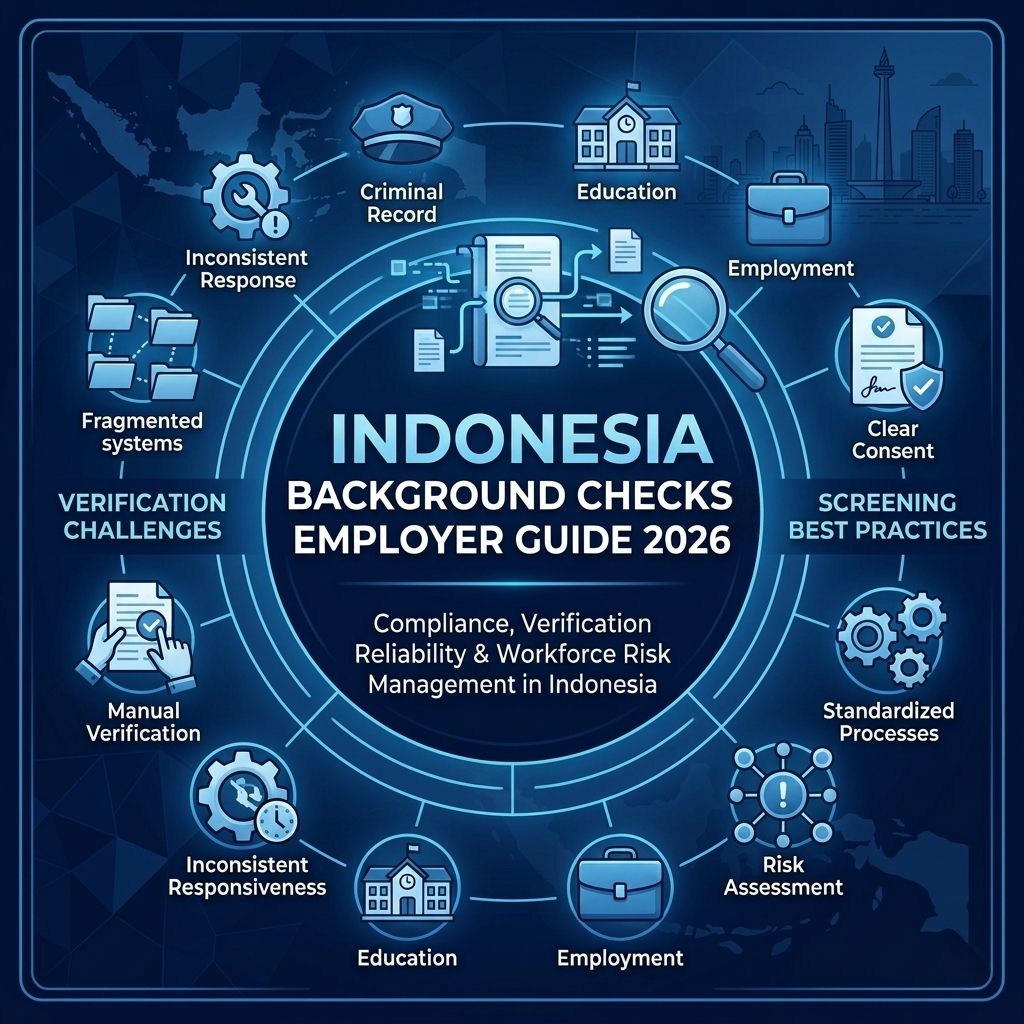
Indonesia Background Checks: Employer Guide, Verification Challenges & Screening Best Practices 2026
Compliance, Verification Reliability & Workforce Risk Management in Indonesia
Indonesia is one of Southeast Asia’s largest and fastest-growing labour markets. It attracts multinational corporations, financial institutions, technology companies, manufacturers, professional services firms, outsourcing providers, and regional employers seeking access to a large and diverse workforce.
Executive Summary
Indonesia background checks are generally feasible, but employers should recognize that Indonesia is one of Asia’s more operationally complex verification environments. The main challenge is often not whether screening is allowed, but whether verification can be completed reliably, consistently, and within expected timelines.
Employers frequently encounter fragmented record systems, inconsistent institutional responsiveness, manual verification processes, variable documentation standards, and candidate-dependent requirements. For regional employers, Indonesia screening should be aligned with a broader compliant background screening policy in Asia, supported by a clear background screening policy template for Asia-Pacific, and assessed against country-specific compliance guidance from the Asia background check compliance guide.
Successful screening programs in Indonesia typically use a structured, localized, and risk-based approach. This means combining clear consent, role-based screening scope, multiple verification sources, local-language capabilities, and strong governance controls.
Download Executive BriefingIntroduction: Why Indonesia Background Checks Require Local Adaptation
Despite Indonesia’s scale and economic importance, the country remains a highly practical and operationally nuanced screening environment. Employers may face fragmented verification ecosystems, variable record quality, regional differences in administrative practices, and limited centralized verification infrastructure.
Common challenges include:
- Fragmented verification ecosystems
- Variable record quality across institutions
- Heavy reliance on manual verification processes
- Candidate-dependent documentation
- Significant differences in responsiveness between organizations and regions
- Limited centralized verification infrastructure
For organizations hiring across multiple jurisdictions, Indonesia should be evaluated as part of a wider regional screening strategy. See eeCheck’s Asia Background Check Guide and Asia Background Screening Report for broader APAC context.
Indonesia Background Checks – At a Glance
| Category | Indonesia Position |
|---|---|
| Legal Framework | Personal Data Protection Law (PDP Law) |
| Consent Required | Yes |
| Criminal Record Access | Candidate involvement generally required |
| Employment Verification | Available but highly manual |
| Education Verification | Common, but institutional responsiveness varies |
| Credit Check | Role-dependent and should be proportionate |
| Civil Litigation Check | Available through public records where relevant |
| Bankruptcy Check | Available through public records where legally available |
| Directorship Check | Available through corporate registry sources |
| Data Localization | Not mandatory |
| Cross-Border Data Transfer | Permitted subject to compliance requirements |
| Standard Coverage | 3–5 years typical |
| Typical Turnaround | 1–15 business days depending on check type |
1. Why Indonesia Presents Unique Screening Challenges
Indonesia is sometimes perceived as a straightforward employment screening market because background checks are generally accepted by employers and many forms of documentation are available. In practice, however, the main challenge is verification reliability rather than legal permissibility.
| Challenge | Why It Matters for Employers |
|---|---|
| Different Record-Keeping Standards | Institutions and employers may maintain records differently, creating inconsistent verification outcomes. |
| Variable Employer Responsiveness | Some employers respond quickly, while others may require repeated follow-up or supporting documentation. |
| Manual Verification Processes | Many checks require direct outreach, local-language communication, or document-based review. |
| Regional Administrative Differences | Verification practices can vary across cities, provinces, institutions, and employer types. |
| Candidate-Dependent Documentation | Some checks may require candidate participation, original documents, or additional authorization. |
Organizations that understand these realities are better positioned to manage hiring risk while maintaining efficiency and compliance. For related regional issues, see why background checks fail in Asia.
2. eeCheck Indonesia Workforce Risk Framework
eeCheck generally categorizes workforce screening in Indonesia into four risk domains: verification risk, identity risk, integrity risk, and governance risk.
| Risk Domain | Purpose | Typical Checks |
|---|---|---|
| Verification Risk | Validates candidate-provided information. | Employment verification, education verification, professional reference checks. |
| Identity Risk | Confirms identity and reduces impersonation risk. | Identity verification, candidate identity documentation review. |
| Integrity Risk | Identifies publicly available legal, financial, or reputational risk indicators. | Criminal record screening, civil litigation checks, bankruptcy and insolvency checks, directorship checks, credit and financial checks. |
| Governance Risk | Identifies potential conflicts of interest and broader business relationships. | Corporate affiliation screening, directorship reviews, conflict-of-interest assessments. |
Organizations that combine multiple risk domains generally achieve stronger hiring outcomes than those relying solely on a single verification source. This approach aligns with risk-based background screening in Asia.
3. Legal Framework Governing Background Checks in Indonesia
Indonesia’s Personal Data Protection Law (PDP Law) is the primary legislation governing personal information processing. Employers should ensure that screening activities are lawful, transparent, purpose-driven, and supported by appropriate consent.
| Compliance Principle | Employer Consideration |
|---|---|
| Consent | Obtain consent before collecting and processing personal information. |
| Purpose Limitation | Clearly define why the information is being collected and how it will be used. |
| Lawful Processing | Ensure screening activities are connected to legitimate hiring or business objectives. |
| Data Security | Apply appropriate security controls to protect candidate information. |
| Retention Practices | Retain data only for appropriate periods and in line with policy requirements. |
Employers should avoid excessive data collection and ensure that screening remains relevant and proportionate to the position being assessed. For program design, see role-based background screening in Asia.
4. Criminal Record Checks & Public Record Screening in Indonesia
Indonesia’s criminal record certificate is commonly known as Surat Keterangan Catatan Kepolisian (SKCK). The SKCK is issued by Indonesian police authorities and generally requires candidate participation.
| Screening Area | Practical Consideration |
|---|---|
| SKCK / Police Clearance | Candidate cooperation is generally required, and timelines may vary depending on process and documentation. |
| Public Record Screening | May be used as part of broader risk management where legally appropriate and proportionate. |
| Layered Approach | Employers may combine candidate-provided documentation with other lawful verification methods. |
| Role Relevance | Criminal and public record screening should be linked to role risk and legitimate business purpose. |
For comparison with other markets, see eeCheck’s Hong Kong criminal record check guide and China background check process guide.
5. Employment Verification in Indonesia
Employment verification is generally available in Indonesia but remains highly dependent on manual processes and employer responsiveness. Verification may include employment dates, job title, employer confirmation, and supporting documentation review.
| Employment Verification Area | Indonesia Practical Consideration |
|---|---|
| Employment Dates | May be confirmed through employer outreach or supporting documentation. |
| Job Title | Often confirmable, but depends on HR response and record availability. |
| Employer Confirmation | May require repeated follow-up, local-language handling, and candidate authorization. |
| Informal Employment | May require alternative verification methods and supporting documents. |
| Supporting Documents | Contracts, payslips, reference letters, and separation documents may support verification. |
For regional comparison, see eeCheck’s guide to employment verification in Asia.
6. Education Verification in Indonesia
Education verification is one of the most commonly requested screening services in Indonesia. It may confirm degree authenticity, institution details, graduation records, and academic credentials.
However, Indonesia’s education sector includes institutions with varying administrative capabilities and record management practices. Employers may experience different response standards, delayed responses, incomplete records, and manual verification requirements.
7. Professional Reference Checks
Professional reference checks are commonly utilized in Indonesia for management hiring, regulated positions, financial services roles, executive recruitment, and other high-trust positions.
| Reference Check Use Case | Why It Matters |
|---|---|
| Management Hiring | Helps assess leadership capability, team management style, and workplace conduct. |
| Regulated Positions | Supports fit-and-proper expectations and role-related risk evaluation. |
| Financial Services Roles | Provides additional insight for roles involving trust, client assets, sensitive information, or financial responsibility. |
| Executive Recruitment | Helps evaluate leadership history, professional reputation, and decision-making style. |
| High-Trust Positions | Supports hiring decisions for roles requiring elevated integrity, responsibility, or confidential access. |
Reference checks may provide additional insight into professional conduct, workplace performance, leadership capabilities, and employment history consistency.
8. Identity Verification
Identity verification may involve review of candidate-provided identity documentation and other lawful verification methods where appropriate.
| Identity Verification Consideration | Recommended Employer Approach |
|---|---|
| Candidate Consent | Ensure appropriate consent is obtained before collecting or reviewing identity information. |
| Proportionate Collection | Collect only information necessary for the hiring purpose and role requirement. |
| Secure Handling | Ensure personal data is handled securely with appropriate access controls. |
| Retention Practices | Clearly define how long identity information will be retained and who may access it. |
Identity verification should be aligned with both hiring objectives and applicable privacy requirements.
9. Additional Risk & Integrity Screening Services
| Screening Service | Common Use Case | Employer Consideration |
|---|---|---|
| Civil Litigation Record Checks | Senior management, regulated roles, executive due diligence, high-trust positions. | Use should be relevant, proportionate, and consistent with privacy requirements. |
| Bankruptcy & Insolvency Checks | Financial services, fiduciary roles, finance functions, senior appointments. | Assess relevance based on role and decision-making authority. |
| Directorship & Corporate Affiliation Checks | Executive hiring, board appointments, regulated roles, governance-sensitive positions. | May help identify business interests and potential conflicts of interest. |
| Credit & Financial Checks | Financial services, fiduciary roles, sensitive management positions. | Should be limited to roles where financial screening is relevant and justified. |
| Professional Reference Checks | Management hiring, executive recruitment, regulated roles, high-trust positions. | Can provide additional insight into conduct, performance, and leadership capability. |
For sensitive roles and regulated sectors, employers may also review financial background screening in Asia.
10. Background Check Services & Typical Turnaround Times
| Screening Service | Typical Turnaround Time |
|---|---|
| Identity Verification | 1–3 business days |
| Criminal Record Check (Public Dataset Search) | 1–3 business days |
| Bankruptcy & Insolvency Check | 1–3 business days |
| Directorship & Corporate Affiliation Check | 1–3 business days |
| Civil Litigation Record Check | 1–5 business days |
| Credit & Financial Check | 3–7 business days |
| Professional Reference Check | 3–7 business days |
| Education Verification | 5–12 business days |
| Employment Verification | 5–15 business days |
Actual turnaround times may vary depending on record availability, institutional responsiveness, candidate cooperation, and local verification requirements. Employers should avoid assuming that the fastest process always produces the most accurate result. See why fast turnaround time in Asia does not always mean accurate background checks.
11. Data Privacy, Consent & Cross-Border Transfers
Under Indonesia’s PDP Law, organizations should obtain appropriate consent, define the purpose of processing, limit collection to necessary information, implement secure handling practices, and restrict access to authorized personnel.
| Governance Area | Recommended Employer Approach |
|---|---|
| Consent | Use clear consent language explaining the scope, purpose, and handling of screening data. |
| Data Minimization | Collect only information necessary for the role and screening purpose. |
| Secure Handling | Apply role-based access, secure storage, and appropriate retention standards. |
| Cross-Border Transfers | Assess transfer requirements when using overseas providers or centralized regional operations. |
| Vendor Oversight | Confirm that screening providers have appropriate privacy, security, and operational controls. |
When evaluating providers, employers may find eeCheck’s background screening vendor questions for Asia useful.
12. Cross-Border Data Transfer Considerations
Organizations conducting regional or global screening programs should assess cross-border data transfers carefully. This is especially important when candidate information is shared between local HR teams, regional compliance teams, overseas screening providers, or centralized hiring platforms.
| Cross-Border Scenario | Why Employers Should Review It |
|---|---|
| Using Overseas Screening Providers | Employers should confirm that overseas providers apply appropriate privacy, security, and processing controls. |
| Centralizing Regional Screening Operations | Regional HR or compliance teams should ensure transfer practices align with applicable legal requirements and internal policies. |
| Sharing Candidate Information Across Jurisdictions | Employers should ensure candidates are informed about cross-border processing where applicable. |
| Regional Reporting and Dashboards | Access to screening results should be limited to authorized personnel with a legitimate business need. |
Employers should ensure that transfers remain aligned with applicable legal requirements and organizational policies.
13. eeCheck Asia Insight
Indonesia is one of the largest employment markets in Asia, but employers should avoid assuming that verification methodologies used in highly centralized jurisdictions will produce the same outcomes locally.
Based on eeCheck’s experience supporting organizations across Asia, successful screening programs in Indonesia typically rely on:
- Verification layering
- Multiple information sources
- Risk-based screening design
- Strong consent frameworks
- Local verification expertise
The organizations that achieve the strongest hiring outcomes are generally those that adapt their screening methodologies to Indonesia’s practical verification environment rather than relying solely on documentation provided during recruitment.
14. Comparison with Other Asian Markets
| Compared Market | Indonesia Screening Difference |
|---|---|
| Singapore | Less centralized verification infrastructure and greater reliance on manual verification. |
| Hong Kong | More fragmented verification environment and higher variability in institutional responsiveness. |
| Vietnam | Similar dependence on local verification efforts, but Indonesia has greater geographic and institutional scale. |
| India | Similar need for manual verification, but generally lower regulatory complexity. |
For country-specific context, see eeCheck’s Singapore background checks guide, Hong Kong background check guide, Vietnam background checks guide, and Japan background check guide.
15. Best Practices for Employers
Employer Checklist for Indonesia Screening
- Obtain clear and compliant candidate consent.
- Apply role-based screening methodologies.
- Use multiple verification sources where appropriate.
- Anticipate manual processes and variable turnaround times.
- Maintain strong privacy and governance controls.
- Work with providers that possess local verification capabilities and regional expertise.
Employers deciding whether to build internal capability or use an external provider may review in-house vs outsourced screening in Asia. For wider program design, see how MNCs scale background screening across Asia.
Frequently Asked Questions
Are background checks legal in Indonesia?
Yes. Background checks are generally possible in Indonesia when supported by appropriate consent, a legitimate hiring purpose, and proportionate data collection in line with privacy and employment considerations.
What law governs personal data processing for background checks in Indonesia?
Indonesia’s Personal Data Protection Law (PDP Law) is the primary framework governing personal information processing. Employers should obtain consent, define the purpose of processing, limit data collection, and apply secure handling practices.
Can employers conduct criminal record checks in Indonesia?
Indonesia’s criminal record certificate is commonly known as SKCK. It is issued by police authorities and generally requires candidate participation. Employers may also consider lawful public record screening where relevant and proportionate.
How long do Indonesia background checks take?
Turnaround times vary by check type. Some public record or identity checks may take 1–3 business days, while education and employment verification may take 5–15 business days depending on institutional responsiveness and candidate cooperation.
Why is employment verification in Indonesia challenging?
Employment verification in Indonesia can be highly manual. Employers may encounter limited responses, delayed timelines, incomplete records, informal employment arrangements, and the need for supporting documents such as contracts, payslips, reference letters, or separation documents.
What background checks are commonly used in Indonesia?
Common checks include identity verification, employment verification, education verification, professional reference checks, criminal record screening, civil litigation checks, bankruptcy and insolvency checks, directorship checks, and role-dependent credit or financial checks.
Final Strategic Takeaway
Indonesia remains one of Asia’s most important hiring markets, but also one of the region’s more operationally complex verification environments. The key challenge for employers is rarely whether screening can be conducted, but whether verification processes are sufficiently robust to produce reliable outcomes.
Organizations that rely only on candidate-provided documents may face elevated verification risk. Employers that implement layered verification methodologies, strong consent frameworks, risk-based screening design, and locally adapted processes are better positioned to make informed hiring decisions.
As hiring becomes increasingly regional and cross-border, understanding Indonesia’s verification environment will remain an important component of effective workforce risk management across Asia. Employers should balance verification accuracy, candidate experience, regulatory compliance, and operational efficiency when designing Indonesia screening programs.
About eeCheck
eeCheck is an Asia-focused employment screening and verification provider supporting 5,000+ organizations across Asia, including financial institutions, government agencies, technology companies, multinational corporations, and regulated industries.
With operations across 10+ countries and local verification teams throughout Asia, eeCheck assists employers in navigating country-specific screening requirements, privacy regulations, and cross-border verification challenges.
As hiring becomes increasingly global, organizations face growing complexity in verifying employment history, academic qualifications, professional credentials, litigation records, and other risk indicators across multiple jurisdictions. eeCheck helps employers implement consistent, risk-based screening programs while adapting to local legal, regulatory, and cultural requirements.
Drawing on extensive experience across Asia’s diverse regulatory environments, eeCheck provides practical guidance on background screening governance, verification methodologies, privacy compliance, and emerging employment screening trends. Our focus is to help organizations make informed hiring decisions while maintaining compliance, fairness, and candidate trust.

