

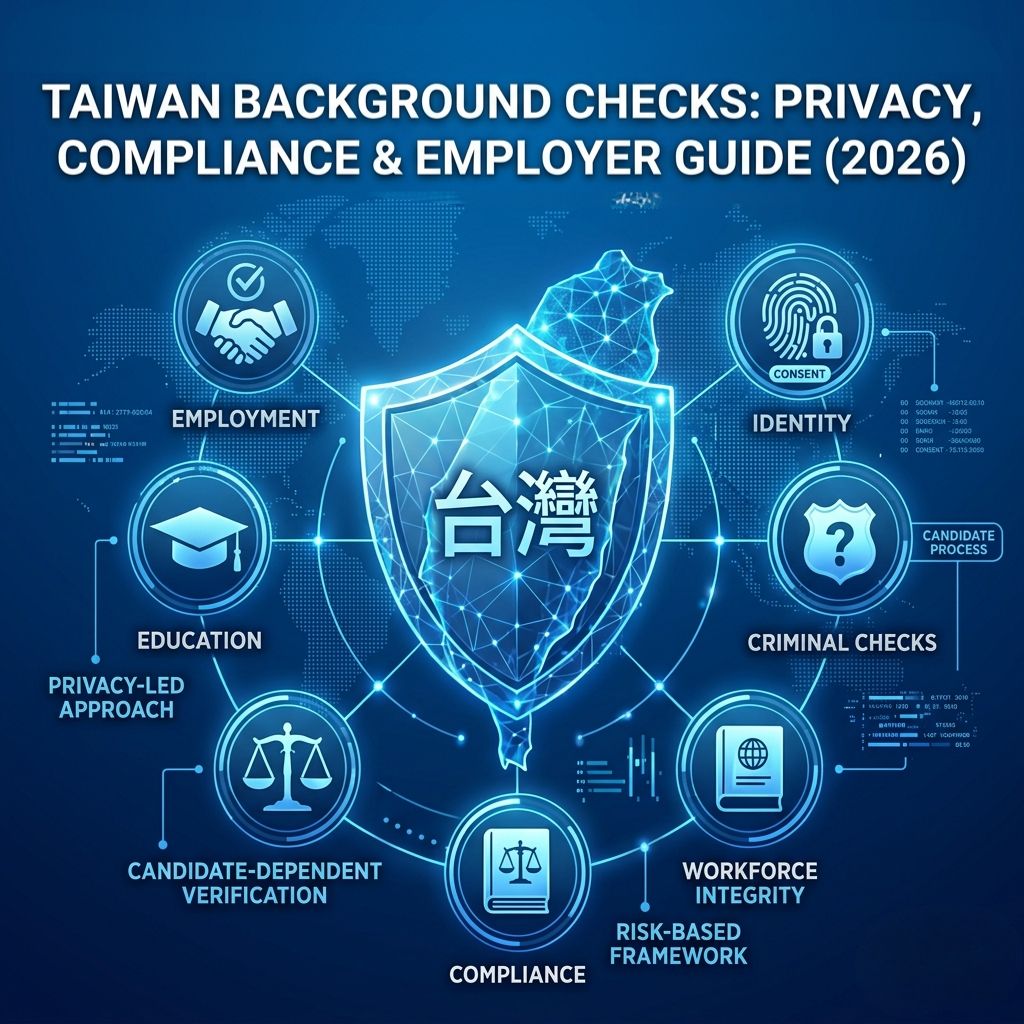
Taiwan Background Checks: Privacy, Compliance & Employer Guide (2026)
Understanding Taiwan employment screening, privacy obligations, candidate consent, and workforce integrity requirements.Executive Summary
Taiwan is one of Asia’s most privacy-conscious jurisdictions for employment screening. Employers must navigate a legal environment where personal data protection is strongly enforced, access to official records is limited, and candidate consent plays a central role in most verification activities. Unlike some jurisdictions where employers can directly access extensive public databases, Taiwan relies heavily on consent-based verification, document validation, and candidate participation. Employers should therefore apply a structured, proportionate, and risk-based screening framework. For broader regional planning, employers may refer to eeCheck’s compliant background screening policy in Asia, background screening policy template for Asia-Pacific, and Asia background check compliance guide.About This Guide
This guide was prepared by eeCheck, an Asia-focused background screening and workforce integrity specialist supporting more than 5,000 organizations across Asia. eeCheck conducts verification programs across banking, financial services, technology, healthcare, education, government-linked organizations, and multinational corporations throughout Hong Kong, Singapore, China, Taiwan, Japan, South Korea, India, Indonesia, Malaysia, Vietnam, and other jurisdictions.The guidance in this article is based on operational experience supporting Taiwan screening programs, regional compliance reviews, and cross-border verification practices throughout Asia-Pacific.
Introduction: Why Taiwan Background Checks Require a Privacy-Led Approach
Taiwan background checks require careful handling because personal data protection, consent, proportionality, and candidate participation are central to the screening process. Employers should avoid treating Taiwan as a simple database-driven jurisdiction. For multinational employers, financial institutions, technology companies, and regulated industries, understanding Taiwan’s background screening landscape is essential to maintaining both compliance and workforce integrity. Organizations hiring across Asia should align Taiwan screening practices with wider regional frameworks such as eeCheck’s Asia Background Check Guide and Asia Background Screening Report.Taiwan Background Check Framework
A compliant Taiwan background screening program may include several verification components depending on the role, industry, candidate profile, and hiring risk level.| Screening Component | Commonly Used | Typical Turnaround Time |
|---|---|---|
| Identity Verification | Yes | 1–3 Business Days |
| Employment Verification | Yes | 3–10 Business Days |
| Education Verification | Yes | 5–12 Business Days |
| Professional Licence Verification | Role Dependent | 3–10 Business Days |
| Reference Checks | Common | 2–7 Business Days |
| Criminal Record Certificate Review | Role Dependent | Candidate Dependent |
| Court Record Search | Role Dependent | 1–3 Business Days |
| Directorship Record Search | Senior Management | 1–3 Business Days |
| Bankruptcy Record Search | Senior Management / Finance Roles | 1–3 Business Days |
| Sanctions & PEP Screening | Regulated Industries | 1–2 Business Days |
Employers should adopt a risk-based approach rather than applying identical screening requirements to all employees.
Legal Framework Governing Background Checks in Taiwan
1. Personal Data Protection Act (PDPA)
Taiwan’s Personal Data Protection Act is the primary legislation regulating the collection, use, processing, and transfer of personal information. Employers must ensure that personal data is collected for a specific and legitimate purpose, relevant to the employment relationship, proportionate to the intended use, and protected against unauthorized access or disclosure.| PDPA Principle | Employer Action |
|---|---|
| Specific Purpose | Explain why the information is collected and how it supports the hiring process. |
| Proportionality | Collect only information that is relevant to the role and screening purpose. |
| Transparency | Inform candidates what checks will be conducted and whether data may be transferred internationally. |
| Security | Apply controlled access, secure storage, and proper retention controls. |
| Candidate Rights | Support access, correction, deletion requests, and understanding how information is used. |
2. Employment and Anti-Discrimination Considerations
Employers should ensure background screening practices are directly relevant to the role being hired. Collecting information unrelated to job performance, legal eligibility, or legitimate business interests may create compliance and reputational risks.| Role Type | Suggested Screening Scope |
|---|---|
| Entry-Level Positions | Identity Verification, Education Verification, Employment Verification |
| Financial Roles | Identity, Employment, Education, Bankruptcy Search, Court Record Search, Sanctions Screening |
| Senior Executives | Identity, Employment, Education, Directorship Search, Bankruptcy Search, Litigation Search, Regulatory Screening, Enhanced Reference Checks |
Why Taiwan Is Different From Other Asian Markets
While Taiwan shares similarities with other mature Asian economies, employers often encounter unique operational challenges relating to consent, access to records, candidate cooperation, and local-language verification.| Area | Taiwan | Singapore | Hong Kong |
|---|---|---|---|
| Criminal Record Access | Candidate obtains certificate | Candidate obtains certificate | Candidate obtains certificate |
| Privacy Expectations | High | High | Moderate to High |
| Employer Verification | Largely manual | Moderate | Moderate |
| Data Protection Requirements | Strong | Strong | Strong |
| Reliance on Candidate Cooperation | High | Moderate | Moderate |
Key Challenges in Taiwan Background Checks
Based on eeCheck’s operational experience supporting Taiwan screening programs, the most common challenges include limited employer access to official records, strong privacy and consent requirements, reliance on candidate cooperation, cross-border verification complexity, and multilingual verification requirements.Many operational delays arise from candidate or recruiter engagement issues rather than from the verification process itself.
Candidate and Recruiter Engagement Challenges
Many candidates and hiring teams are unfamiliar with the purpose and importance of background screening. Common issues include delayed document submission, incomplete employment histories, missing education information, failure to respond to clarification requests, and limited recruiter follow-up during verification.Candidate Delays in Obtaining Official Records
Some checks depend heavily on the candidate, especially Police Criminal Record Certificates, credit reports where applicable, and supporting identification documents. For more regional context on delays and verification quality, see eeCheck’s guide on why fast turnaround time in Asia does not always mean accurate background checks and how to optimize screening turnaround time in Asia.Common Taiwan Background Check Mistakes
| Common Mistake | Why It Matters |
|---|---|
| Assuming employers can directly obtain criminal records | In most cases, candidates must obtain and provide the official certificate themselves. |
| Collecting excessive personal data | Over-collection may create unnecessary PDPA compliance risk. |
| Using global templates without Taiwan adaptation | North America or Europe templates may not align with Taiwan’s legal and operational environment. |
| Treating court searches as criminal record searches | Public court records are not equivalent to official criminal record certificates. |
| Failing to document consent properly | Consent remains one of the most important compliance requirements. |
| Not aligning Taiwan checks with regional programs | Organizations may under-screen or over-screen Taiwan hires compared to regional standards. |
Criminal Record Checks in Taiwan
The Police Criminal Record Certificate is the primary mechanism for demonstrating criminal history status in Taiwan. It is generally issued through the National Police Agency and typically requires candidate participation.Employers generally cannot independently obtain a candidate’s criminal record in Taiwan. Candidate cooperation and documented consent are essential.
Employers comparing criminal record checks across Asia may also refer to eeCheck’s Hong Kong criminal record check guide.
Employment Verification in Taiwan
Employment verification remains one of the most valuable screening tools available to employers. Typical verification elements include employment dates, position held, department, reporting structure, and eligibility for rehire where available. Best practice is to combine employer verification with supporting documentation such as employment contracts, payslips, tax documents, and resignation records where appropriate. For a wider regional perspective, see eeCheck’s guide to employment verification in Asia.Education Verification in Taiwan
Taiwanese universities generally maintain procedures for confirming academic credentials. Education verification may confirm institution attended, degree awarded, major or program, dates of attendance, and graduation status. Many educational records and university communications are conducted primarily in Traditional Chinese. Organizations should ensure access to Mandarin-speaking verification specialists and local-language document review capability.Professional Licence Verification
For regulated professions, employers may need to verify professional registrations, industry licences, membership status, and certification validity. Examples include financial services professionals, healthcare practitioners, engineers, legal professionals, and accountants. For regulated and finance-related roles, see eeCheck’s financial background screening in Asia.Identity and Right-to-Work Verification
Identity verification objectives include identity confirmation, right-to-work assessment, fraud detection, and document authenticity review.| Candidate Type | Common Identity Documents |
|---|---|
| Taiwan Citizens | National Identification Card |
| Foreign Nationals | Alien Resident Certificate, Passport, Work Authorization Documents |
Bankruptcy, Directorship and Litigation Searches
For leadership, finance, compliance, and fiduciary positions, employers may conduct additional public record screening where legally accessible and role-relevant. These searches should always be interpreted carefully and in context.Credit and Financial Integrity Checks
Credit-related checks may be appropriate for financial institutions, treasury functions, investment management, and senior finance positions. Employers should ensure the check is relevant to the role, candidate consent requirements are satisfied, and the collection and use of information comply with PDPA principles. For more detail on credit screening considerations, see eeCheck’s Hong Kong credit reports for employment screening guide.Data Privacy and Consent Requirements
Consent remains one of the most important aspects of background screening in Taiwan. Employers should obtain clear written authorization, explain the scope of checks, identify the purpose of screening, limit collection to necessary information, and maintain appropriate retention controls.Over-collection of information can create unnecessary compliance risk. Taiwan screening should be designed around necessity, proportionality, and candidate transparency.
Cross-Border Data Transfer Considerations
Organizations operating regional screening programs should carefully evaluate cross-border data transfers. Additional considerations may arise when sending data outside Taiwan, using overseas screening providers, consolidating HR records regionally, or storing information in cloud environments. For multinational employers, Taiwan checks should be integrated into broader governance frameworks such as MNC background screening in Asia and Asia background screening executive briefing.Best Practices for Employers
| Best Practice | Practical Benefit |
|---|---|
| Obtain informed written consent | Ensures compliance with Taiwan PDPA requirements and transparency obligations. |
| Apply risk-based screening requirements | Aligns screening depth with role risk, business necessity, and regulatory expectations. |
| Verify information directly from authoritative sources whenever possible | Improves verification accuracy, reliability, and audit defensibility. |
| Use candidate-provided official documentation where required | Supports checks where direct employer, university, or government access may be restricted. |
| Maintain strong data protection controls | Protects personal information and reduces compliance and reputational risks. |
| Avoid collecting excessive personal information | Supports PDPA data minimization principles and reduces unnecessary privacy exposure. |
| Align Taiwan screening requirements with regional and global screening frameworks | Maintains consistency across jurisdictions while adapting verification methodologies to local legal requirements. |
| Maintain clear audit trails for compliance purposes | Supports governance, documentation standards, regulatory review, and defensible hiring decisions. |
Why Global Employers Work with eeCheck for Taiwan Screening
eeCheck supports organizations across Asia with localized background screening programs designed to balance compliance, candidate experience, and verification accuracy.| eeCheck Capability | Employer Value |
|---|---|
| Taiwan Employment Verification | Supports accurate confirmation of candidate work history. |
| Taiwan Education Verification | Helps validate academic qualifications through appropriate source verification. |
| Criminal Record Certificate Workflow Support | Helps manage candidate-dependent documentation processes. |
| Court Record Research | Supports supplementary public record review where role-relevant. |
| Directorship and Bankruptcy Screening | Supports senior leadership, finance, and fiduciary due diligence. |
| Global Sanctions and PEP Screening | Supports regulated industry and financial integrity screening. |
| Cross-Border Verification Across Asia-Pacific | Helps employers screen candidates with multi-country histories. |
Asia Background Screening Perspective
As organizations continue expanding across Asia, screening programs are increasingly moving away from isolated country-by-country processes toward regionally aligned workforce integrity frameworks. eeCheck maintains one of Asia’s broadest verification coverage networks, supporting screening programs across Hong Kong, Singapore, China, Taiwan, Japan, South Korea, India, Indonesia, Malaysia, Vietnam, and other jurisdictions. For country-level planning, employers may also review eeCheck’s Vietnam background checks guide, Japan background check guide, and Indonesia background checks guide.Frequently Asked Questions
Are background checks allowed in Taiwan?
Background checks are generally possible in Taiwan when supported by informed candidate consent, legitimate hiring purpose, proportionality, and appropriate data protection controls under the PDPA.
Can employers directly obtain criminal records in Taiwan?
In most cases, candidates must obtain and provide the official Police Criminal Record Certificate themselves. Employers generally cannot independently obtain a candidate’s criminal record.
How long do Taiwan background checks take?
Turnaround time depends on the check type, documentation quality, candidate cooperation, and institutional responsiveness. Many checks can take from 1 to 12 business days, while candidate-dependent checks may take longer.
Is candidate consent required for Taiwan background screening?
Yes. Clear written consent is a core requirement for most employment screening activities in Taiwan. Consent should explain the screening scope, purpose, data handling, and any cross-border processing where applicable.
Should all employees receive the same Taiwan background check package?
No. Employers should apply a risk-based and role-based approach. Entry-level roles, financial roles, senior executives, and regulated positions may require different screening scopes.
Final Takeaway
Taiwan is not a jurisdiction where employers can rely solely on database-driven screening. Successful background checks depend on candidate consent, structured verification workflows, local expertise, and strong privacy compliance practices. Organizations that combine PDPA compliance, risk-based screening design, multilingual verification capability, and authoritative source verification are best positioned to make informed hiring decisions while maintaining compliance.For employers hiring in Taiwan, background screening should be viewed not simply as an HR process, but as a critical component of workforce risk management, governance, regulatory compliance, and organizational trust.

