

Adverse Media & Sanctions Screening for Employment in Asia: 2026 Guide
Published: 25 August 2026 | Last updated: 25 August 2026
Most employment background checks answer a straightforward question: is the information a candidate has provided accurate? Adverse media and sanctions screening answer a different question: is there credible information in public sources, regulatory records or sanctions lists that may create legal, regulatory, integrity or reputational risk for the organisation — even if every line of the candidate’s CV is accurate? For financial institutions and other regulated employers in Asia, these checks can support assessments of honesty, integrity, reputation, conflicts and financial-crime risk. Outside regulated sectors, they are increasingly used for senior executives, finance and treasury personnel, compliance professionals, procurement teams, technology administrators and other trust-critical positions.Executive Summary
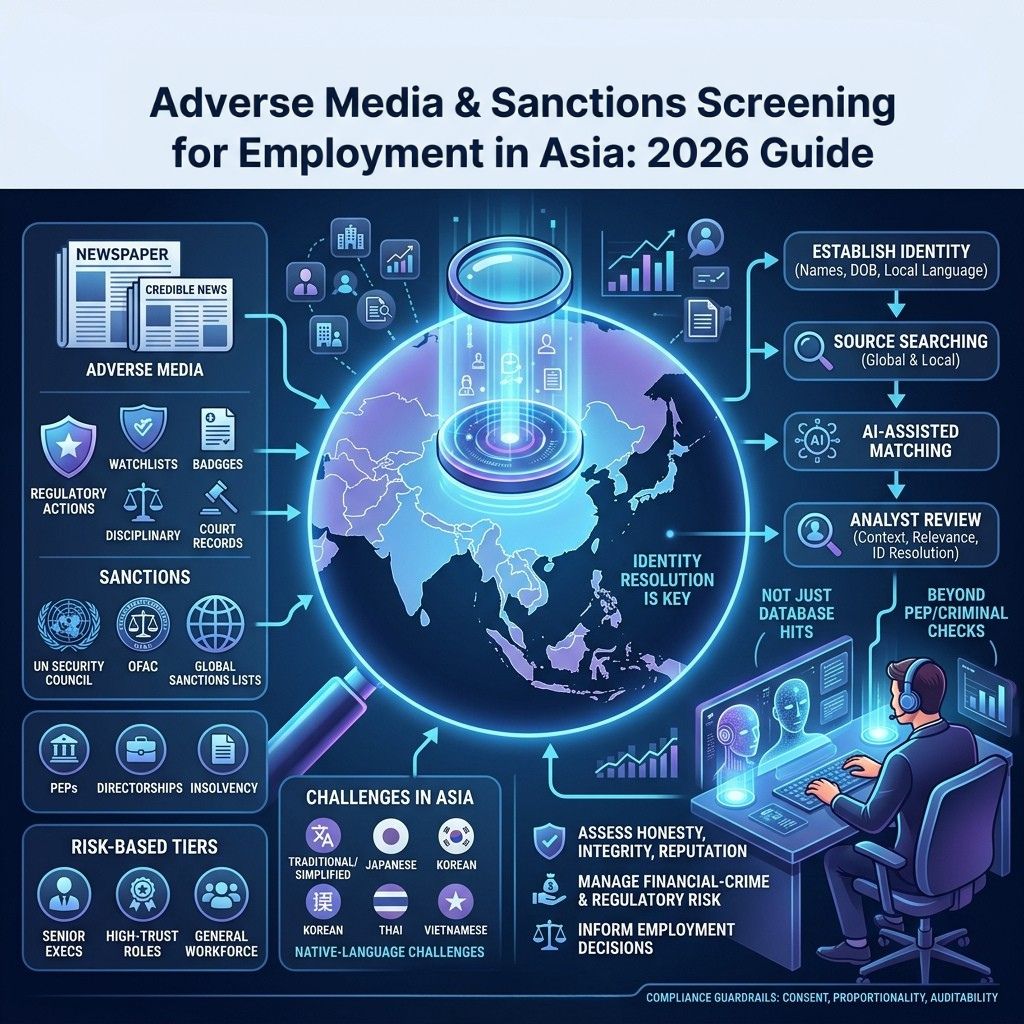
Adverse media screening is a structured review of credible news, regulatory and other appropriate public sources for potentially relevant information about an individual. Sanctions screening is different: it tests whether an individual may match a person designated under applicable government or international sanctions regimes. These checks should not be treated as interchangeable with PEP, regulatory, directorship or criminal-record screening. Each answers a different risk question, and a database hit is never enough on its own. Identity resolution, source quality, context, role relevance and proportionality are essential before findings are reported or used in an employment decision. Asia presents additional challenges because of local-language reporting, romanisation, naming conventions and uneven source quality. Effective programmes therefore combine technology-assisted searching with analyst review and identity matching.For broader programme design, see eeCheck’s Compliant Background Screening Policy in Asia, Role-Based Background Screening in Asia, Risk-Based Background Screening in Asia and Asia Background Check Compliance Guide.
What Is Adverse Media Screening?
Adverse media screening, sometimes called negative news screening, is a structured search of credible news, regulatory and other appropriate public sources for information linking an individual to conduct that may be relevant to their employment.| Screening Area | Examples of Potentially Relevant Information |
|---|---|
| Financial crime | Fraud, bribery, corruption, money laundering, embezzlement and other serious financial misconduct. |
| Regulatory action | Enforcement actions, public reprimands, prohibition orders, licence suspensions or revocations and other disciplinary actions. |
| Litigation and insolvency | Relevant civil proceedings, bankruptcy or insolvency matters and director disqualifications, where lawful and proportionate. |
| Serious professional misconduct | Credible reporting concerning serious workplace misconduct, professional negligence, breaches of fiduciary responsibility or significant safety violations. |
| Conflicts and integrity concerns | Undisclosed business interests, directorships or other public information that may create a material conflict with the proposed role. |
What Is Sanctions Screening?
Sanctions screening determines whether an individual potentially matches a person designated under applicable government or international sanctions regimes.| Sanctions Regime / Source | Maintained By | Why It May Matter |
|---|---|---|
| UN Security Council Consolidated List | United Nations | Important international baseline, with UN sanctions implemented through domestic legal frameworks. |
| OFAC sanctions lists, including the SDN List | U.S. Department of the Treasury | Relevant to organisations with U.S. operations, U.S. persons, U.S.-linked transactions or other U.S. sanctions exposure. |
| UK Sanctions List | UK Government | Relevant to organisations and activities within the scope of UK sanctions requirements. |
| EU sanctions measures | European Union | Relevant to organisations and activities subject to EU sanctions requirements. |
| Applicable local sanctions requirements | Relevant national authorities | Employers must consider sanctions obligations applicable in the jurisdictions in which they operate. |
Sanctions, PEP, Regulatory and Adverse Media Screening Are Not the Same Thing
| Check | Primary Question | What a Match Means |
|---|---|---|
| Sanctions | Is the person potentially subject to an applicable sanctions designation? | May create legal and compliance obligations; requires identity resolution and escalation. |
| PEP | Is the person a politically exposed person? | Indicates potential heightened exposure to corruption or influence risk; does not itself indicate wrongdoing. |
| Regulatory / Watchlist | Has a regulator taken public action against the person? | May be relevant to licensing, fitness and propriety, integrity or suitability. |
| Adverse Media | Is there credible public reporting of potentially relevant adverse conduct? | Requires contextual assessment; reporting or allegations should not automatically be treated as established facts. |
| Directorship / Disqualification | Does the individual hold relevant corporate positions or have a disqualification history? | May identify conflicts, undisclosed interests or governance concerns. |
Why Employers Conduct Adverse Media and Sanctions Screening
Adverse media and sanctions screening can complement traditional employment and education verification by identifying public, regulatory and sanctions-related information that may be relevant to the role. These checks are particularly useful where integrity, regulatory exposure, financial-crime risk or reputation are important considerations.1. Fitness, Propriety and Regulatory Expectations
Financial regulators commonly require regulated firms to assess whether relevant individuals are fit and proper for their responsibilities. In Singapore, the Monetary Authority of Singapore’s framework considers factors including honesty, integrity and reputation, alongside competence, capability and financial soundness. In Hong Kong, the Securities and Futures Commission’s Fit and Proper Guidelines similarly consider matters relating to an individual’s reputation, character, reliability and financial integrity. Adverse media, sanctions and regulatory-record screening can therefore provide supporting evidence for these assessments. However, the regulatory obligation and the screening method are not the same thing. A regulator may require an organisation to assess fitness, propriety or integrity without prescribing adverse media screening as the only method. The screening programme should therefore reflect the employer’s actual regulatory obligations and the risks of the role.2. Insider and Integrity Risk
A reference check can confirm previous employment, but it may not reveal other public information that is relevant to the proposed role, such as:- regulatory action in another jurisdiction;
- undisclosed directorships or business interests;
- credible allegations of fraud or corruption;
- public insolvency or disqualification information;
- sanctions exposure; or
- serious misconduct reported outside the candidate’s previous workplace.
3. Reputation and Governance
The appointment of a CEO, CFO, director or other senior executive may attract scrutiny from employees, investors, regulators, clients and the media. Screening before appointment can help an organisation identify material public information early and assess whether further clarification, due diligence or escalation is appropriate. For boards, listed companies, financial institutions and investment-backed businesses, adverse media screening can therefore form part of broader executive due diligence and governance rather than simply being another pre-employment check. For wider programme design, employers may also refer to eeCheck’s Financial Background Screening in Asia, HKMA & SFC Fit and Proper Guide and Asia Background Screening Executive Briefing.Who Should Be Screened?
A strong screening programme is generally risk-based rather than one-size-fits-all.| Risk Tier | Typical Roles | Potential Screening Scope |
|---|---|---|
| Regulated financial-industry roles | Licensed representatives, regulated personnel and key officeholders | Sanctions + PEP + regulatory/watchlist screening, plus role-appropriate adverse media and other integrity checks. |
| High-trust functions | Finance, treasury, payments, procurement, compliance, security and privileged IT | Sanctions + PEP where appropriate + adverse media, plus relevant directorship/conflict searches. |
| Senior management & directors | C-suite, board members, country heads | Enhanced adverse media + sanctions + PEP + regulatory + litigation/insolvency + directorship screening, subject to applicable law. |
| General workforce | Standard operational and professional roles | Core employment verification; add sanctions, PEP or integrity screening where justified by sector, role, jurisdiction or client requirements. |
How Adverse Media and Sanctions Screening Works
| Stage | What Happens |
|---|---|
| 1. Establish identity | Use legally available identifiers such as full legal name, aliases, date of birth, nationality, jurisdiction and local-language name. |
| 2. Search appropriate sources | Search relevant sanctions lists, regulator publications, established news, public records, court or insolvency information, corporate records and appropriate commercial databases. |
| 3. Resolve potential matches | Classify hits as confirmed match, possible match or false positive by comparing available identifiers and context. |
| 4. Assess relevance and context | Determine what the original source says, whether the matter is an allegation or established outcome, whether it was resolved and whether it is relevant to the proposed role. |
Why Screening in Asia Is Particularly Challenging
| Challenge | Why It Matters |
|---|---|
| Name matching | Romanisation and shared names can produce large numbers of false positives. |
| Native-language research | Relevant information may exist only in Traditional Chinese, Simplified Chinese, Japanese, Korean, Vietnamese, Bahasa Indonesia, Malay, Thai or other local languages. |
| Source quality | Regulator notices, court records and established media should not be treated the same as anonymous posts or low-quality duplicated websites. |
| Local context | Legal, regulatory, insolvency and corporate terminology differ by jurisdiction; translation alone is not enough. |
eeCheck Insight
Across Asia-focused screening, some of the most important work takes place after an automated search generates a hit. Common issues include identical romanised names, local-language aliases, incomplete identifying information, duplicate articles, old allegations and sanctions/watchlist candidates incorrectly matched solely because of a similar name.For this reason, eeCheck combines technology-assisted searching with analyst review and identity resolution. Technology improves coverage and consistency; human review determines whether the information actually relates to the candidate and whether the source has been represented accurately.
AI Can Improve Screening — But Should Not Make the Employment Decision
AI can assist with multilingual search expansion, name variation generation, translation, article classification, duplicate detection, entity matching and large-volume source review. But AI-generated summaries can also merge two people with similar names, remove important qualifications from an allegation, mistake an accusation for a conviction or infer facts the source never established. For employment screening, AI should therefore support research and analyst review rather than replace evidence-based decision-making. Material findings should be traceable back to their underlying sources. See also AI Background Checks & Automation Risks and Future of Background Checks in Asia.Compliance Guardrails for Employers
| Guardrail | Employer Consideration |
|---|---|
| Consent and transparency | Establish an appropriate legal basis and provide the notices and consents required under applicable laws and circumstances. |
| Proportionality | Screening scope should be justified by the role and risk; more data does not automatically mean better screening. |
| Accuracy before inference | Distinguish allegations, charges, civil claims, regulatory findings, convictions and other established outcomes. |
| Candidate review and right to respond | Where potentially material adverse information is identified, consider an appropriate process for clarification or response. |
| Auditability | Document what was searched, when, which identifiers were used, how matches were resolved and what was ultimately reported. |
Should Screening Continue After Hiring?
For some positions, pre-employment screening provides only a snapshot. A person who was clear at hiring could later become subject to sanctions, regulatory enforcement, criminal proceedings, significant adverse reporting or other developments relevant to an ongoing fit-and-proper assessment. For regulated, senior and particularly sensitive roles, organisations may therefore consider periodic rescreening or appropriately designed ongoing monitoring, subject to applicable employment, privacy and data-protection requirements. Frequency should be determined by risk rather than automatically applying continuous monitoring to the entire workforce.Where These Checks Fit Into a Broader Programme
Adverse media and sanctions screening complement rather than replace traditional verification.| Programme Component | Potential Role |
|---|---|
| Identity verification | Establish the correct person before searching. |
| Employment verification | Validate work history. |
| Education / professional qualification | Confirm qualifications and credentials. |
| Criminal record checks | Check lawful and available criminal-record sources by jurisdiction. |
| Regulatory / disciplinary searches | Identify relevant regulator action. |
| Mandatory reference checks | Meet applicable sector-specific reference requirements. |
| Sanctions / PEP / adverse media | Assess applicable designation, political exposure and credible public reporting. |
| Litigation / insolvency / directorship | Support role-relevant integrity, financial-risk and conflict assessment. |
| Role-specific social media screening | Assess relevant publicly available online activity where lawful and justified. |
Building an Audit-Ready Programme
| Question | What Good Practice Looks Like |
|---|---|
| Why are we conducting this check? | The screening should correspond to a genuine employment, regulatory or risk requirement. |
| Are we searching the right sources? | Coverage should reflect the candidate’s jurisdictions, languages and risk exposure. |
| Are we sure the information relates to this person? | Identity resolution should come before conclusions. |
| Are we reporting the source accurately? | Allegations, regulatory findings and convictions must not be conflated. |
| Can we demonstrate our process? | The methodology, sources, review and outcome should be appropriately documented. |
Adverse Media & Sanctions Screening with eeCheck
eeCheck provides employment background screening across 200+ countries and territories, supporting multinational employers and regulated organisations across Asia.| eeCheck Capability | Support |
|---|---|
| Global sanctions and watchlist screening | Screening against relevant global and local sources. |
| Adverse media research | Structured review of credible public reporting. |
| PEP screening | Political exposure screening where appropriate. |
| Regulatory and disciplinary searches | Review of regulator and disciplinary information. |
| Directorship and corporate-record research | Support for conflict and governance assessment. |
| Multilingual / native-language research | Coverage across relevant Asian languages and naming conventions. |
| Identity-based false-positive resolution | Analyst review to distinguish real matches from namesakes. |
| Analyst-reviewed findings | Contextual assessment rather than database-only reporting. |
| Source-referenced reporting | Findings traceable to underlying sources. |
| Audit-supporting workflows | Structured processes designed to support governance and compliance requirements. |
Frequently Asked Questions
Is adverse media screening the same as a criminal record check?
No. A criminal record check searches specified criminal-record sources according to the rules of the relevant jurisdiction. Adverse media screening searches credible public information that may include reporting about alleged or established conduct. An adverse media result should not be treated as equivalent to a criminal conviction.Is adverse media screening required by MAS?
MAS requires relevant regulated persons and institutions to comply with applicable fitness-and-propriety and other regulatory requirements. Adverse media screening can be one method used to support those assessments, but employers should distinguish between a regulatory outcome that must be assessed and a particular screening tool used to support that assessment.Does a sanctions database hit mean the candidate is sanctioned?
No. A database hit is a potential match. The employer or screening provider must resolve identity using available identifiers before treating it as a confirmed match.Is a PEP automatically considered high risk or unsuitable for employment?
No. PEP status does not itself indicate criminal activity, misconduct or unsuitability for employment.Should every employee receive adverse media screening?
Not necessarily. A risk-based approach is generally more proportionate. Screening scope should reflect responsibilities, access, regulatory status, jurisdiction and role risk.How far back should adverse media screening go?
There is no universal period appropriate to every role and jurisdiction. Organisations should establish a defensible lookback methodology based on regulatory requirements, local law, the nature of the position and the seriousness and relevance of information being assessed.Can AI perform adverse media screening automatically?
AI can improve search, translation, classification and triage. However, material employment-screening findings should be supported by identifiable underlying sources and appropriately reviewed before being reported or used in decision-making.What is the difference between adverse media and social media screening?
Adverse media screening primarily examines third-party news, regulatory and other appropriate public sources concerning the candidate. Social media screening generally examines relevant publicly available content associated with the candidate’s own online presence.Primary Regulatory and Compliance References
Employers designing adverse media, sanctions and regulatory screening programmes should consult the current requirements applicable to their organisation, sector and jurisdiction. The following official sources may provide useful regulatory, sanctions and data-protection context:
| Authority / Source | Relevant Reference |
|---|---|
| Monetary Authority of Singapore (MAS) | Fit-and-proper criteria and applicable financial-sector regulatory requirements. |
| Securities and Futures Commission of Hong Kong (SFC) | Fit and Proper Guidelines and related regulatory requirements. |
| Hong Kong Monetary Authority (HKMA) | Applicable supervisory requirements and Mandatory Reference Checking requirements for relevant authorised institutions. |
| United Nations Security Council | Consolidated Sanctions List. |
| U.S. Department of the Treasury — Office of Foreign Assets Control (OFAC) | Sanctions programmes and sanctions lists. |
| UK Government | UK Sanctions List and related sanctions guidance. |
| European Union | EU restrictive measures and sanctions information. |
| Personal Data Protection Commission Singapore (PDPC) | PDPA guidance and data-protection obligations. |
| Office of the Privacy Commissioner for Personal Data, Hong Kong (PCPD) | PDPO guidance and personal-data protection requirements. |
Final Strategic Takeaway
Adverse media and sanctions screening are most effective when treated as part of a broader, risk-based employment screening programme rather than as standalone database searches.
The strongest programmes focus on source quality, identity resolution, proportionality, local-language coverage, context and auditability. A sanctions or adverse-media hit should be treated as the beginning of an assessment, not the conclusion.
For employers operating across Asia, the objective should be to combine technology with evidence-based human review, maintain clear governance and adapt screening scope to the role, jurisdiction and regulatory environment.
For further guidance, see eeCheck’s Asia Background Check Guide, Financial Background Screening in Asia and Asia Background Screening Report.
This guide provides general information about employment background screening practices and is not legal advice. Regulatory, sanctions, privacy and employment-law requirements vary by jurisdiction and should be assessed based on the circumstances of each organisation and role.

