

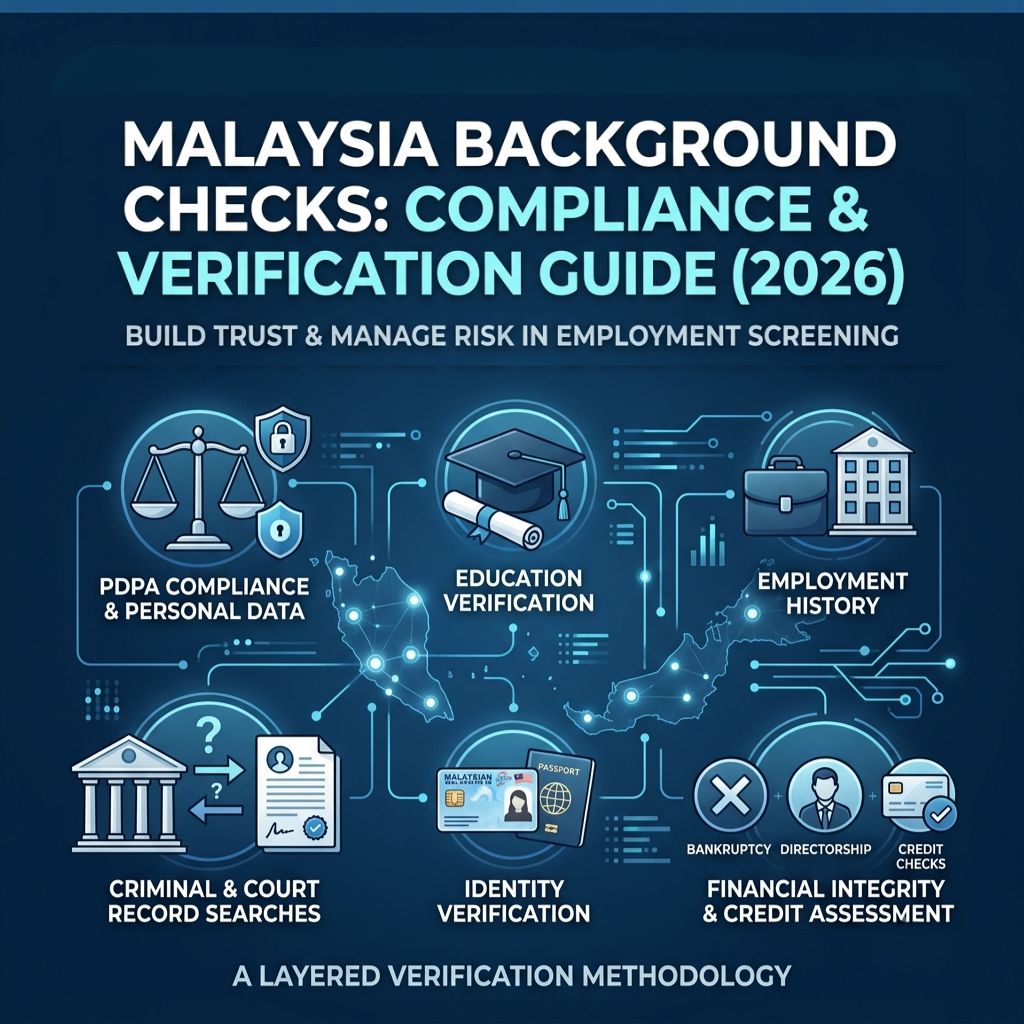
Malaysia Background Checks for Employers: Compliance & Verification Guide (2026)
Published: 28 July 2026 | Last updated: 28 July 2026
For employers conducting background checks in Malaysia, the key challenge is combining reliable verification with Malaysia’s Personal Data Protection Act (PDPA), candidate consent requirements and the practical limits of official record access. This guide explains the main screening methods available to employers, including employment and education verification, criminal and court record searches, identity checks, bankruptcy, directorship and role-relevant financial screening.
Executive Summary
Malaysia offers one of the more structured employment screening environments in Southeast Asia. Compared with many neighbouring jurisdictions, employers benefit from relatively mature public institutions, established universities, accessible corporate information, and comprehensive data protection legislation.
However, Malaysia is not a fully centralised verification environment. Employers must still navigate privacy obligations under the Personal Data Protection Act (PDPA), varying institutional response times, and limited direct access to official criminal records.
Successful background screening in Malaysia therefore relies on balancing legal compliance, candidate cooperation, and risk-based verification methodologies.
| Key Characteristic | Malaysia Screening Environment |
|---|---|
| Legal framework | Established legal framework under the Personal Data Protection Act 2010 (as amended). |
| Universities and employers | Generally responsive universities and employers. |
| Official criminal records | Limited employer access to official criminal records. |
| Alternative sources | Availability of alternative public court and corporate record searches. |
| Institutional consistency | Stronger institutional consistency than many ASEAN jurisdictions. |
Malaysia sits between Singapore and Indonesia in terms of verification maturity—offering relatively structured verification processes while still requiring multi-source validation for comprehensive screening.
For broader programme design, employers may also refer to eeCheck’s Compliant Background Screening Policy Guide, Asia-Pacific Background Screening Policy Template, Asia Background Check Compliance Guide and Asia Background Check Guide.
Legal Framework Governing Background Checks in Malaysia
Personal Data Protection Act (PDPA)
Malaysia’s Personal Data Protection Act 2010 governs the collection, use, disclosure and storage of personal data for commercial purposes.
Employers and screening providers should ensure personal data is:
| Requirement | Expected Practice |
|---|---|
| Lawful and fair collection | Personal data should be collected lawfully and fairly. |
| Purpose limitation | Information should be relevant to the employment purpose. |
| Data minimisation | Collection should be limited to what is necessary. |
| Security | Personal data should be securely stored. |
| Retention | Information should be retained only for appropriate periods. |
| Access control | Personal data should be protected against unauthorised access. |
For employment screening, organisations should clearly inform candidates of:
| Candidate Notice Area | Information to Provide |
|---|---|
| Scope | The scope of screening. |
| Purpose | The purpose of each verification. |
| Data collected | The information that may be collected. |
| Recipients | Who may receive the information. |
| Overseas processing | Whether overseas processing will occur. |
| Retention | How long the information will be retained. |
Although consent remains an important component of employment screening, employers should also ensure that every check is proportionate and relevant to the position being filled. This is consistent with a role-based background screening and risk-based background screening approach.
Key Characteristics of Background Checks in Malaysia
Malaysia presents several characteristics that distinguish it from neighbouring markets.
For regional planning and timing comparisons, see eeCheck’s Asia Background Check Turnaround Benchmarks and Turnaround Time in Asia: Why “Fast” Is Not Always Accurate.
| Comparison | Malaysia Position |
|---|---|
| Compared with Indonesia and Vietnam | Institutions generally maintain better records, universities are more responsive, corporate information is more accessible, and verification processes are more standardised. |
| Compared with Singapore | Fewer government databases are directly available, criminal record access remains more restricted, and greater reliance is placed on candidate cooperation and document verification. |
As a result, employers should adopt a layered verification methodology rather than relying on any single source. For wider regional planning, see eeCheck’s Asia Background Check Guide and Asia Background Screening Report.
Criminal Record and Court Record Checks
Certificate of Good Conduct
Malaysia’s official criminal status document is the Certificate of Good Conduct.
The certificate is generally obtained by the individual through the Malaysian Government.
Employers cannot directly access Malaysian criminal record databases.
| Limitation | Practical Consideration |
|---|---|
| Candidate participation | Candidate participation is required. |
| Processing time | Processing may require several weeks. |
| Point-in-time status | The certificate reflects information available at the time of issuance. |
| Continuous monitoring | It should not be interpreted as continuous monitoring. |
Recommended Use
Where an official criminal status document is required, employers should request a candidate-provided Certificate of Good Conduct together with identity verification.
Alternative Court Record Search
Where candidate participation is unavailable or an official certificate cannot reasonably be obtained, employers may consider a best-effort court record search.
This methodology may include searches of publicly available:
| Public Source | Use |
|---|---|
| Court cause lists | Search available court listing information. |
| Published judgments | Review publicly available judgments. |
| Electronic court information systems | Search available electronic court information. |
| Public legal notices | Review relevant public legal notices. |
This methodology differs significantly from an official criminal record certificate.
| Public Court Search Limitation | Important Interpretation |
|---|---|
| Police database access | Does not access police databases. |
| Nationwide coverage | Is not a nationwide criminal database search. |
| Completeness | May not identify every criminal proceeding. |
| Negative result | Should not be interpreted as confirming the absence of criminal history. |
Instead, it serves as an additional risk assessment tool using lawfully accessible public records.
Potential matches should always be reviewed carefully, verified against available identifiers, and assessed according to relevance before any employment decision is made.
For wider regional context on official and public-source criminal screening, see eeCheck’s Government Background Checks in Asia.
Employment Verification
Employment verification is generally more structured than in many ASEAN countries.
| Verification Area | Typical Practice |
|---|---|
| Commonly verified | Employment dates, job titles, employment status. |
| Often restricted | Performance, disciplinary matters, reasons for leaving, salary information. |
| Response times | Response times vary considerably between multinational corporations, government-linked organisations and small local businesses. |
| Best practice | Combine direct employer verification, employment documentation and payroll documentation where appropriate. |
For wider regional context, see eeCheck’s Employment Verification in Asia guide.
Education Verification
Malaysia maintains a relatively mature higher education sector consisting of public universities, private universities, university colleges and vocational institutions.
Most universities maintain formal verification procedures.
| Area | Consideration |
|---|---|
| Response time | May differ depending on institution, graduation year, archive availability and verification process. |
| Higher-risk institutions | Particular care should be exercised with smaller private colleges, overseas branch campuses and discontinued institutions. |
| Information to verify | Qualification awarded, graduation status, field of study and attendance period. |
Identity and Right-to-Work Verification
Identity verification typically includes:
| Verification | Typical Approach |
|---|---|
| MyKad | Verification for Malaysian citizens. |
| Passport | Verification for foreign nationals. |
| Work eligibility | Work eligibility confirmation where applicable. |
Identity verification forms the foundation of all subsequent screening activities and should be completed before other checks commence.
Bankruptcy, Civil Litigation, Directorship and Credit Checks
Malaysia provides comparatively good access to several public and corporate information sources.
| Check | Malaysia Approach | Key Consideration |
|---|---|---|
| Bankruptcy | Bankruptcy searches may be conducted through financial information database records where legally available. | Commonly requested for financial, executive and fiduciary positions. |
| Civil Litigation | Public court information may assist in identifying selected civil proceedings involving an individual. | Coverage varies by court, case type and available public information. These searches should be described as best-effort public court record searches rather than comprehensive nationwide litigation searches. |
| Directorship | Corporate registry searches may identify an individual’s involvement as a director of an organization. | Identity-based searches are preferable to minimise false matches. |
| Credit Checks | Credit assessments are generally appropriate only where justified by the position. | Typical examples include financial institutions, senior finance positions and fiduciary responsibilities. Employers should ensure such checks remain proportionate and compliant with the PDPA. |
For additional context on financial integrity screening, see eeCheck’s Financial Background Screening in Asia guide.
Data Privacy and Cross-Border Transfers
Malaysia’s PDPA requires organisations to implement appropriate safeguards when handling candidate information.
| Employer Responsibility | Recommended Practice |
|---|---|
| Data collection | Collect only relevant information. |
| Access | Restrict access. |
| Security | Maintain appropriate security controls. |
| Retention | Document retention practices. |
| Overseas transfer | Establish appropriate safeguards for overseas transfers. |
| Regional vendors | Ensure overseas screening vendors maintain comparable data protection standards. |
Regional employers operating across Asia should ensure that overseas screening vendors maintain comparable data protection standards. See also eeCheck’s MNC Background Screening in Asia guide.
Comparison with Other Asian Jurisdictions
| Country | Comparison with Malaysia |
|---|---|
| Singapore | More centralised government verification systems. |
| Indonesia | Malaysia offers more structured institutional verification. |
| Vietnam | Better university responsiveness and stronger corporate records. |
| Thailand | Similar consent-based approach but generally more consistent institutional responses. |
| Philippines | Similar reliance on candidate participation for official criminal certificates, with stronger corporate record availability in Malaysia. |
Country-specific guidance is also available in eeCheck’s Singapore Background Checks Guide, Indonesia Background Checks Guide, Thailand Background Checks Guide, Philippines Background Checks Guide and Vietnam Background Checks Guide.
Best Practices for Employers
An effective Malaysian background screening programme should:
| Best Practice | Recommended Approach |
|---|---|
| Candidate consent | Obtain informed candidate consent. |
| Role-based screening | Apply role-based screening rather than a one-size-fits-all approach. |
| Identity | Verify identity before conducting other checks. |
| Official certificates | Use official certificates where available. |
| Court searches | Supplement official documents with best-effort public court record searches where appropriate. |
| Employment verification | Combine employment verification with supporting documentation. |
| Education verification | Verify education directly with awarding institutions. |
| Financial integrity | Apply bankruptcy, directorship and credit checks only where relevant to the role. |
| PDPA | Maintain full compliance with Malaysia’s PDPA requirements. |
Conclusion
Malaysia provides one of Southeast Asia’s more mature employment screening environments, supported by structured institutions, responsive universities and established corporate records.
Nevertheless, employers should recognise that no single source provides complete assurance.
The most effective programmes combine:
| Programme Component | Purpose |
|---|---|
| PDPA-compliant processes | Support lawful and transparent processing. |
| Identity verification | Establish candidate identity. |
| Employment verification | Validate work history. |
| Education verification | Confirm qualifications. |
| Official certificates | Use authoritative documentation where available. |
| Alternative public court searches | Provide supplementary risk information. |
| Role-based financial integrity checks | Support relevant finance, fiduciary and executive roles. |
By adopting a layered and risk-based methodology, organisations can significantly improve hiring confidence while maintaining compliance with Malaysian legal requirements.
Need Support for Background Checks in Malaysia?
Malaysia’s verification environment offers employers a strong foundation for employment screening, but successful programmes still require careful navigation of privacy obligations, institutional processes and varying record accessibility.
eeCheck provides:
| Service | Support |
|---|---|
| Malaysia screening | Comprehensive background screening across Malaysia. |
| PDPA compliance | PDPA-compliant screening methodologies. |
| Verification | Education, employment and identity verification. |
| Public and corporate searches | Best-effort court, bankruptcy and corporate record searches. |
| Regional programmes | Cross-border screening programmes across Asia. |
| Technology | AI-powered verification workflows supported by local expertise. |
Whether hiring within Malaysia or managing regional recruitment across Asia, eeCheck helps organisations implement compliant, efficient and reliable background screening programmes tailored to their operational and regulatory requirements.
Related Malaysia & Asia Background Screening Resources
| Resource | Why It Is Relevant |
|---|---|
| Asia Background Check Guide | Regional framework for multi-country screening. |
| Employment Verification in Asia | Regional considerations for primary-source employment verification. |
| Asia Background Check Turnaround Benchmarks | Country-specific planning benchmarks for screening timelines. |
| Risk-Based Background Screening in Asia | Guidance on matching screening depth to role risk. |
| MNC Background Screening in Asia | Useful for employers managing multi-country hiring programmes. |
Frequently Asked Questions
How do employers conduct background checks in Malaysia?
Employers typically combine candidate consent, identity verification, direct employment and education verification, and role-relevant public, corporate, criminal or financial checks where appropriate. The scope should remain proportionate to the position and compliant with Malaysia’s PDPA requirements.
What law governs employment background checks in Malaysia?
Malaysia’s Personal Data Protection Act 2010 governs the collection, use, disclosure and storage of personal data for commercial purposes.
Can employers directly access Malaysian criminal record databases?
No. Malaysia’s official criminal status document is the Certificate of Good Conduct, which is generally obtained by the individual through the Malaysian Government.
Can a public court record search replace a Certificate of Good Conduct?
No. A best-effort public court search does not access police databases, is not a nationwide criminal database search, and should not be interpreted as confirming the absence of criminal history.
What employment information is commonly verified in Malaysia?
Employers commonly verify employment dates, job titles and employment status. Information such as performance, disciplinary matters, reasons for leaving and salary is often more restricted.
When are credit, bankruptcy and directorship checks appropriate?
These checks are generally most appropriate where they are relevant to the role, such as financial, executive and fiduciary positions.
Final Strategic Takeaway
Malaysia provides one of Southeast Asia’s more mature employment screening environments, but no single source provides complete assurance.
The strongest screening programmes combine PDPA-compliant processes, identity verification, employment and education verification, official certificates where available, alternative public court record searches and role-based financial integrity checks.
For broader regional planning, see eeCheck’s Asia Background Screening Executive Briefing and Background Screening Vendor Questions for Asia.

