

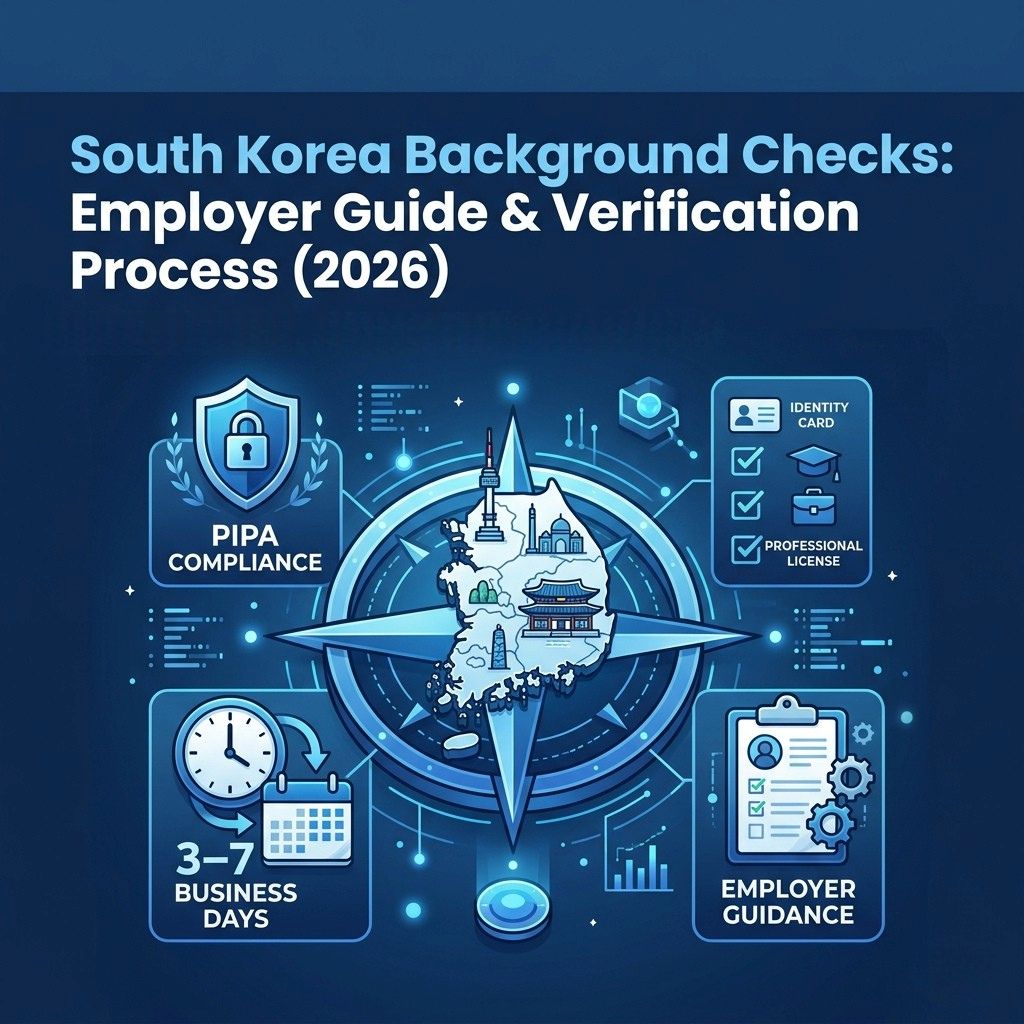
South Korea Background Checks: Employer Guide & Verification Process (2026)
Published: 14 August 2026 | Last Updated: 14 August 2026
Legal Framework, Privacy Requirements & Employer Considerations South Korea is one of Asia’s most privacy-conscious employment markets. While employment background screening is widely used by multinational corporations, financial institutions and regulated employers, screening activities must comply with strict privacy requirements under the Personal Information Protection Act (PIPA). Unlike some jurisdictions where employers have broad access to personal information, South Korea places significant emphasis on individual privacy rights, explicit consent and proportionality. Employers should therefore ensure that screening programmes are carefully designed, role-appropriate and legally justified. For organisations hiring in South Korea, a compliant background screening programme balances effective risk management with strong data governance.Executive Summary
South Korea permits employment background screening, but the process must be designed carefully around the Personal Information Protection Act (PIPA), explicit and specific candidate consent, purpose limitation, data minimisation and appropriate safeguards for personal information. Employment verification and education verification are generally feasible and commonly used. Professional licence verification may also be appropriate for regulated professions, while criminal record access is highly restricted and generally unavailable directly to employers except in limited circumstances permitted by law. Typical overall screening turnaround is 3–7 business days, although actual timing depends on employer responsiveness, educational institution processing and document completeness. Employers should use a proportionate and risk-based screening approach supported by clear consent and strong governance. For wider programme design, see eeCheck’s Compliant Background Screening Policy in Asia, Background Screening Policy Template for Asia-Pacific, Role-Based Background Screening in Asia and Asia Background Check Compliance Guide.South Korea Background Checks – At a Glance
| Category | South Korea Position |
|---|---|
| Legal Framework | Personal Information Protection Act (PIPA) |
| Consent Required | Yes – explicit and specific |
| Criminal Record Access | Highly restricted |
| Employment Verification | Generally feasible |
| Education Verification | Common |
| Credit Check | Restricted and role-dependent |
| Cross-Border Data Transfer | Permitted with consent and safeguards |
| Typical Screening Coverage | 3–5 years |
| Typical Turnaround | 3–7 business days for the overall screening package |
1. Legal Framework Governing Background Checks
Employment background screening in South Korea is primarily governed by the Personal Information Protection Act (PIPA), one of Asia’s most comprehensive privacy laws. PIPA establishes strict obligations for organisations collecting and processing personal information, including explicit candidate consent, purpose limitation, data minimisation, protection of sensitive personal information, accountability for data processing and appropriate safeguards for cross-border transfers. Unlike some jurisdictions where employers enjoy broader discretion, South Korean employers should ensure that every verification activity is proportionate to the position being filled. For broader regional guidance, see The Ultimate Guide to Background Checks in Asia and Asia Background Screening Executive Briefing.2. Consent Requirements
Obtaining valid consent is one of the most important compliance requirements when conducting background checks in South Korea.| Consent Element | What Should Be Explained |
|---|---|
| Information to Be Verified | What information will be verified. |
| Purpose | Why the information is being collected. |
| Use of Information | How the information will be used. |
| Retention | How long the information will be retained. |
| Cross-Border Transfer | Whether information will be transferred outside South Korea. |
3. What Employers Can Verify
The availability of different background screening checks varies under South Korean law.| Screening Check | Availability | Key Considerations |
|---|---|---|
| Identity Verification | ✔ Available | Personal identifiers should be handled carefully under PIPA. |
| Employment Verification | ✔ Available | Verification is generally feasible, although employer response rates may vary. |
| Education Verification | ✔ Common | Frequently conducted for both domestic and international qualifications. |
| Professional Licence Verification | ✔ Where applicable | Common for regulated professions. |
| Criminal Record Check | Limited | Access is highly restricted and generally unavailable directly to employers. |
| Credit History | Limited | Typically appropriate only for financial or fiduciary roles. |
| Civil Litigation & Bankruptcy | Limited | Availability depends on lawful access to public records. |
| Directorship & Corporate Interests | ✔ Available | Corporate registry searches may identify company affiliations and directorships. |
4. Typical Background Check Process
A typical employment screening programme in South Korea follows a straightforward process:| Step | Action |
|---|---|
| 1 | Obtain explicit candidate consent. |
| 2 | Collect supporting documentation where required. |
| 3 | Conduct lawful verification with authorised sources. |
| 4 | Review any discrepancies or adverse findings. |
| 5 | Issue the screening report and document hiring decisions. |
5. Typical Turnaround Time
| Verification | Typical Time |
|---|---|
| Identity Verification | 2–5 business days |
| Employment Verification | 3–7 business days |
| Education Verification | 3–7 business days |
| Professional Licence Verification | 3–7 business days |
| Civil Litigation Search | 2–5 business days |
| Overall Screening Package | 3–7 business days |
6. Employer Compliance Considerations
When conducting background screening in South Korea, employers should pay particular attention to:| Compliance Area | Employer Expectation |
|---|---|
| Candidate Consent | Obtain clear and specific candidate consent. |
| Proportionality | Limit screening to information necessary for the role. |
| Sensitive Personal Information | Protect sensitive personal information throughout processing. |
| Retention & Deletion | Apply appropriate retention and deletion policies. |
| Cross-Border Transfers | Manage cross-border data transfers in accordance with PIPA. |
| Documentation | Maintain adequate documentation for audit and compliance purposes. |
7. Common Compliance Risks
| Risk | Potential Impact |
|---|---|
| Collecting unnecessary personal information | Privacy law breach |
| Insufficient consent documentation | Regulatory non-compliance |
| Improper handling of sensitive personal data | Legal exposure |
| Poor documentation of screening decisions | Audit and compliance risk |
| Screening beyond business necessity | Violation of proportionality principles |
8. Employer Best Practices
Employers hiring in South Korea should consider the following best practices:| Best Practice | Why It Matters |
|---|---|
| Obtain clear, role-specific candidate consent | Supports transparency and lawful processing. |
| Limit screening to role-relevant checks | Supports proportionality and reduces unnecessary data collection. |
| Avoid unnecessary collection or retention | Reduces privacy exposure. |
| Control access to screening reports | Protects sensitive personal information. |
| Manage overseas transfers carefully | Supports compliance with applicable legal requirements. |
| Review screening policies regularly | Helps reflect changes in privacy regulations. |
Frequently Asked Questions
Is background screening legal in South Korea?
Yes. Background screening is legal when conducted in accordance with the Personal Information Protection Act (PIPA) and supported by appropriate candidate consent.Can employers obtain criminal record information?
Access to criminal record information is highly restricted and is generally not available directly to employers except in limited circumstances permitted by law.Are credit checks allowed?
Credit checks are generally limited to roles where financial integrity is relevant and should only be conducted where legally justified and supported by appropriate consent.Is South Korea considered a high-privacy jurisdiction?
Yes. South Korea is widely regarded as one of Asia’s most privacy-focused jurisdictions, with comprehensive regulation governing the collection and processing of personal information.Final Strategic Takeaway
South Korea presents a mature but highly regulated environment for employment background screening. Employers should adopt a risk-based approach that balances effective hiring decisions with strict compliance under the Personal Information Protection Act (PIPA). Successful screening programmes in South Korea are built on four key principles: obtain explicit and transparent candidate consent, conduct only role-relevant and proportionate checks, protect personal information throughout the screening process, and maintain strong governance and documentation practices. By integrating privacy, proportionality and sound governance into every stage of the screening process, employers can reduce hiring risk while remaining compliant with one of Asia’s most robust data protection regimes. For wider regional context, see eeCheck’s Asia Background Screening Report and MNC Background Screening in Asia.Related Country & Regional Guides
| Guide | Internal Link |
|---|---|
| Asia Background Check Guide | Read guide |
| Singapore Background Checks Guide | Read guide |
| Hong Kong Background Check Guide | Read guide |
| China Background Check Process | Read guide |
| Taiwan Background Checks Guide | Read guide |
| Japan Background Check Guide | Read guide |
| India Background Check Process | Read guide |
| Philippines Background Checks Guide | Read guide |
| Vietnam Background Checks Guide | Read guide |
| Thailand Background Checks Guide | Read guide |
| Malaysia Background Check Guide | Read guide |
| Indonesia Background Checks Guide | Read guide |
| Macau Background Check Guide | Read guide |

